Loan Payment Calculations: Complete Guide
Master loan payment calculations with formulas, methods, and practical examples.

Understanding Loan Payment Calculations
When you borrow money through a loan, understanding how your monthly payments are calculated is essential for effective financial planning and budgeting. Your loan payment is determined by three primary factors: the principal amount you borrow, the interest rate charged by the lender, and the loan term or repayment period. Rather than relying on complex mental calculations, modern tools like loan calculators can help you estimate your monthly payments accurately, making it easier to compare options and avoid costly mistakes.
The Three Core Components of Loan Calculations
Before diving into formulas and calculations, it’s important to understand the fundamental elements that determine your loan payment:
The Principal
The principal is the total amount of money you borrow from the lender. This is the base figure from which all interest calculations are derived. For example, if you take out a $20,000 auto loan, that $20,000 is your principal.
The Interest Rate
The interest rate, typically expressed as an annual percentage rate (APR), represents the cost of borrowing money. This rate determines how much extra you’ll pay beyond the principal amount. A lower interest rate means less money paid in interest over the life of the loan, making it a crucial factor when comparing loan offers.
The Loan Term
The loan term is the duration of your loan, typically measured in years. Common terms include 3, 5, 10, 15, 20, and 30 years, depending on the type of loan. The longer your loan term, the more total interest you’ll pay, although your monthly payment will be lower. Conversely, a shorter term means higher monthly payments but less total interest paid.
The Monthly Payment Formula
To calculate your monthly loan payment, lenders use the following standard amortization formula:
M = P × r × (1+r)ⁿ / [(1+r)ⁿ − 1]
Where:
- M = Monthly payment amount
- P = Principal (loan amount)
- r = Monthly interest rate (annual APR ÷ 12)
- n = Total number of monthly payments (years × 12)
Step-by-Step Calculation Process
Step 1: Convert Annual Interest Rate to Monthly Rate
Divide your annual interest rate (APR) by 12 to get your monthly interest rate. For a 6% APR loan, you would calculate: 0.06 ÷ 12 = 0.005, or 0.5% per month.
Step 2: Calculate Total Number of Payments
Multiply the number of years by 12 to get the total number of monthly payments. For a 5-year loan, you would have: 5 × 12 = 60 total payments.
Step 3: Apply the Formula
Once you have your monthly interest rate and total number of payments, plug these values into the amortization formula along with your principal amount. Using our $20,000 loan example at 6% APR for 5 years:
- P = $20,000
- r = 0.005
- n = 60
- M = $20,000 × 0.005 × (1.005)⁶⁰ / [(1.005)⁶⁰ − 1]
- M ≈ $386.66
Understanding Amortization Schedules
An amortization schedule is a detailed breakdown of each payment you make over the life of your loan, showing how much of each payment goes toward principal and how much goes toward interest. This schedule reveals an important pattern: in early payments, a larger portion goes toward interest, while as you progress, more of your payment applies to the principal balance.
First Month Interest Calculation
To find the interest portion of your first payment, multiply your monthly interest rate by your initial loan balance. Using our $20,000 loan at 6% APR: 0.005 × $20,000 = $100 in interest for the first month. The remaining portion of your $386.66 payment ($286.66) goes toward reducing your principal balance.
Subsequent Payments
Each month, as your principal balance decreases, the interest portion of your payment also decreases. This means the principal portion increases with each payment, accelerating the payoff of your loan over time. By the final payment, most of your monthly payment will be applied to principal, with minimal interest charges.
Interest Calculation Methods Used by Lenders
Add-On Method
With the add-on method, lenders calculate total interest by multiplying the principal amount by the interest rate and the loan term. The formula is: I = A × ic × N, where I is total interest, A is the loan amount, ic is the contractual interest rate per period, and N is the number of periods.
Once total interest is calculated, it’s added to the principal, and the combined amount is divided by the number of payments. For example, a $10,000 loan at 6% annual interest over 2 years would incur $1,200 in interest (I = $10,000 × 0.06 × 2). Each annual payment would be: ($10,000 + $1,200) ÷ 2 = $5,600.
Discount Method
The discount method calculates interest upfront and deducts it from the loan amount you receive. If you borrow $10,000 with a 6% discount rate over 2 years, you’d owe $1,200 in interest but would only receive $8,800 (the principal minus the interest). You’d still repay the full $10,000 over the loan term, making this method more expensive for borrowers than it initially appears.
Remaining Balance Method
The remaining balance method, also known as the declining balance or amortization method, calculates interest based on your outstanding principal balance each period. This is the most common method used for consumer loans and mortgages, as it provides a fair calculation of interest based on what you actually owe.
Daily Interest Calculation Methods
The 30/360 Method
The 30/360 method assumes 360 days in a year and 30 days in each month. To calculate, divide the annual interest rate by 360 to get the daily rate, then multiply by 30 for the monthly rate. For a 4% annual rate: (0.04 ÷ 360) × 30 = 0.333% monthly rate. This method standardizes calculations and returns a true representation of the stated interest rate.
The Actual/365 Method
This method uses the actual number of days in each month and assumes 365 days in a year. It’s more precise than the 30/360 method since it accounts for varying month lengths and leap years.
The Actual/360 Method
The Actual/360 method divides the annual rate by 360 (creating a larger daily rate than dividing by 365) but then multiplies by the actual number of days in the month or year. This method typically results in higher interest charges for borrowers since the daily rate is larger.
Comparing Loan Offers: Monthly vs. Total Cost
When evaluating loan options, look at both the monthly payment and the total cost of the loan. Two loans might have similar monthly payments but vastly different total costs depending on their terms and interest rates. Calculate the total amount you’ll repay by multiplying your monthly payment by the total number of payments, then subtract the principal to find total interest paid.
For instance, a $100,000 mortgage at 4% for 30 years results in a $477 monthly payment and approximately $71,730 in total interest. A shorter 5-year balloon loan with the same terms would have the same $477 monthly payment, but you’d owe $90,448 at the end of five years, making the comparison more complex but potentially more affordable if you plan to refinance or sell.
Factors Affecting Your Monthly Payment
Loan Amount
Larger loan amounts directly increase your monthly payment. All other factors being equal, borrowing more money means paying more each month.
Interest Rate
Your interest rate significantly impacts your payment. Even a 1% difference can mean hundreds of dollars in monthly payments on large loans like mortgages. Higher credit scores typically qualify for lower rates.
Loan Term
Longer terms reduce monthly payments but increase total interest paid. Shorter terms increase monthly payments but save on interest over the life of the loan.
Payment Frequency
Whether you make monthly, quarterly, or annual payments affects the calculation. Most consumer loans use monthly payments, but some business loans or agricultural loans may use different frequencies.
Prepayment and Extra Payments
Making extra payments or paying off your loan early reduces the total interest you’ll pay and shortens your loan term significantly. Even small additional payments each month can result in substantial savings over time.
Using Loan Calculators Effectively
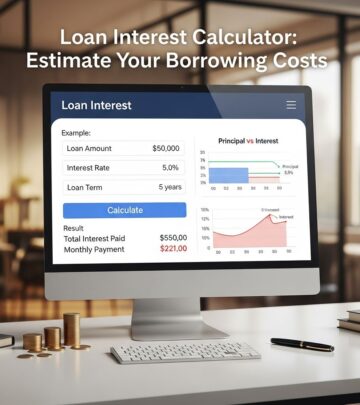
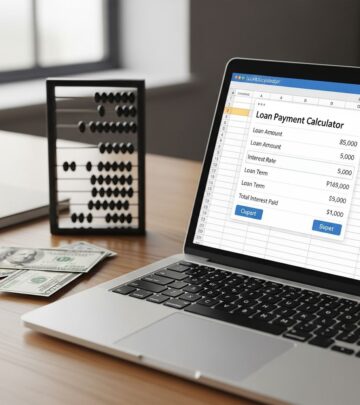
Modern loan calculators streamline the payment calculation process. To use one effectively, gather the following information: your desired loan amount, the interest rate you’ve been offered or expect to receive, and the loan term in years. Enter these figures into the calculator, which instantly provides your estimated monthly payment. Most calculators also show total interest paid and allow you to adjust variables to see how changes affect your payment.
Comparing multiple scenarios helps you understand trade-offs. For example, you might see that extending a loan term from 5 years to 7 years reduces your monthly payment by $50 but costs you an additional $3,000 in total interest. This information empowers you to make informed decisions aligned with your financial situation.
Practical Examples
Auto Loan Example
Consider a $20,000 auto loan at 6% APR for 5 years. Using the formula: Monthly payment ≈ $386.66. Over 60 months, you’ll pay approximately $23,200 total, with $3,200 in interest charges.
Personal Loan Example
A $10,000 personal loan at 8% APR for 3 years (36 payments) results in a monthly payment of approximately $313. Total repayment would be around $11,268, with $1,268 in interest.
Mortgage Example
A $300,000 mortgage at 3.5% APR for 30 years (360 payments) produces a monthly payment of approximately $1,347. Total repayment would be around $484,932, with $184,932 in interest charges.
Frequently Asked Questions
Q: Can I calculate loan payments without a calculator?
A: While the amortization formula is complex, you can perform the calculations manually with a scientific calculator. However, using online loan calculators is faster, more accurate, and helps you avoid mathematical errors. Most lenders and financial websites offer free calculators.
Q: How does making a larger down payment affect my loan payment?
A: A larger down payment reduces your principal amount, which directly lowers your monthly payment. For example, putting 20% down instead of 10% on a home purchase means financing less money and paying less monthly interest.
Q: What’s the difference between APR and interest rate?
A: APR (Annual Percentage Rate) includes both the interest rate and other costs or fees associated with the loan, providing a more complete picture of borrowing costs. When calculating payments, you typically use the APR to ensure all costs are reflected.
Q: Can I negotiate my interest rate?
A: Yes, interest rates are often negotiable, especially for mortgages, auto loans, and personal loans. Shopping around with multiple lenders and improving your credit score can help you secure better rates, significantly reducing your monthly payment and total interest paid.
Q: What happens if I pay extra toward my loan?
A: Extra payments are typically applied directly to your principal balance, reducing the remaining interest charges and shortening your loan term. This strategy can save you thousands in interest over the life of the loan.
Q: How accurate are online loan calculators?
A: Online loan calculators are generally very accurate when you input correct information. However, actual payments may vary slightly due to factors like fees, taxes, insurance, or variable interest rates not accounted for in basic calculators.
References
- How To Calculate Loan Payments And Costs — Bankrate. 2024. https://www.bankrate.com/loans/personal-loans/how-to-calculate-loan-payments/
- How a Bank Determines Loan Payment Calculations — Universal Class. https://www.universalclass.com/articles/business/finance/loan-payment-calculations.htm
- How to Calculate Your Personal Loan Monthly Payment — TD Bank. https://www.td.com/us/en/personal-banking/personal-loan/how-to-calculate-personal-loan-payment
- How do mortgage lenders calculate monthly payments? — Consumer Finance Protection Bureau. 2024. https://www.consumerfinance.gov/ask-cfpb/how-do-mortgage-lenders-calculate-monthly-payments-en-1965/
- 30/360, Actual/365, and Actual/360 – How Lenders Calculate Interest — Adventures in CRE. https://www.adventuresincre.com/lenders-calcs/
- Long-Term Loan Repayment Methods — Colorado State University Extension. https://www.extension.colostate.edu/docs/pubs/farmmgt/03757.pdf
- Interest Calculation Methods in Loans — Mambu Support Documentation. https://support.mambu.com/docs/interest-calculation-methods-in-loans
Similar Articles








Read full bio of Sneha Tete