Loan Origination: Process, Importance, and Best Practices
Master loan origination: Complete guide to lending process, underwriting, and compliance requirements.
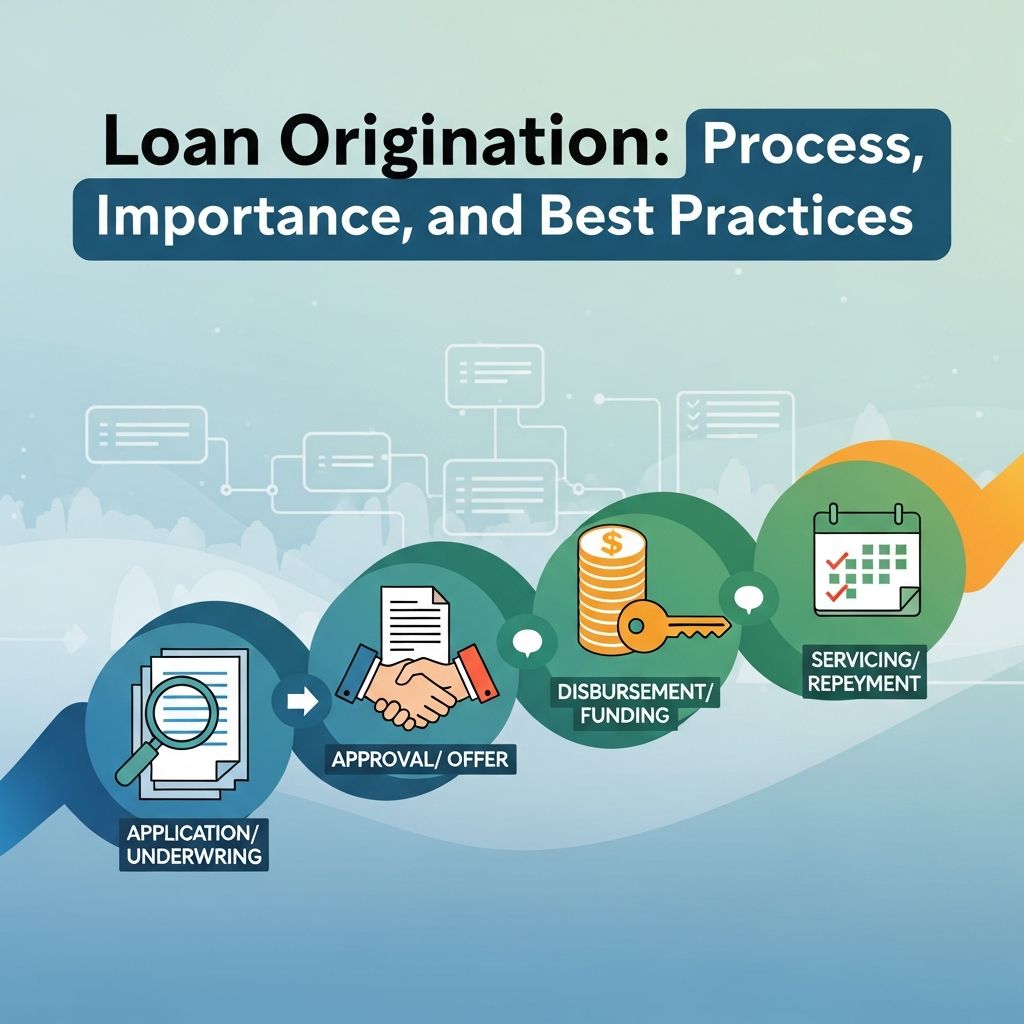
What is Loan Origination?
Loan origination is the complete process through which a lender evaluates, approves, and funds a loan to a borrower. This comprehensive process begins when a borrower submits an application and continues through various stages of assessment, documentation, and verification until the lender disburses funds. In the modern financial landscape, loan origination has become increasingly sophisticated, incorporating advanced technology, rigorous compliance frameworks, and multi-stage underwriting procedures to ensure both lender protection and borrower suitability.
The origination process serves multiple critical functions within the lending ecosystem. It allows lenders to assess credit risk, verify borrower capacity to repay, confirm the legitimacy of loan purposes, and establish appropriate loan terms and interest rates. Additionally, loan origination ensures compliance with federal, state, and local lending regulations, including fair lending laws, truth-in-lending requirements, and consumer protection statutes.
Key Stages of the Loan Origination Process
The loan origination process typically unfolds through several distinct phases, each with specific objectives and required documentation:
Pre-Qualification and Application
The origination process begins with pre-qualification, during which prospective borrowers provide preliminary financial information to determine their general eligibility and potential loan amount range. This stage helps borrowers understand their borrowing capacity and allows lenders to filter applicants. Once a borrower decides to proceed, they complete a formal application providing detailed personal, financial, and employment information. Modern lenders increasingly utilize digital platforms that streamline application submission and initial data collection, significantly reducing time-to-completion and improving the borrower experience.
Document Submission and Verification
Following application submission, borrowers must provide supporting documentation to verify the information they submitted. Required documents typically include:
- Recent pay stubs and W-2 forms or tax returns for self-employed individuals
- Bank statements and investment account statements
- Employment verification letters from current employers
- Credit reports and credit authorization forms
- Property appraisals for secured loans
- Proof of identity and residency
- Existing debt obligations documentation
Verification serves as a critical control mechanism, ensuring that borrowers have accurately represented their financial situations and that the information provided supports loan approval.
Credit Analysis and Underwriting
Underwriting represents the core evaluation phase where trained underwriters assess credit risk by analyzing the borrower’s creditworthiness, debt-to-income ratio, employment stability, and overall financial profile. Underwriters examine credit scores and credit reports to identify historical payment patterns, existing debt levels, and any negative credit events such as late payments, charge-offs, or collections. They verify employment to confirm job stability and income consistency. Advanced underwriting may involve automated underwriting systems that apply algorithmic risk assessment models to standardize evaluation and accelerate decision-making.
Property Appraisal and Collateral Assessment
For secured loans, particularly mortgages and home equity lines of credit, lenders order independent appraisals to verify property value. Appraisers assess market conditions, comparable property sales, and physical property condition to determine fair market value. This appraisal protects lenders by ensuring the collateral value adequately covers the loan amount, typically maintaining loan-to-value ratios within acceptable parameters.
Approval and Conditional Approval
Following underwriting review, lenders issue approval decisions. Outright approval means the lender will fund the loan subject to standard conditions such as receipt of final verification documents or proof of insurance. Conditional approval requires the borrower to satisfy additional requirements before funding, such as explaining credit anomalies, providing additional documentation, or paying down other debts. Loan denial occurs when underwriting determines unacceptable credit risk or loan structure incompatibility with lending policies.
Loan Documentation and Closing
Approved borrowers proceed to the documentation and closing stage. During this phase, borrowers execute loan agreements, promissory notes, and security instruments. For mortgages, a closing agent coordinates the signing process, ensures all documents are properly executed, verifies the borrower’s identity, and collects required fees. Digital closing technologies have increasingly streamlined this process, allowing borrowers to sign documents electronically from remote locations.
Funding and Disbursement
Once all documents are executed and conditions satisfied, the lender disburses funds. For mortgages, funds typically transfer directly to the seller or escrow account. For other loan types, funds may disburse directly to the borrower or to service providers on the borrower’s behalf.
Underwriting Standards and Credit Assessment
Underwriting standards form the foundation of sound lending practices and regulatory compliance. Lenders establish documented underwriting guidelines that specify acceptable credit scores, maximum debt-to-income ratios, minimum employment tenure requirements, and other credit criteria. These standards must comply with fair lending laws, which prohibit discrimination based on protected characteristics such as race, color, religion, national origin, sex, familial status, or disability.
Credit assessment relies on multiple factors beyond credit scores, including employment verification, income analysis, debt obligations review, and asset verification. Lenders evaluate both compensating factors that may offset credit weaknesses and risk factors that require stronger compensating credentials. Modern underwriting increasingly incorporates alternative credit data sources for borrowers with limited traditional credit histories, including payment histories for utilities, rent, and telecommunications services.
Regulatory Compliance in Loan Origination
Loan origination operates within a complex regulatory framework designed to protect consumers and ensure fair lending practices. Key regulatory requirements include:
- Truth in Lending Act (TILA): Requires clear disclosure of loan terms, annual percentage rate (APR), finance charges, and other material loan terms
- Fair Credit Reporting Act (FCRA): Governs credit report usage, requires adverse action notices when credit reports negatively affect lending decisions
- Equal Credit Opportunity Act (ECOA): Prohibits discrimination in credit transactions based on protected characteristics
- Fair Housing Act: Prevents discrimination in residential lending based on protected characteristics
- Dodd-Frank Act: Establishes consumer protection standards and qualified mortgage criteria
- Know Your Customer (KYC) Requirements: Mandate verification of borrower identity and beneficial ownership for compliance purposes
Compliance failures expose lenders to significant penalties, litigation expenses, and reputational damage. Accordingly, most lenders employ dedicated compliance personnel and implement robust quality control procedures throughout the origination process.
Technology in Modern Loan Origination
Technology has fundamentally transformed loan origination, improving speed, accuracy, and borrower experience. Loan Origination Systems (LOS) platforms automate workflow management, document organization, and compliance verification. Application programming interfaces (APIs) enable real-time data verification from employment and banking institutions. Artificial intelligence and machine learning algorithms enhance credit risk assessment by analyzing patterns across millions of historical loans. Digital disclosure and electronic signature capabilities eliminate paper-based closing processes and enable remote origination.
Robotic process automation (RPA) handles repetitive tasks such as document collection, data entry, and condition verification, reducing processing time and minimizing errors. Cloud-based platforms enable seamless collaboration between lenders, borrowers, third-party vendors, and secondary market investors.
Loan Origination in Different Lending Contexts
Mortgage Origination
Mortgage origination follows specialized procedures tailored to residential real estate lending. Mortgage lenders must comply with mortgage-specific regulations and often sell loans to secondary market investors such as Fannie Mae, Freddie Mac, or investment banks. Mortgage origination includes specific requirements regarding qualified mortgages, appraisal standards, and escrow account establishment for property taxes and homeowners insurance.
Commercial Loan Origination
Commercial loan origination typically involves more complex underwriting given larger loan amounts and business-related purposes. Commercial underwriters analyze business financial statements, cash flow projections, industry trends, and management experience. Collateral appraisals may involve specialized expertise in commercial real estate valuation, equipment assessment, or inventory analysis.
Consumer Loan Origination
Consumer loan origination encompasses auto loans, personal loans, and credit cards. These products often feature faster origination timelines and more automated underwriting processes compared to secured lending. Many consumer lenders utilize alternative credit scoring models and rapid approval decisions, sometimes providing loan decisions within minutes of application.
The Role of Loan Originators and Loan Officers
Loan originators are professionals who guide borrowers through the origination process. They explain available loan products, gather financial information, and coordinate documentation submission. In mortgage lending, loan officers typically must be licensed through the Nationwide Multistate Licensing System and Registry (NMLS) and maintain continuing education to comply with regulatory requirements. Loan officers serve as critical touchpoints between lenders and borrowers, helping ensure clear communication and accurate information gathering.
Secondary Market and Loan Origination
Loan origination is heavily influenced by secondary market standards. Many loan originators sell completed loans to investors in the secondary market rather than holding them in portfolio. Secondary market investors such as government-sponsored enterprises (GSEs), investment banks, and institutional investors establish origination standards that originators must follow. These standards directly impact underwriting requirements, documentation procedures, and pricing structures.
Common Challenges in Loan Origination
Modern loan origination faces several significant challenges. Regulatory complexity requires ongoing compliance updates and staff training. Cybersecurity threats pose risks to sensitive borrower information. Competition from fintech lenders pressures traditional lenders to improve speed and reduce costs. Documentation burden continues increasing as regulations expand. Talent shortages in the lending industry create resource constraints, particularly for experienced underwriters and compliance specialists. Economic volatility affects credit quality and default rates, requiring more conservative underwriting standards during downturns.
Frequently Asked Questions About Loan Origination
Q: How long does the loan origination process typically take?
A: Timelines vary significantly by loan type. Mortgage origination typically takes 30-45 days from application to closing. Auto loans and personal loans may close within days or weeks. Commercial loans often require 6-12 weeks or longer given their complexity. Digital lenders may offer approval decisions within hours or minutes for standardized products.
Q: What credit score is needed for loan approval?
A: Credit score requirements vary by lender and loan type. Mortgage lenders typically require credit scores of 620 or higher, though scores of 740+ receive better terms. Auto lenders may accept scores below 600, though with higher interest rates. Personal loan lenders vary widely. Commercial lenders focus on business credit rather than personal credit scores.
Q: Can I improve my chances of loan approval?
A: Yes. Improving credit scores, reducing existing debt, increasing savings for a larger down payment, maintaining stable employment, and providing detailed explanations of any credit problems enhance approval prospects. Consider addressing credit report errors before applying.
Q: What documents do I need for loan origination?
A: Generally, you’ll need identification, proof of income (pay stubs, W-2s, or tax returns), bank statements, employment verification, and credit authorization forms. Specific requirements depend on your loan type and the lender’s requirements.
Q: What is a pre-approval versus pre-qualification?
A: Pre-qualification is informal and based on self-reported information, providing a rough estimate of borrowing capacity. Pre-approval involves full underwriting and document verification, providing a formal approval amount. Pre-approval carries much greater weight in real estate transactions.
Q: Can I be denied after being pre-approved?
A: Yes, though rare. Circumstances such as significant credit deterioration, employment loss, major new debt, or property appraisal shortfalls can result in denial even after pre-approval. Conditional approval allows lenders to impose additional requirements before final funding.
Q: How do lenders verify employment and income?
A: Lenders contact employers directly using verified contact information, review pay stubs and W-2 forms, analyze tax returns for self-employed borrowers, and utilize third-party verification services. Documentation must show consistent income history and reasonable likelihood of income continuation.
Q: What is debt-to-income ratio and why does it matter?
A: Debt-to-income (DTI) ratio divides monthly debt payments by gross monthly income, expressed as a percentage. Most lenders accept maximum DTI ratios of 43-50%, though some may go higher with compensating factors. Lower DTI indicates stronger repayment capacity.
References
- Understanding Collateralized Loan Obligations (CLOs) — Guggenheim Investments. 2024-12-31. https://www.guggenheiminvestments.com/perspectives/portfolio-strategy/understanding-collateralized-loan-obligations-clo
- Consumer Compliance Handbook: Truth in Lending — Federal Reserve Board. 2024. https://www.federalreserve.gov/boarddocs/press/general/2007/20070914a.htm
- Fair Lending: Overview and Enforcement — Federal Trade Commission. 2023. https://www.ftc.gov/business-guidance/resources/fair-lending
- Mortgage Origination Standards and Guidelines — Consumer Financial Protection Bureau. 2024. https://www.consumerfinance.gov/
- Underwriting Guidelines for Residential Lending — Office of the Comptroller of the Currency. 2023. https://www.occ.treas.gov/
- Loan Origination Systems and Technology Implementation — Society for Information Management. 2024. https://www.simnet.org/
Similar Articles








Read full bio of medha deb