Loan Modifications and Credit Score Effects
Discover how altering your mortgage terms through modification impacts your credit profile, from short-term drops to long-term recovery strategies.
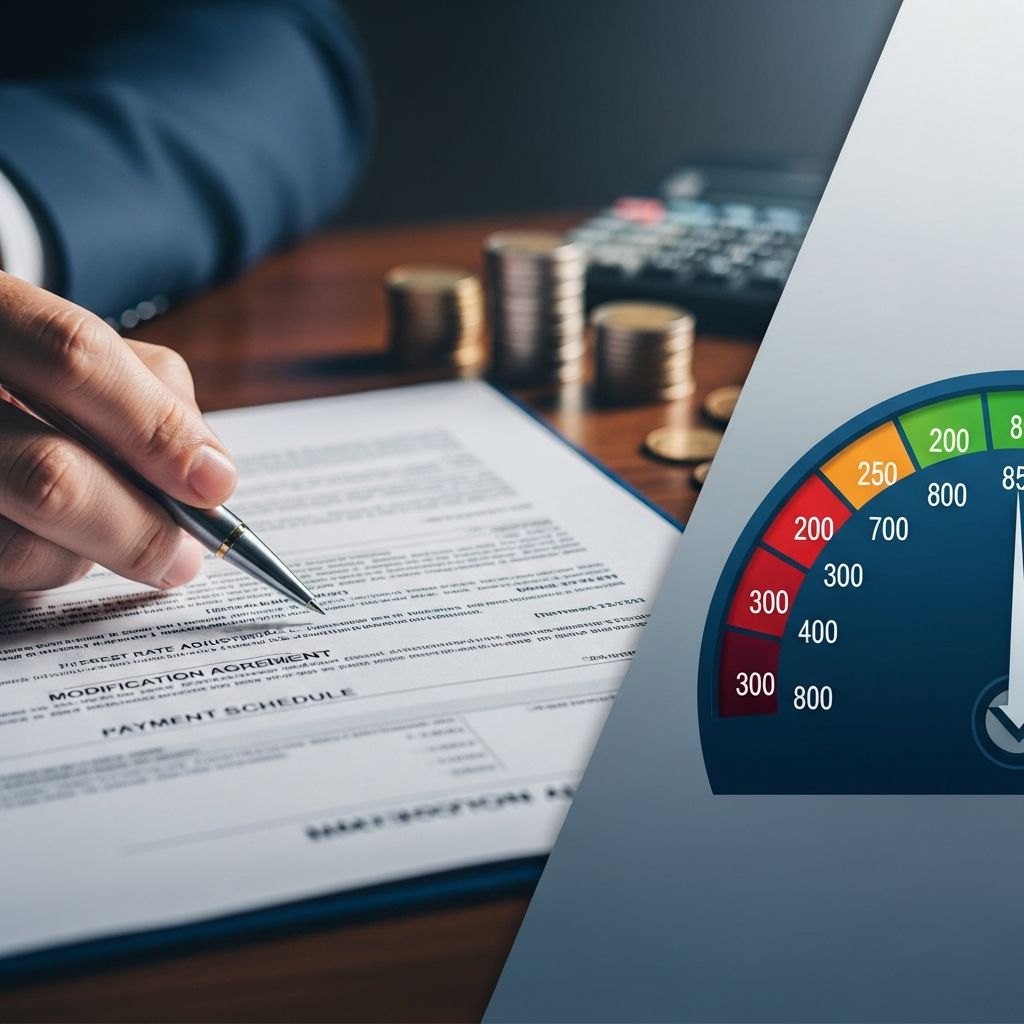
Mortgage loan modifications adjust existing home loan terms to make payments more manageable during financial hardship. These changes, such as lowered interest rates or extended repayment periods, can temporarily harm credit scores but frequently offer protection against more severe consequences like foreclosure.
Understanding Mortgage Loan Modifications
A loan modification involves negotiating with your lender to revise key loan elements. Common adjustments include reducing the interest rate, extending the loan duration to lower monthly amounts, or forgiving a portion of the principal balance. Lenders agree to these because they reduce the risk of default and the high costs associated with repossessing properties.
Eligibility often hinges on demonstrating financial distress, which might require proof of income reduction or impending inability to pay. Government-backed initiatives, like those from the Federal Housing Finance Agency, have historically facilitated these programs to stabilize housing markets during economic downturns.
Short-Term Credit Score Disruptions
Participating in a loan modification can lead to an immediate decline in credit scores, typically ranging from 30 to 100 points. This drop stems from several factors tied to the application and approval process.
- Hard credit inquiries: Lenders perform thorough checks on your credit history, which appear as inquiries and slightly lower scores for up to a year.
- Delinquency reporting: Many programs demand at least one missed payment to qualify, and each 30-day late payment can subtract 80 to 110 points from FICO scores.
- Account restructuring: Changing original terms may be noted on credit reports, signaling risk to future lenders.
According to analyses from credit scoring models, recent delinquencies carry heavier weight, amplifying the impact on borrowers with otherwise strong histories.
How Lenders Report Modifications to Credit Bureaus
The way a servicer documents the modification profoundly influences its credit repercussions. Reports to bureaus like Experian, Equifax, and TransUnion use specific codes that algorithms interpret differently.
| Reporting Code | Description | Typical Score Impact | Duration on Report |
|---|---|---|---|
| AC | Account modified due to financial difficulty | Moderate negative (30-100 points) | Up to 7 years |
| CN | Federal program modification | Neutral or minimal | Varies |
| Settled | Paid for less than full balance | Severe negative | 7 years |
| Restructured | Terms adjusted without settlement | Mild negative | 7 years |
Avoiding ‘settled’ notations is crucial, as they mimic debt forgiveness and deter new credit approvals. Federal guidelines encourage neutral coding for approved programs to mitigate undue harm.
Comparing Modifications to Foreclosure and Other Options
While modifications pose risks, they pale against alternatives like foreclosure, which slashes scores by 100 to 160 points and lingers for seven years.
- Foreclosure often results in home loss, legal fees, and restricted borrowing for years.
- Short sales or deeds-in-lieu cause similar but slightly lesser damage.
- Refinancing, by contrast, has negligible impact if payments remain current.
Data from Federal Reserve studies indicate that modified loans help borrowers retain homes 70-80% of the time, fostering stability over outright default.
Federal Programs and Their Credit Implications
U.S. government efforts, such as the Home Affordable Modification Program (HAMP), streamline modifications with standardized criteria. These initiatives partner with lenders to offer relief before full delinquency.
Key benefits include trial payment periods without immediate credit penalties and specialized reporting codes like ‘CN’ that FICO scores ignore. Housing counselors from HUD-approved agencies provide free guidance to navigate applications and minimize score hits.
Strategies to Minimize Credit Damage During Modification
Proactive steps can soften the blow to your credit profile.
- Contact your servicer early, before missing payments, to explore pre-delinquency options.
- Gather documentation swiftly—pay stubs, tax returns, hardship letters—to expedite approval.
- Continue payments during processing if possible; partial payments may be applied without full delinquency status.
- Monitor reports from all three bureaus for accuracy and dispute errors promptly.
Investment advisors emphasize maintaining other accounts current to offset mortgage-related dips.
Rebuilding Credit After a Modification
Post-modification recovery hinges on consistent behavior. On-time payments under new terms rebuild positive history, often restoring scores within 12-24 months.
- Target 35% utilization on revolving credit to boost factors like payment history (35% of FICO).
- Secure secured cards or credit-builder loans for controlled growth.
- Review reports annually via AnnualCreditReport.com for lingering inaccuracies.
Successful management signals resilience to lenders, potentially unlocking better rates on future credit.
Long-Term Financial Advantages of Modifications
Beyond averting foreclosure, modifications stabilize budgets, freeing resources for savings or debt reduction. Over time, affordable payments enhance overall financial health, indirectly supporting creditworthiness.
Studies show participants often see score rebounds surpassing pre-modification levels after two years of compliance, demonstrating to markets their capacity for responsibility amid adversity.
Frequently Asked Questions
Will a loan modification always lower my credit score?
Not necessarily; impact varies by reporting and prior history. Federal codes can neutralize effects.
How long does modification stay on my credit report?
Up to seven years, but positive payment history dilutes its influence over time.
Can I get a modification without missing payments?
Some programs allow it if default is foreseeable; consult HUD counselors.
Is modification better than refinancing?
For distressed borrowers, yes—refis require good credit, while mods target hardships.
How do I qualify for government modification aid?
Typically, income below 80-120% area median, with trial payments proving affordability.
References
- How Loan Modifications Affect Credit Scores — Federal Reserve Bank of Boston (Prabal Chakrabarti). 2010. https://www.bostonfed.org/-/media/Documents/cb/PDF/Chakrabarti_loan_modification.pdf
- How Does a Loan Modification Affect Your Credit Scores? — Experian. 2023. https://www.experian.com/blogs/ask-experian/how-a-mortgage-modification-program-can-affect-credit-scores/
- How Loan Modifications are Affecting Credit Reports and Scores — FamilyGA. 2010. https://familyga.com/how-loan-modifications-are-affecting-credit-reports-and-scores/
- Loan Modifications Credit Scores Impact — Foreclosure Defense Group. 2024. https://foreclosuredefensegroup.com/loan-modifications-credit-scores-impact/
- How Does a Mortgage Loan Modification Affect Your Credit Score? — Quicken Loans. 2023. https://www.quicken.com/blog/real-estate-personal-finance-how-does-mortgage-loan-modification-affect-your-credit-score/
Similar Articles








Read full bio of medha deb