Loan Interest Calculator: Estimate Your Borrowing Costs
Calculate loan interest accurately and understand your total borrowing costs effectively.
When you borrow money from a lender, you pay interest—the cost of borrowing expressed as a percentage of your loan balance. Understanding how interest works and how to calculate it is crucial for making informed financial decisions. Whether you’re considering a personal loan, auto loan, or any other type of debt, knowing what you’ll pay in total interest can help you choose the right loan and payment strategy for your budget.
How to Use a Loan Interest Calculator
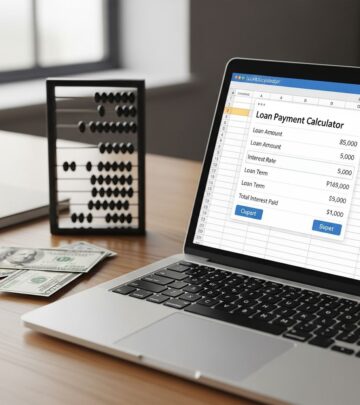
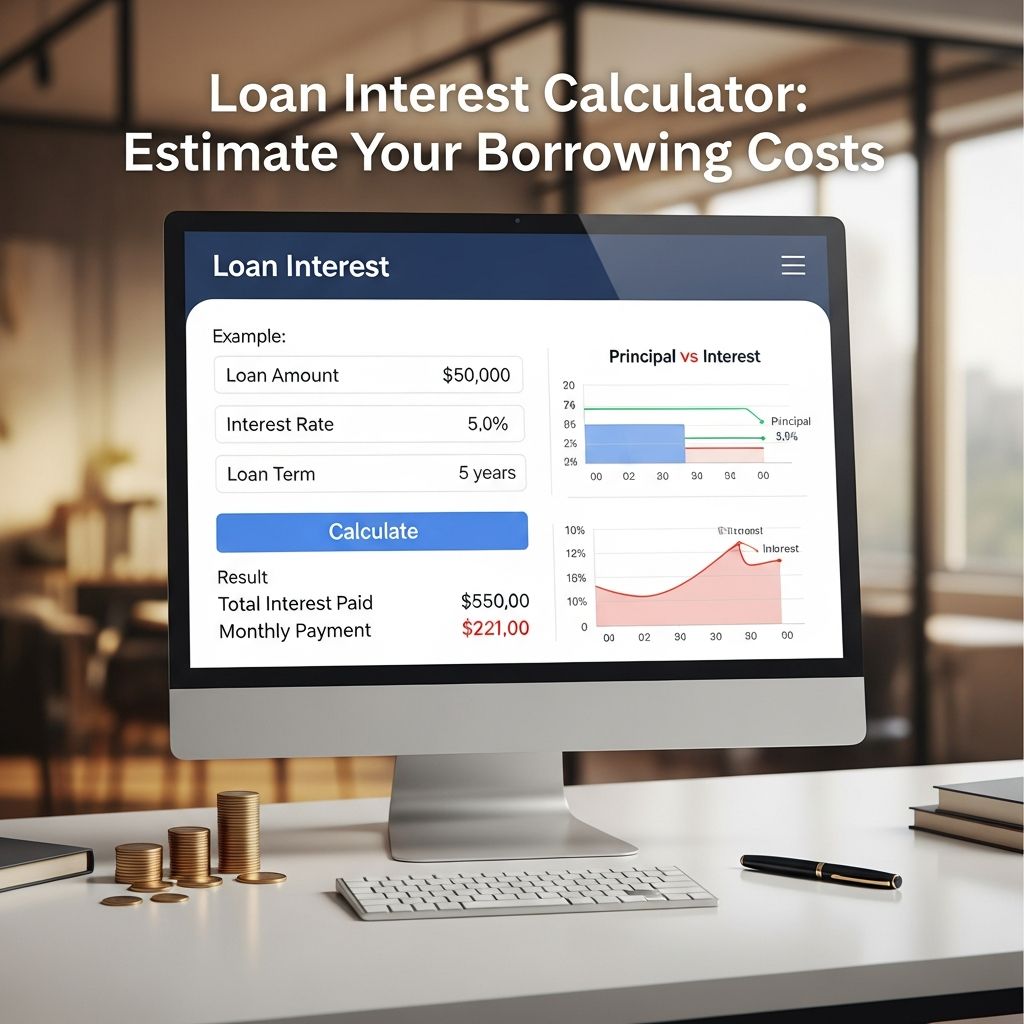
A loan interest calculator is a powerful tool that removes the guesswork from borrowing. To use the calculator effectively, you’ll need to input specific information about your loan. Here’s what you’ll typically need:
Step-by-Step Guide to Using the Calculator
Enter the Beginning Balance: Start by inputting the principal amount—the total amount of money you’re borrowing from the lender. This is your starting loan balance before any payments are made.
Input Your Interest Rate: Next, enter the interest rate offered by your lender. This rate is typically expressed as an annual percentage rate (APR) and significantly impacts how much you’ll pay in total interest over the life of the loan.
Add Minimum and Maximum Payment Amounts: The calculator asks you to enter both the minimum and maximum monthly payments you can afford. This dual approach allows you to compare different payment strategies and see how varying payment amounts affect your total interest costs.
Click Calculate: Once you’ve entered all required information, click the calculate button. The results will display the total interest you’ll pay under both payment scenarios, plus the monthly average for each option.
Interpreting Your Results
The calculator shows you the total interest for your minimum payment plan and your maximum payment plan. By comparing these two scenarios, you can see the real financial impact of paying more each month. Generally, the more you pay monthly, the less total interest you’ll ultimately pay. This visual comparison helps you identify the right payment strategy for your financial situation.
Test various payment amounts to find the sweet spot between affordability and interest savings. Many borrowers discover they can pay slightly more than the minimum payment without straining their budget, resulting in significant long-term savings.
Understanding Loan Interest Fundamentals
Interest is fundamentally the price you pay for the privilege of borrowing money. Lenders charge interest as compensation for lending you funds and assuming the risk that you might not repay. Your monthly payments cover two components: principal (the original amount borrowed) and interest (the cost of borrowing).
As you make monthly payments, you gradually reduce your principal balance. However, you’re also paying interest during this entire period, which adds significantly to your total loan cost. The structure of how this interest is calculated depends on your loan type and agreement with your lender.
Why Interest Calculation Methods Matter
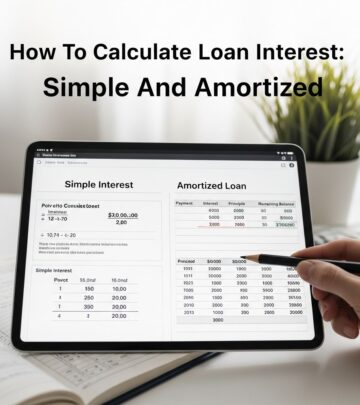
Different loans use different interest calculation methods, and these differences substantially affect how much you’ll ultimately pay. The two primary methods are simple interest and amortized interest. Understanding which method applies to your loan helps you anticipate your total costs and make better borrowing decisions.
Simple Interest Calculation Method
Simple interest is the more straightforward of the two calculation methods and is commonly used for short-term, fixed-rate loans. This method doesn’t account for compounding or the complexity of monthly payment structures, making it easier to understand and calculate.
The Simple Interest Formula
The formula for calculating simple interest is:
Interest = Principal × Interest Rate × Time (in years)
For example, if you borrow $10,000 at a 6 percent annual interest rate for 3 years, your calculation would be:
$10,000 × 0.06 × 3 = $1,800 total interest
This means you would pay $1,800 in interest charges over the three-year loan period, making your total repayment amount $11,800.
When Simple Interest Applies
Simple interest is typically used for personal loans with fixed terms and short to medium-length durations. This method is straightforward because it assumes a consistent interest charge based on the original principal amount, regardless of how much you’ve paid down.
Simple Interest Example Comparison
The difference between interest rates dramatically affects your total costs. Consider a $10,000 loan over 5 years with different interest rates:
| Interest Rate | 8% | 15% | 30% |
|---|---|---|---|
| Monthly Payment | $313 | $347 | $425 |
| Total Interest Paid | $1,281 | $2,480 | $5,283 |
As this table demonstrates, even a few percentage points can cost you hundreds or even thousands of dollars over the life of your loan. Shopping around for better rates is absolutely worth your time.
Amortized Interest Calculation Method
Amortized interest is used for larger loans like mortgages, most auto loans, and many personal loans. This method is more complex because it recalculates interest each month based on your remaining balance rather than the original principal amount.
How to Calculate Amortized Interest
Here’s the step-by-step process for calculating amortized interest manually:
Step 1: Calculate Monthly Interest Rate Divide your annual interest rate by 12 (the number of months in a year). For example, if you have a 6 percent interest rate, divide 0.06 by 12 to get 0.005.
Step 2: Multiply by Remaining Balance Multiply this monthly rate by your current loan balance to find your interest for that month. If your remaining balance is $5,000, your first month’s interest would be $5,000 × 0.005 = $25.
Step 3: Calculate Principal Payment Subtract the interest from your fixed monthly payment to see how much goes toward principal. If your monthly payment is $430.33 and interest is $25, then $405.33 goes toward principal.
Step 4: Subtract from Balance Reduce your loan balance by the principal payment amount. Your new balance would be $5,000 – $405.33 = $4,594.67.
Step 5: Repeat for Each Month Repeat this process for each subsequent month using your new remaining balance. To find total interest paid, add all monthly interest payments together.
Amortized Interest Payment Schedule Example
Here’s a sample amortization schedule showing how your payments break down between principal and interest:
| Payment Date | Payment | Principal | Interest | Total Interest | Balance |
|---|---|---|---|---|---|
| Sep 2025 | $445.60 | $393.19 | $52.42 | $52.42 | $4,606.81 |
| Oct 2025 | $445.60 | $397.31 | $48.29 | $100.71 | $4,209.51 |
| Nov 2025 | $445.60 | $401.47 | $44.13 | $144.84 | $3,808.04 |
| Dec 2025 | $445.60 | $405.68 | $39.92 | $184.76 | $3,402.36 |
| Jan 2026 | $445.60 | $409.93 | $35.67 | $220.43 | $2,992.42 |
| Feb 2026 | $445.60 | $414.23 | $31.37 | $251.80 | $2,578.19 |
| Mar 2026 | $445.60 | $418.57 | $27.03 | $278.83 | $2,159.62 |
| Apr 2026 | $445.60 | $422.96 | $22.64 | $301.47 | $1,736.65 |
| May 2026 | $445.60 | $427.40 | $18.21 | $319.67 | $1,309.26 |
| Jun 2026 | $445.60 | $431.88 | $13.73 | $333.40 | $877.38 |
| Jul 2026 | $445.60 | $436.40 | $9.20 | $342.60 | $440.98 |
| Aug 2026 | $445.60 | $440.98 | $4.62 | $347.22 | $0.00 |
Notice how the interest portion decreases each month while the principal portion increases. This is the key characteristic of amortized loans—early payments are interest-heavy, while later payments primarily reduce your principal balance.
Key Factors That Affect Your Loan Interest
Your Interest Rate
Your interest rate is the single biggest driver of loan cost. Even a 1 to 2 percent difference can add hundreds of dollars to your total repayment amount over the life of the loan. Always shop around with multiple lenders to find the most competitive rates available to you.
Your Credit Score
Lenders use your credit score to assess borrowing risk. Those with higher credit scores unlock significantly lower interest rates, while those with lower scores may face substantially higher borrowing costs. Improving your credit score before applying for a loan can save you considerable money.
Payment Timing
Making a payment even five days late means your principal balance remained higher for those extra days, resulting in more interest being charged. Staying current with payments helps minimize interest accumulation.
Frequently Asked Questions
Q: What’s the difference between simple and amortized interest?
A: Simple interest is calculated on the original principal amount and is typically used for short-term loans. Amortized interest is recalculated each month based on your remaining balance and is used for larger loans like mortgages and auto loans. Amortized loans tend to have early payments that are interest-heavy.
Q: How much will I save by making larger monthly payments?
A: The amount you save depends on your loan’s interest rate and term. Generally, increasing your monthly payment by even $50-100 can save thousands in interest over the life of the loan. Use a calculator to compare different payment amounts.
Q: Does my interest rate ever change during the loan?
A: For fixed-rate loans, your interest rate remains the same throughout the entire loan term. However, variable-rate loans may have interest rates that adjust periodically based on market conditions.
Q: What’s included in my monthly payment?
A: Your monthly payment covers both principal (the amount borrowed) and interest (the cost of borrowing). Depending on your loan type, it may also include other fees, insurance, or taxes.
Q: Should I pay off my loan early if possible?
A: Paying off your loan early can save substantial interest charges. However, check your loan agreement for prepayment penalties that might apply. In most cases, early repayment is financially beneficial.
References
- Loan Interest Calculator — Bankrate. 2025-08-12. https://www.bankrate.com/loans/loan-interest-calculator/
- How To Calculate Loan Interest: Simple And Amortized — Bankrate. 2025. https://www.bankrate.com/loans/personal-loans/how-to-calculate-loan-interest/
- How To Calculate Loan Payments And Costs — Bankrate. 2025. https://www.bankrate.com/loans/personal-loans/how-to-calculate-loan-payments/
- What are Interest Rates? — Bank of England. 2025. https://www.bankofengland.co.uk/explainers/what-are-interest-rates
Similar Articles








Read full bio of medha deb