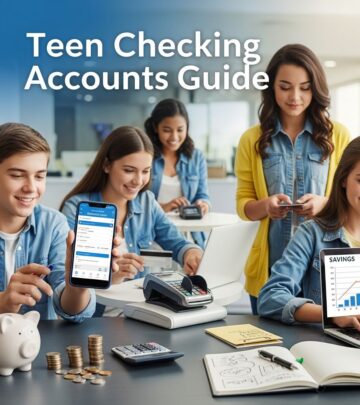
Should You Link Your Bank Account With Your Child’s?
Understand the pros, cons, and safer alternatives before opening a joint bank account or credit line with your child.

As children grow and start managing money on their own, many parents consider linking their bank account to their child’s account to provide support, oversight, or a safety net. Joint accounts and other connection options can be useful, but they also create legal and financial risks that are easy to overlook. This guide explains how parent–child banking links work, the pros and cons of each option, and how to choose an approach that fits your child’s age, maturity, and financial needs.
Why Link Bank Accounts With Your Child?
Parents typically think about linking accounts when their child begins handling larger sums of money or regular expenses—such as a first job, high school activities, or college living costs.
Common reasons to link accounts include:
- Teaching money skills: Letting your child manage real money while you still have a way to supervise and step in if needed.
- Preventing costly mistakes: Young people are more likely to overdraw accounts or overspend, especially when using debit cards or payment apps.
- Funding everyday expenses: Parents may want a convenient way to send money for food, books, gas, or emergencies.
- Monitoring income and spending: Seeing how your child uses money can reveal teaching opportunities around savings, budgeting, and priorities.
- Emergency backup: If a payment fails or an unexpected expense arises, a linked setup allows parents to step in quickly.
Research shows that financial behaviors formed in adolescence often persist into adulthood, so guided practice using real accounts can be a powerful teaching tool when managed carefully.1
Find the Best Checking Accounts
Before you decide how to link your finances, you will want to evaluate which bank and which account type are right for you and your child. Many banks offer dedicated student or teen checking accounts that are built for parent–child oversight.
When comparing checking accounts, consider:
- Monthly fees: Look for no-fee or easily waived-fee accounts for students or minors.
- Overdraft policies: Some banks waive overdraft fees for student accounts or offer low-fee overdraft protection.
- Parental controls: Features such as alerts, spending limits, and view-only access can help you supervise without fully sharing ownership.
- ATM access and network: Check how easy it is for your child to withdraw cash without paying ATM surcharges.
- Online and mobile tools: Budgeting tools, alerts, and transaction categorizations can make teaching easier.
According to the Consumer Financial Protection Bureau (CFPB), comparing account fee structures and overdraft practices is particularly important for young consumers, who are more likely to incur overdraft fees and may not fully understand how they work.2
Adding a Child to a Bank Account: Main Options
There is no single way to link your finances with your child’s. Instead, there is a spectrum of options ranging from full co-ownership to light-touch oversight. Each approach balances convenience and risk differently.
The main options include:
- Opening a joint bank account with your child.
- Sharing a credit card through authorized-user status or a joint card.
- Using overdraft linking from a parent account to a child account.
- Obtaining authorized access to your child’s separate account without making it joint.
The right choice depends on your child’s age, your financial comfort level, and how much control you want them to have.
Joint Bank Account
A joint bank account is a single account owned legally by both you and your child. Each of you can deposit, withdraw, and view transactions. The bank generally treats both account holders as having equal rights to the funds.
| Feature | Pros | Cons |
|---|---|---|
| Access to money | Both parent and child can use the account for deposits, withdrawals, and payments. | Child has full access and can withdraw or spend all funds. |
| Oversight | Parent can see all transactions in real time and intervene quickly. | Requires constant communication to avoid accidental overdrafts. |
| Legal responsibility | Easy for either party to handle banking tasks on the other’s behalf. | Both owners’ creditors may have claims on the funds.3 |
| Simplicity | One shared account simplifies transfers and payments. | Untangling ownership later can be complicated for estate or tax reasons. |
Advantages of a joint account with your child:
- You can easily transfer money for tuition, books, rent, or emergencies.
- You can monitor spending patterns and discuss them with your child.
- Your child has immediate access to funds for urgent needs without waiting for a transfer.
Key risks and concerns:
- Loss of control: Legally, the child can withdraw the full balance at any time, even if you provided all the money.
- Exposure to your child’s creditors: If your child incurs debts (e.g., from an accident or unpaid obligations), creditors may seek funds in the joint account.3
- Overdrafts from miscommunication: If both of you make withdrawals without coordinating, the account may overdraw, triggering fees.
- Financial aid impact: For students, assets in a joint account may be treated more heavily in college financial aid formulas compared with a parent-only account.4
Because a joint account gives broad access and creates shared exposure, it is often best suited for older teens or young adults who have demonstrated some financial responsibility and with whom you have open lines of communication.
Shared Credit Card
If your primary goal is to help your child pay expenses rather than manage a shared pool of savings, sharing access to a credit card may be more appropriate than a joint bank account. There are two main ways to do this:
- Adding your child as an authorized user on your existing credit card.
- Opening a joint credit card account with your child (where allowed).
Authorized user
When your child is an authorized user:
- You remain the primary account holder and are legally responsible for paying the bill.
- Your child has a card with their name but charges post to your account.
- This can help your child begin building a credit history if the issuer reports authorized-user data to credit bureaus, which many major issuers do.5
Joint credit card
Some issuers offer joint credit card accounts, where both you and your child are co-applicants and jointly responsible for balances:
- Both parties’ credit histories are considered for approval.
- Both are fully liable for the debt; missed payments affect both credit scores.5
- This route can be useful for older children with some income who are ready for shared responsibility.
Benefits of card sharing:
- Convenient way for your child to pay for books, transportation, or emergencies.
- Card protections (fraud protections, zero liability policies) may be stronger than with debit cards.
- Possible opportunity to build positive credit history with responsible use.
Risks of card sharing:
- Instant access to borrowing: Your child can charge up to the credit limit very quickly.
- Debt and interest: If unpaid balances accumulate, interest charges can grow rapidly.
- Credit score damage: Late payments or high utilization can harm both your credit profiles on a joint account.
To reduce risk, many parents start with a card that has a low credit limit and clear rules about what expenses are allowed and who pays the bill.
Overdraft Linking
Some banks allow you to link your child’s checking account to your own account (or to a savings account) as a form of overdraft protection. If your child spends more than the checking balance, the bank automatically pulls funds from the linked account to cover the shortfall.
Advantages:
- Prevents standard overdraft fees, which can be very expensive relative to small balances.
- Ensures important payments—like rent or tuition—are not declined due to timing or minor miscalculations.
- Allows your child to learn about budgeting with a safety net.
Risks and trade-offs:
- Drain on parent funds: Your child can indirectly access your account any time they overspend.
- Transfer fees: Many banks charge a fee each time overdraft protection transfers are triggered, though typically less than standard overdraft fees.2
- Hidden overspending: Because transactions continue to be approved, your child may not feel the immediate impact of overdrawing their account.
The CFPB notes that automatic overdraft programs can be costly and confusing for young consumers, recommending that families review fee disclosures carefully and consider whether overdraft transfers or simply declining transactions is the better teaching tool.2
Authorized Access (Without Joint Ownership)
If your goal is primarily oversight rather than shared ownership, you can often be listed as someone with authorized access to your child’s account rather than a full joint owner. Bank policies vary, but this can include:
- View-only access to statements and transactions.
- The ability to make deposits or transfers into the account.
- Limited withdrawal or decision-making authority, depending on the bank’s structure and your child’s age.
Benefits of authorized access:
- Your child’s money is kept legally separate from your own, which can protect you from their creditors and vice versa.3
- You can still monitor spending and step in with guidance.
- It encourages your child to take ownership of their finances while allowing you to supervise.
Limitations:
- You may not be able to unilaterally move money out of the account.
- In an emergency (such as your child becoming incapacitated), you might still need additional legal authority such as a power of attorney to fully manage the account.6
Should I Link My Bank Account With My Child’s Account?
Deciding whether—and how closely—to link your finances with your child’s ultimately comes down to balancing convenience with risk. The more tightly accounts are linked, the easier it is to move money and monitor activity, but the more you expose your own funds to your child’s mistakes, creditors, and life events.
Convenience vs. Risk Spectrum
You can think of the options as lying on a spectrum:
- Highest convenience, highest risk: Full joint bank account or joint credit card.
- Moderate convenience, moderate risk: Child’s account with overdraft linkage to parent’s account; authorized-user credit card.
- Lower convenience, lower risk: Separate child account with parent authorized access and occasional transfers.
For many families, a hybrid approach works best—especially as children age and their financial needs change.
Adapting Your Approach as Your Child Grows
It is helpful to update your strategy over time rather than set it once and forget it. Consider the following age-related guidelines (these are general patterns; your child’s maturity matters more than age alone):
- Early teens (13–15)
Focus on supervised practice.- Use a teen or student checking account with robust parental controls.
- Consider authorized access and alerts rather than joint ownership.
- Keep balances small and emphasize budgeting basics.
- Older teens (16–18)
Gradually increase responsibility.- Introduce a debit card with clear spending rules.
- Possibly add your child as an authorized user on a low-limit credit card.
- Discuss overdraft policies and whether a limited overdraft link makes sense.
- Young adults (college age and beyond)
Move toward independence.- Encourage your child to maintain their own checking and savings accounts.
- Use transfers or one-time support for large expenses instead of sharing ownership.
- Reassess and possibly remove joint or overdraft links once your child shows consistent, responsible behavior.
As financial-planning organizations often emphasize, gradually shifting responsibility to your child while keeping support in place can help them become confident, independent money managers without exposing the family to unnecessary risk.3
Practical Tips for Parents
Whatever structure you choose, a few best practices can make the arrangement safer and more educational:
- Set clear rules about what the account or card is for (e.g., gas, textbooks, emergencies) and what is off-limits.
- Schedule regular check-ins to review statements, discuss decisions, and adjust budgets.
- Use alerts (text or email) so both you and your child see low balances, large purchases, or overdraft events.
- Keep records of who contributed what, especially if you are sharing large sums, to avoid confusion later.
- Discuss credit and debt openly—how interest works, why on-time payments matter, and what happens if bills are ignored.
Many parents also coordinate account decisions with broader conversations about saving for goals, student loans, and long-term planning so their child sees the bigger picture, not just day-to-day transactions.
Frequently Asked Questions (FAQs)
Q: Is a joint bank account with my child the best way to help pay their college expenses?
A: Not necessarily. A joint account offers convenience but exposes your funds to your child’s creditors and can affect financial-aid calculations. For many families, a separate student account with scheduled transfers or authorized access gives enough convenience with less risk.4
Q: Will adding my child as an authorized user on my credit card help them build credit?
A: It can. Many major card issuers report authorized-user activity to credit bureaus, allowing your child to benefit from your positive payment history as long as the account is well managed. However, missed payments or high balances will also appear on your record and may indirectly affect your child’s profile if they later apply for credit.5
Q: How can I protect my own money if I want oversight but not joint ownership?
A: Consider keeping your accounts separate and obtaining authorized access to your child’s account instead of making it joint. You can also use scheduled transfers or payment apps to send money as needed while keeping legal ownership of your funds in your name.3
Q: Are overdraft protection transfers a good idea for a teen account?
A: Overdraft-linked transfers can be cheaper than standard overdraft fees and avoid declined transactions, but they also let your child dip into your funds without a hard stop. Carefully review the bank’s fee schedule and consider pairing any overdraft protection with low limits and frequent reviews so your child still feels the consequences of overspending.2
Q: When should I remove my child from a joint account or card?
A: Many parents start unwinding joint arrangements once their child has regular income, a track record of managing their own account responsibly, and, ideally, a starter credit history. At that point, you can shift to separate accounts with occasional support, which maintains their independence and reduces your financial exposure.
References
- Building Blocks to Help Youth Achieve Financial Capability — Consumer Financial Protection Bureau. 2016-09-08. https://files.consumerfinance.gov/f/documents/092016_cfpb_BuildingBlocksReport_ModelAndRecommendations_web.pdf
- Data Point: Frequent Overdrafters — Consumer Financial Protection Bureau. 2017-08-04. https://files.consumerfinance.gov/f/documents/cfpb_data-point_frequent-overdrafters_2017.pdf
- Joint Accounts with Adult Children: What Women Need to Know — Savant Wealth Management. 2023-02-15. https://savantwealth.com/savant-views-news/article/joint-accounts-with-adult-children-what-women-need-to-know/
- The EFC Formula, 2023–2024 — U.S. Department of Education. 2023-01-01. https://fsapartners.ed.gov/knowledge-center/library/resource-type/efc-formula-guide
- Credit Reports and Scores — Consumer Financial Protection Bureau. 2023-05-10. https://www.consumerfinance.gov/consumer-tools/credit-reports-and-scores/
- Managing Someone Else’s Money: Help for Agents Under a Power of Attorney — Consumer Financial Protection Bureau. 2021-06-01. https://files.consumerfinance.gov/f/201311_cfpb_msem_guide_power-of-attorney.pdf
Similar Articles








Read full bio of medha deb