Line of Best Fit: Definition, Formula & Calculation
Master the line of best fit: Learn how to identify trends, predict outcomes, and make data-driven decisions.
What Is a Line of Best Fit?
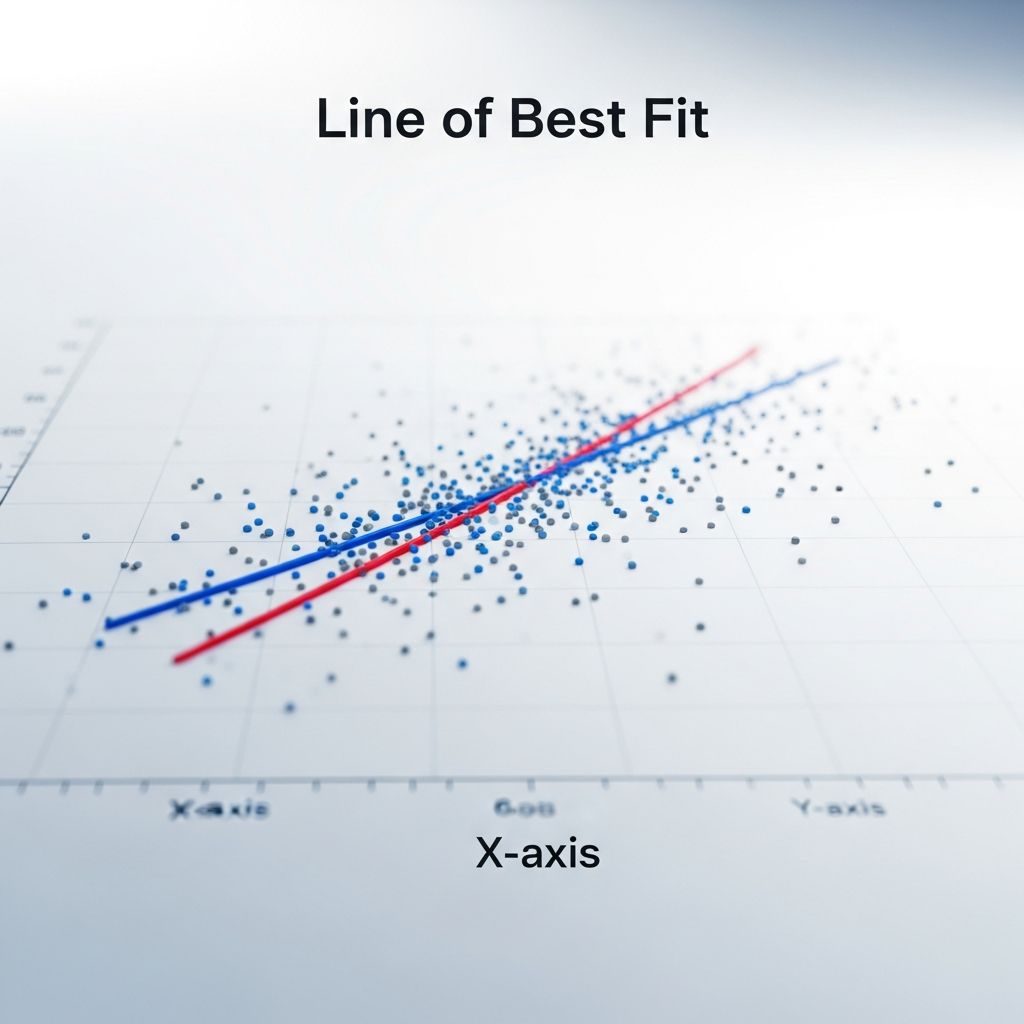
A line of best fit, also known as a trend line or linear regression line, is a straight line drawn through a scatter plot of data points that represents the general trend of the relationship between two variables. Rather than passing through every single data point, the line of best fit approximates the overall direction and pattern of the data, allowing analysts and investors to identify underlying trends and make predictions about future values.
In essence, the line of best fit serves as a visual representation that simplifies complex data by showing how one variable changes in relation to another. When raw data points are scattered across a graph, it can be difficult to discern meaningful patterns. The line of best fit addresses this challenge by smoothing out the noise and highlighting the dominant trend, making it easier to understand relationships between variables and forecast future outcomes.
The significance of the line of best fit extends across numerous fields, from finance and economics to business analytics and scientific research. In financial markets, for example, investors use trend lines to predict stock price movements, identify support and resistance levels, and develop trading strategies. Understanding how to calculate and interpret the line of best fit is therefore an essential skill for anyone working with quantitative data.
Key Characteristics of the Line of Best Fit
The line of best fit has several defining characteristics that make it a valuable analytical tool:
Balance and Minimization
The line of best fit does not pass through every data point; instead, it balances the data by minimizing the overall distance between each point and the line. This means some points will lie above the line while others fall below it, but the line is positioned to keep the cumulative distance as small as possible.
Slope Interpretation
The slope of the line reveals how much one variable changes in relation to the other. For instance, in a business context, the slope might show how much sales increase for every dollar spent on advertising. A steeper slope indicates a stronger relationship between variables, while a flatter slope suggests a weaker connection.
Y-Intercept Significance
The y-intercept—the point where the line crosses the vertical axis—provides valuable information about what happens when the independent variable equals zero. In practical terms, this can help businesses understand baseline costs or starting values in their analyses.
Representation of Trend Direction
A good line of best fit clearly shows whether data is trending upward, downward, or remaining relatively stable over time. This directional information is crucial for decision-making in finance, business, and other fields.
The Mathematics Behind the Line of Best Fit
The mathematical foundation of the line of best fit relies on linear regression, a statistical method that establishes a linear relationship between two variables. The fundamental equation for the line of best fit is:
y = mx + b
In this formula, m represents the slope (indicating how steep the line is), b represents the y-intercept (where the line crosses the vertical axis), x is the independent variable, and y is the dependent variable. This simple yet powerful equation allows analysts to make predictions by substituting known values of x to estimate corresponding values of y.
The Least Squares Method
The key to calculating an accurate line of best fit is employing the least squares method, a mathematical technique that minimizes the sum of squared errors between actual data points and the line. Rather than simply averaging deviations, this method squares the differences, ensuring that positive and negative errors do not cancel each other out. This approach guarantees that the line fits as closely as possible to all data points in aggregate.
The least squares method works by calculating the differences (called residuals) between each actual data point and the corresponding point on the line, then squaring these differences. The line is positioned so that the sum of all these squared differences is minimized. This mathematical rigor ensures that outliers have significant influence on the line’s position, which is both a strength and a potential weakness depending on the context.
Calculating the Line of Best Fit
Modern technology has made calculating the line of best fit remarkably straightforward. Most spreadsheet applications, statistical software, and even graphing calculators include built-in functions to compute trend lines automatically. Users simply input their data points, and the software calculates the slope and y-intercept using the least squares method.
To calculate manually, analysts must:
- Determine the mean (average) of the x-values
- Determine the mean of the y-values
- Calculate the covariance between x and y variables
- Calculate the variance of the x variable
- Use these values to solve for the slope (m)
- Use the slope and means to calculate the y-intercept (b)
Despite the existence of computational tools, understanding the underlying mathematics helps analysts interpret results more effectively and recognize when a line of best fit may not be appropriate for their data.
Applications in Financial Analysis
Stock Market Analysis and Price Forecasting
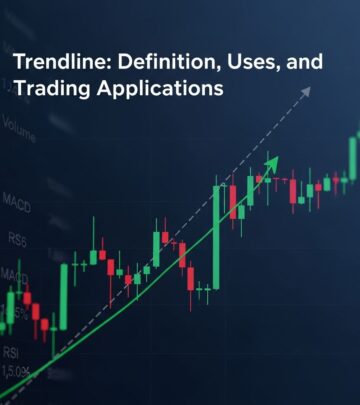
In financial markets, the line of best fit plays a crucial role in technical analysis, which focuses on analyzing price and volume data to predict future trends. By plotting historical stock prices on a scatter plot and drawing a trend line, investors can visualize whether a stock is generally appreciating, depreciating, or moving sideways. This information helps investors make informed decisions about when to buy or sell securities.
The trend line can reveal support levels, where prices tend to stop falling because demand exceeds supply, and resistance levels, where prices typically stop rising because supply exceeds demand. Identifying these levels provides valuable trading signals and helps investors optimize their entry and exit points.
Economic Indicator Forecasting
Beyond individual securities, the line of best fit can predict broader economic indicators such as inflation rates, GDP growth, and interest rate movements. By analyzing historical economic data, policymakers and economists can use trend lines to anticipate future economic conditions and adjust policy accordingly. This macro-level application helps businesses plan investments and adjust their operations in response to expected economic changes.
Business Performance Analysis
Companies use the line of best fit to analyze relationships between various business metrics. For example, a retail business might plot the relationship between advertising expenditure and sales revenue to understand the return on advertising investment. Similarly, a manufacturing company might analyze the relationship between raw material costs and production volume to forecast future expenses and profitability.
Understanding Limitations and Avoiding Common Mistakes
Misinterpretation of Perfect Fit
A widespread misconception is that the line of best fit will always pass through every data point or provide perfect predictions. In reality, the line represents only the general trend, and perfect fit is rare in real-world data. If data points are scattered far from the line, it indicates that the relationship between variables is weak or that the data does not follow a simple linear pattern. In such cases, the line of best fit may not be particularly useful for making predictions.
Sensitivity to Outliers
Because the least squares method squares the errors, extreme outliers can disproportionately influence the position of the line. A single unusual data point can shift the line significantly, potentially leading to misleading conclusions. Analysts must carefully examine data for outliers and consider whether they represent genuine phenomena or measurement errors that should be excluded from analysis.
Linear Relationship Assumption
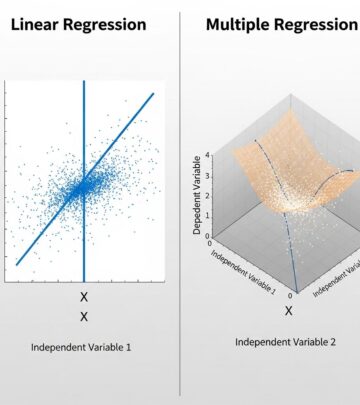
The line of best fit assumes a linear relationship between variables. However, real-world relationships are often nonlinear or curvilinear. Forcing a linear trend line through data that actually follows an exponential, logarithmic, or polynomial pattern can result in poor predictions and flawed conclusions. Analysts should examine scatter plots carefully to ensure that a linear model is appropriate before using a line of best fit.
Correlation Versus Causation
A line of best fit that shows a strong relationship between two variables does not prove that one variable causes changes in the other. Correlation and causation are distinct concepts. Just because two variables trend together does not mean one drives the other; they might both be influenced by a third factor, or the relationship might be coincidental.
Characteristics of a Quality Line of Best Fit
A well-constructed line of best fit should possess several qualities that enhance its reliability and usefulness:
| Characteristic | Description | Importance |
|---|---|---|
| Even Distribution | Data points are approximately evenly distributed above and below the line | Indicates the line accurately represents the central trend |
| Minimal Outlier Influence | The line is not distorted by a few extreme values | Ensures the trend reflects the majority of the data |
| High R-Squared Value | The coefficient of determination is close to 1.0 | Indicates the line explains a large proportion of data variation |
| Appropriate Model Selection | Linear regression is the correct choice for the data pattern | Ensures predictions are based on the correct mathematical model |
| Contextual Relevance | The line makes logical sense given the real-world context | Prevents acceptance of mathematically valid but unrealistic results |
Practical Benefits for Investors and Analysts
Risk-Reward Assessment
The line of best fit helps investors understand the risk-to-reward ratio of their investments. When a trend line shows positive momentum, investors gain foresight into potential rewards relative to the capital invested. Conversely, a declining trend line may signal increasing risk or diminishing returns.
Profitability Optimization
Businesses use the line of best fit to identify which trends are most profitable and allocate resources accordingly. By understanding historical relationships between variables like marketing spend and revenue, companies can optimize their business operations and implement more lucrative strategies.
Strategic Decision Support
The visual clarity provided by the line of best fit makes it an excellent decision-support tool. Rather than struggling to interpret tables of numbers, stakeholders can quickly grasp the direction and strength of trends from a graph, facilitating faster and more confident decision-making.
Using the Line of Best Fit Effectively
To use the line of best fit effectively, analysts should follow several best practices:
- Examine the raw data visually before calculating the line to identify obvious patterns or anomalies
- Consider whether a linear relationship is appropriate for the data
- Calculate the R-squared value to assess how well the line fits the data
- Examine residuals (the differences between actual and predicted values) to identify systematic patterns that a linear model might miss
- Use the line of best fit in conjunction with other analytical tools rather than relying on it exclusively
- Consult with subject matter experts who understand the real-world context
- Document assumptions and limitations when communicating results to stakeholders
Frequently Asked Questions (FAQs)
Q: What is the main purpose of a line of best fit?
A: The main purpose is to identify the underlying trend in scattered data and provide a basis for making predictions about future values. It simplifies complex data by showing the general direction and strength of the relationship between two variables.
Q: How does the line of best fit differ from connecting all the data points?
A: A line of best fit minimizes overall distance to all points rather than connecting them individually. This provides a clearer picture of the underlying trend and is more useful for prediction, whereas connecting all points would just create a jagged line that doesn’t reveal the pattern.
Q: Can the line of best fit be used for nonlinear data?
A: A linear line of best fit is not appropriate for nonlinear data. However, other regression models (exponential, polynomial, logarithmic) can be applied to curved data patterns. Always examine your scatter plot to determine the appropriate model.
Q: What does an R-squared value tell you about a line of best fit?
A: The R-squared value, ranging from 0 to 1, indicates what proportion of the variation in the dependent variable is explained by the independent variable. A value closer to 1.0 indicates a better fit, while values closer to 0 suggest the linear model explains little of the variation.
Q: Should I always use a line of best fit for my data?
A: No. The line of best fit is most useful when there is a clear linear relationship between variables and you have a reasonable sample size. For small datasets, nonlinear relationships, or when other analytical methods are more appropriate, alternative approaches may be better choices.
Q: How do I handle outliers when calculating a line of best fit?
A: First, determine whether outliers represent genuine data or measurement errors. If they’re errors, remove them. If they’re genuine but extreme, consider using robust regression methods that are less sensitive to outliers, or note them as important exceptions when interpreting results.
Q: Can I use a line of best fit to prove causation?
A: No. A line of best fit shows correlation, not causation. Two variables can move together without one causing changes in the other. Proving causation requires experimental evidence or logical reasoning beyond what a trend line can provide.
Q: What software can I use to calculate a line of best fit?
A: Most spreadsheet applications like Excel or Google Sheets include built-in trendline functions. Statistical software like R, Python (with libraries like NumPy and Pandas), SPSS, and Stata also provide comprehensive regression analysis tools.
References
- Line of Best Fit: Definition, Calculation, and Key Applications — OneMoneyWay. https://onemoneyway.com/en/dictionary/line-of-best-fit/
- Line of Best Fit | Definition, Role, Drawing Methods, Pros & Cons — Finance Strategists. https://www.financestrategists.com/wealth-management/fundamental-vs-technical-analysis/line-of-best-fit/
- Line of Best Fit In Excel: Definition, Benefits and Steps — Indeed Career Advice. https://www.indeed.com/career-advice/career-development/line-of-best-fit-excel
Similar Articles








Read full bio of Sneha Tete