Limited Partnership: Definition, Structure, and Business Uses
Understanding limited partnerships: structure, liability, taxation, and real-world applications.
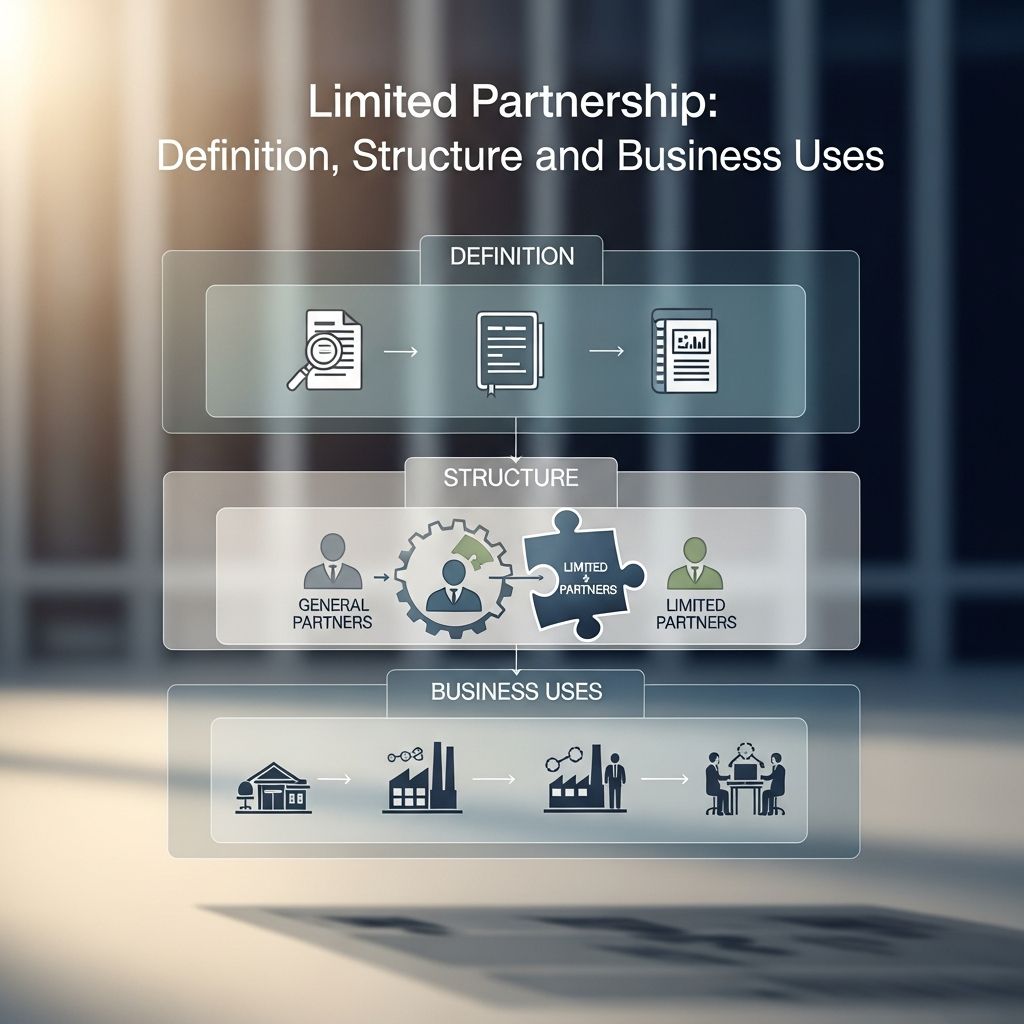
A limited partnership (LP) is a business structure consisting of at least two types of partners: general partners who manage the business and assume full legal responsibility, and limited partners who invest capital but retain limited liability. This hybrid model creates a clear separation between operational control and financial risk, making it an attractive choice for various business contexts.
The limited partnership structure has gained widespread adoption across multiple industries because it offers flexibility, tax efficiency, and risk management benefits. Unlike corporations or general partnerships, LPs provide a framework where passive investors can contribute capital without bearing operational responsibilities or unlimited liability exposure.
Understanding the Structure of a Limited Partnership
To grasp what constitutes a limited partnership, one must understand the distinct roles within this business entity. The LP structure centers on two primary partner types, each with defined responsibilities and rights.
The General Partner (GP)
The General Partner serves as the actual manager and decision-maker of the limited partnership. GPs hold comprehensive authority over business operations, including making strategic decisions, entering into contracts, and managing day-to-day activities. However, this control comes with significant responsibility: General Partners assume full legal liability for the partnership’s actions and obligations. If the partnership faces lawsuits or debt obligations, the GP’s personal assets may be at risk.
In many limited partnerships, particularly in private equity and investment funds, the GP also receives a management fee in addition to a share of profits. This compensation structure aligns the GP’s interests with the success of the venture.
Limited Partners (LPs)
Limited Partners function as passive investors within the partnership structure. They contribute capital to the business and receive a proportional share of profits based on their investment amount. However, LPs do not participate in day-to-day operations, and critically, their liability is limited to the capital they have contributed to the company. This limited liability protection is the defining characteristic that distinguishes LPs from general partners.
Limited Partners cannot engage in management decisions or control operations. Their role is purely financial—they provide liquidity to fuel the partnership’s growth and investments. In return for this capital contribution and acceptance of limited involvement, LPs benefit from potential profit distributions and downside protection through their liability caps.
Key Characteristics of Limited Partnerships
Limited partnerships possess several distinctive features that make them particularly appealing for certain business contexts:
Pass-Through Taxation
One of the most significant advantages of limited partnerships is their pass-through taxation treatment. Unlike corporations, which face double taxation (corporate-level taxation followed by shareholder-level taxation), LPs avoid this burden. Profits generated by the partnership are not taxed at the corporate level. Instead, these profits pass through to individual partners, who report them as personal income on their tax returns. This structure often results in significant tax efficiency compared to traditional corporate entities.
Separation of Control and Liability
The fundamental appeal of limited partnerships lies in the clear demarcation between operational control and financial risk. General Partners assume full operational control and full liability. Limited Partners provide capital but remain insulated from operational decisions and management responsibilities. This separation enables investors with capital but limited expertise or availability to participate in business ventures without becoming entangled in operational management.
Limited Liability for Passive Investors
Limited Partners are not personally liable for the partnership’s debts or obligations beyond their capital contributions. This feature protects LPs’ personal assets from partnership-related liabilities, providing crucial risk management for investors. The liability cap creates predictability regarding potential losses and enables investors to structure their portfolios with known maximum exposure levels.
Formation and Legal Requirements
Establishing a limited partnership requires adherence to specific legal formalities that vary by jurisdiction. Generally, the formation process includes several essential steps:
Registration and Documentation
Most jurisdictions require formal registration of the limited partnership with relevant government authorities, typically at the state or national level. This registration process establishes the LP as a legal entity and creates an official record of its existence and structure.
Partnership Agreement
A comprehensive partnership agreement serves as the foundational document outlining the terms, conditions, and operations of the limited partnership. This agreement specifies each partner’s capital contributions, profit-sharing arrangements, management rights, decision-making procedures, dispute resolution mechanisms, and conditions for partner withdrawal or admission. The partnership agreement protects all parties by establishing clear expectations and reducing potential conflicts.
Filing Requirements
Depending on the jurisdiction, specific documents must be filed with relevant authorities to formally establish the LP. These filings typically include a Certificate of Limited Partnership or similar foundational documents that provide notice to creditors and the public of the partnership’s formation and structure.
Limited Partnership vs. Other Business Structures
| Feature | Limited Partnership | General Partnership | Corporation | LLC |
|---|---|---|---|---|
| Liability | Limited for LPs; Unlimited for GPs | Unlimited for All Partners | Limited for All Shareholders | Limited for All Members |
| Management Control | Only GPs Manage; LPs Passive | All Partners Manage | Board of Directors Manages | Members Can Manage or Delegate |
| Taxation | Pass-Through | Pass-Through | Double Taxation (Corporate + Individual) | Pass-Through (Flexible) |
| Formation Complexity | Moderate | Simple | Complex | Moderate |
| Capital Raising | Excellent for Attracting Passive Capital | Limited Passive Investment Options | Excellent via Stock Sales | Good via Membership Interests |
The limited partnership structure distinguishes itself from other business entities in critical ways. Unlike general partnerships, where all partners share unlimited liability and actively manage the business, LPs assign operational responsibility and associated risks to General Partners. This division creates space for passive investors who want portfolio exposure without management involvement.
Compared to corporations, limited partnerships offer superior tax efficiency through pass-through taxation while maintaining liability protections comparable to corporate structures. Limited Liability Companies (LLCs) offer similar flexibility but typically feature more fluid management arrangements and may provide superior privacy protections depending on jurisdiction.
Common Applications of Limited Partnerships
Private Equity and Venture Capital
Private equity funds and venture capital partnerships represent the most prevalent application of the limited partnership structure. In these contexts, the General Partner manages the fund, selects investments, and oversees portfolio companies. Limited Partners—often institutional investors such as pension funds, foundations, endowments, and sovereign wealth funds—provide capital. This arrangement aligns incentives while enabling large pools of passive capital to access professional investment management and higher-return opportunities.
Real Estate Investments
Real estate limited partnerships enable investors to participate in property acquisitions and developments without directly managing assets. The General Partner identifies opportunities, negotiates acquisitions, manages properties, and handles tenant relations. Limited Partners provide capital and receive distributions from rental income and eventual property sales. This structure particularly appeals to institutional investors seeking real estate exposure without operational involvement.
Family Businesses and Joint Ventures
Limited partnerships frequently structure family businesses where some family members actively work in the business while others serve as passive investors. Similarly, joint ventures between partners from different countries or with different expertise levels benefit from the LP structure’s ability to separate active management from passive investment. This arrangement particularly suits scenarios where partners need capital without requiring additional operational managers.
Investment Funds
Beyond private equity, limited partnerships structure hedge funds, mutual funds, and various investment vehicles. The GP manages the fund’s investment strategy and operations while LPs provide capital and share in returns. This structure proves particularly common among pension funds, sovereign wealth funds, and endowment funds seeking professional management and exposure to various asset classes.
Taxation Considerations
Limited partnerships generally fit into pass-through tax regimes with relative ease. Profits flow through to partners and are taxed at the individual level rather than the entity level, avoiding double taxation. However, certain jurisdictions, such as Luxembourg, may offer exceptions or preferential tax treatment, particularly for investment funds. This international variation emphasizes the importance of consulting tax professionals when establishing or investing in limited partnerships across different jurisdictions.
Rights and Responsibilities of Limited Partners
Limited Partners enjoy specific rights while accepting defined limitations:
Profit Distribution Rights
Limited Partners receive a percentage of partnership profits proportional to their capital investment, as outlined in the partnership agreement. These distributions typically occur annually or according to a schedule specified in the agreement.
Information Access
Limited Partners generally have the right to access certain company information, including financial statements and operational reports, enabling them to monitor their investments. However, the scope of this access varies based on partnership agreements and may be more limited than what General Partners receive.
Withdrawal and Transfer
Limited Partners may withdraw from the partnership under terms specified in the partnership agreement. These agreements typically establish procedures for withdrawal, potential penalties, and conditions for transferring partnership interests to third parties.
Liability Limitations
Critically, Limited Partners remain protected from personal liability for partnership debts and obligations beyond their capital contributions. This protection represents a fundamental characteristic of the limited partnership structure and a primary reason many investors favor this entity type.
Frequently Asked Questions
Q: What is the primary difference between a General Partner and a Limited Partner?
A: The General Partner manages the business, makes decisions, enters contracts, and assumes unlimited liability. Limited Partners contribute capital, receive profit shares, but have no management involvement and their liability is limited to their capital contribution.
Q: Can a Limited Partner become involved in management decisions?
A: No. If a Limited Partner actively participates in management, they risk losing their liability protection and being reclassified as a General Partner with unlimited liability exposure. This is why LPs maintain passive roles.
Q: How is a Limited Partnership taxed differently from a corporation?
A: Limited Partnerships use pass-through taxation, where profits are taxed at the partner level rather than the entity level. Corporations face double taxation at both corporate and shareholder levels, making LPs more tax-efficient.
Q: What happens if a Limited Partnership fails?
A: Limited Partners lose only their invested capital. Their personal assets remain protected because their liability is capped at their capital contribution. General Partners, however, may face personal liability beyond their contributions.
Q: Are Limited Partnerships used internationally?
A: Yes. Limited Partnerships have widespread international acceptance, particularly in private equity, real estate, and investment contexts. However, specific formation requirements and tax treatment vary by jurisdiction.
References
- What Is a Limited Partnership? — Ascot International. 2025-07-14. https://www.ascotinternational.net/blog/what-is-a-limited-partnership/
Similar Articles








Read full bio of Sneha Tete