LG vs Samsung TV: Which OLED TV is Right for You in 2025?
Compare LG and Samsung OLED TVs: Features, performance, and which brand wins for your viewing style.
LG vs Samsung TV: A Complete Comparison Guide for 2025
The television market in 2025 has become increasingly competitive, with LG and Samsung leading the charge in OLED technology. Both manufacturers offer premium flagship models that deliver exceptional picture quality, advanced features, and innovative technologies. Understanding the differences between these two brands is essential for making an informed purchase decision. This comprehensive guide examines the key distinctions between LG and Samsung TVs to help you determine which brand best suits your needs.
Picture Quality and Display Technology
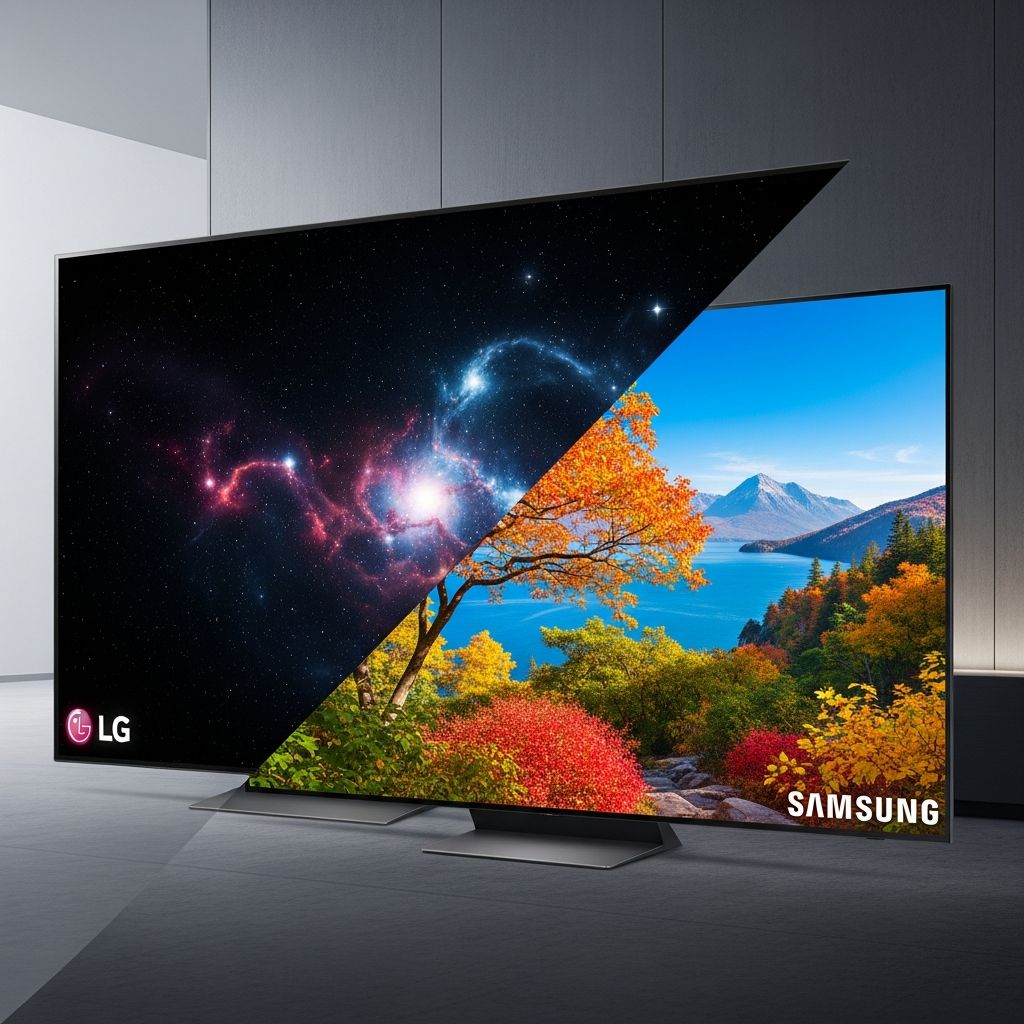
Both LG and Samsung employ cutting-edge OLED panel technology, but their approaches differ significantly. The LG G5 utilizes LG’s proprietary W-OLED (White OLED) panel with a four-layer structure, while Samsung’s S95F features QD-OLED (Quantum Dot OLED) technology. These different panel architectures result in distinct visual characteristics that appeal to different viewers.
LG’s W-OLED technology excels at delivering superior contrast and deeper black levels. The G5 produces some of the richest and most inky blacks available in the television market, making it ideal for dark room viewing and content with significant shadow detail. This advantage stems from LG’s refined panel design that prioritizes deep blacks and reference-level picture accuracy.
Samsung’s QD-OLED technology, conversely, prioritizes brightness and dynamic color rendering. The S95F achieves higher peak brightness levels and demonstrates more vibrant, saturated colors compared to LG’s offering. This makes Samsung TVs particularly suited for bright rooms and HDR content where color dynamism takes center stage.
Brightness and HDR Performance
Peak brightness represents a crucial differentiator between these two manufacturers. Measurements show the LG G5 achieving HDR peak brightness of 2,268 nits, while the Samsung S95F reaches 2,132 nits—both impressive figures that exceed typical viewing requirements. However, brightness isn’t merely about raw nits; it’s about how consistently that brightness is maintained across different content types.
The LG G5 maintains superior brightness consistency throughout HDR scenes, providing sustained luminance that prevents image dimming during fast-moving or intense sequences. This characteristic makes the G5 feel more immediately engaging when watching action-packed content. Samsung compensates for slightly lower peak brightness through aggressive dynamic tone mapping and sharpening, creating images with considerable visual impact despite the lower raw brightness numbers.
For bright room viewing, both televisions perform admirably, though Samsung’s higher baseline brightness provides a slight advantage when ambient light is a significant factor. The trade-off involves Samsung’s matte anti-glare panel versus LG’s glossy display, with each approach offering distinct benefits.
Color Accuracy and Gamut Coverage
Color performance represents another area where these brands take different approaches. Both the LG G5 and Samsung S95F achieve over 99% DCI-P3 color space coverage, ensuring exceptional color reproduction across professional content. However, the subjective viewing experience differs between the two.
LG’s W-OLED panels deliver more natural and reference-accurate color reproduction, making the G5 particularly appealing for content creators and viewers who prioritize color fidelity. The colors appear less aggressive and more true-to-source, contributing to a picture that feels easier to watch for extended periods.
Samsung’s QD-OLED technology produces more dynamic and saturated colors, especially in HDR content. This results in a more visually striking presentation that some viewers find more engaging and immersive. The trade-off involves sacrificing some color accuracy for enhanced visual impact and presence.
Anti-Reflective Coatings and Glare Performance
Display coating technology significantly impacts usability in various lighting conditions. Samsung introduced its Glare Free technology with an anti-reflective matte coating, while LG maintains a traditional glossy screen on the G5. Each approach presents advantages and disadvantages.
Samsung’s matte coating excels at minimizing reflections from ambient light sources like ceiling lamps and windows. Testing demonstrates that the S95F produces significantly fewer visible reflections compared to competitors, making it superior for bright environments. However, this matte coating diffuses light across the display, which reduces contrast and can make images appear slightly less punchy.
LG’s glossy panel delivers superior contrast and visual impact but shows more reflections in bright rooms. The reflective surface can be distracting when overhead lights are on or when sunlight directly hits the screen. For dark room viewing, this traditional approach works exceptionally well, but bright room performance suffers compared to Samsung’s anti-glare solution.
Gaming Performance and Input Latency
Gaming enthusiasts will appreciate the technical specifications both televisions offer. Both the LG G5 and Samsung S95F support 165Hz refresh rates and variable refresh rate (VRR) technology, ensuring smooth gaming performance with compatible PlayStation 5 and Xbox Series X/S consoles.
Input latency measurements reveal that both televisions perform similarly, delivering responsive gaming experiences without noticeable lag. The LG G5 enjoys a slight advantage due to more consistent firmware updates and superior HGIG (HDR Gaming Interest Group) standard support, which optimizes HDR performance specifically for gaming applications.
Samsung’s gaming features remain competitive, with excellent motion handling and rapid response times. The choice between these two for gaming comes down to personal preference regarding picture mode adjustments and calibration support rather than fundamental performance differences.
Dark Room Performance and Shadow Detail
For cinephiles and dark room enthusiasts, LG’s performance shines. The G5’s superior black levels and shadow detail preservation make it the ideal choice for movie watching in controlled lighting environments. The television’s reference-level calibration ensures shadow detail remains visible without crushing, preserving the filmmaker’s intended contrast ratios.
One technical issue affects the LG G5 specifically: dithering artifacts appear on dark gray scenes when connected via PC. Dithering manifests as a crawling or noisy effect that degrades the visual experience with computer-connected content. This limitation doesn’t significantly impact television viewing but can be problematic for PC-to-TV gaming or content streaming scenarios.
Samsung’s QD-OLED technology renders near-black content cleanly without the dithering issues present on LG’s implementation, though its raised black levels compared to LG don’t achieve the same reference-level darkness.
Off-Axis Viewing and Panel Consistency
Modern television viewing often involves multiple viewers watching from different angles and distances. Both LG and Samsung OLED panels demonstrate excellent off-axis performance, maintaining consistent image quality when viewed from the side.
The image remains stable with minimal color shift or brightness degradation, making these panels ideal for larger viewing areas where viewers sit at various angles. Sony and Samsung actually show slight advantages in this category, though the differences are subtle and unlikely to impact most viewing scenarios.
Design and Build Quality
Both manufacturers deliver premium build quality befitting their flagship status. The LG G5 and Samsung S95F feature sleek designs with minimal bezels and stand options that complement modern home theaters. Design preferences come down to personal taste, as both televisions integrate seamlessly into contemporary living spaces.
Sound quality presents another differentiator. Independent testing reveals that the Sony Bravia 8 II offers more powerful built-in sound than either LG or Samsung, though both the G5 and S95F provide adequate audio for casual viewing. Most consumers pair these televisions with external audio systems anyway, minimizing the impact of built-in speaker performance.
Operating Systems and Smart Features
LG utilizes webOS as its smart television operating system, while Samsung employs Tizen. Both platforms offer extensive streaming app libraries, intuitive navigation, and smart home integration. The choice between them largely depends on personal familiarity and preference, as both deliver comprehensive smart TV functionality.
webOS generally receives praise for consistent firmware support and regular feature updates, while Tizen offers deep Samsung ecosystem integration for users invested in Samsung devices and services. Neither platform presents a compelling reason to choose one brand over the other from a pure functionality standpoint.
HDR Format Support
Both LG and Samsung support major HDR formats including Dolby Vision, HDR10, and HLG. LG’s advantage lies in its full support across all content sources, while Samsung’s HDR format compatibility remains comprehensive though slightly more limited in specific scenarios. For most viewers, this distinction has minimal practical impact on daily viewing experiences.
Price and Value Proposition
Pricing for these flagship models typically situates them in the premium television market segment. The LG G5 and Samsung S95F command similar price points, making the decision about value depend on which features matter most to your viewing habits.
If you prioritize picture accuracy, deep blacks, and reference-level performance for dark room viewing, the LG G5 offers superior value. If bright room performance, anti-glare technology, and vibrant color rendering appeal to you, the Samsung S95F justifies its price tag.
Which TV Should You Choose?
Choose the LG G5 if:
- You watch primarily in dark or controlled lighting environments
- Picture accuracy and reference-level calibration matter to you
- You want the deepest black levels and superior shadow detail
- You value consistent firmware support and gaming optimizations
- You’re willing to sacrifice some brightness for superior contrast
Choose the Samsung S95F if:
- You watch in bright rooms with significant ambient light
- You prefer vibrant colors and dynamic tone mapping
- Anti-reflective coating technology appeals to you
- Higher peak brightness matters for HDR content impact
- You want a television that makes a visual statement with punchy, engaging colors
Frequently Asked Questions
Q: Which TV has better black levels, LG or Samsung?
A: The LG G5 delivers superior black levels with deeper, richer blacks compared to Samsung’s S95F. LG’s W-OLED technology prioritizes black level depth, making it the clear winner for viewers who value reference-level black rendering.
Q: Does Samsung’s TV look brighter than LG’s?
A: While both achieve impressive brightness levels (LG G5: 2,268 nits, Samsung S95F: 2,132 nits), Samsung compensates for slightly lower peak brightness with aggressive dynamic tone mapping and sharpening that creates a visually impactful presentation.
Q: Which TV is better for bright rooms?
A: Samsung’s S95F with its Glare Free anti-reflective matte coating performs better in bright rooms, minimizing reflections and maintaining consistent image quality despite ambient light.
Q: Are gaming features comparable between LG and Samsung?
A: Both support 165Hz refresh rates and VRR technology with similar input latency performance. LG has a slight advantage due to superior HGIG support and more consistent firmware updates for gaming optimization.
Q: Does LG G5 support Dolby Vision?
A: Yes, the LG G5 supports Dolby Vision, while the Samsung S95F does not. This provides an advantage for LG when watching Dolby Vision-encoded content.
Q: What’s the dithering issue with LG G5?
A: When connected via PC, the LG G5 can display dithering artifacts (noisy, crawling effects) on dark gray scenes. This doesn’t affect standard TV viewing but can impact PC gaming and streaming scenarios.
Q: Which TV should I buy if I can’t decide?
A: Independent testing indicates the LG G5 represents the best overall choice for most viewers due to its superior black levels, picture accuracy, and consistent reference-level performance across varied content types.
References
- The Best TV of 2025 – Sony vs LG, Samsung, & Panasonic — Home Theater Review. 2025. https://hometheaterreview.com/the-best-tv-of-2025-sony-vs-lg-samsung-panasonic/
- I Tested LG, Samsung and Sony’s Elite 2025 OLED TVs Side-by-Side — TechRadar. 2025. https://www.techradar.com/televisions/i-tested-lg-samsung-and-sonys-elite-2025-oled-tvs-side-by-side-heres-the-one-id-buy-with-my-own-money
- LG G5 OLED vs Samsung S95F OLED – Picture, Sound Comparison — YouTube. 2025. https://www.youtube.com/watch?v=n2cqpbClPcw
- LG 4K vs Samsung: Are LG TVs Really Worth the Extra Money in 2025? — DHGate Smart. 2025. https://smart.dhgate.com/lg-4k-vs-samsung-are-lg-tvs-really-worth-the-extra-money-in-2025/
- Best OLED TVs in 2025 Tested — Tom’s Guide. 2025. https://www.tomsguide.com/tvs/oled-tvs/best-oled-tvs
Similar Articles








Read full bio of Sneha Tete