Letter of Recommendation Template & Guide
Master writing compelling recommendation letters with our comprehensive template and expert guidance.
A letter of recommendation is a formal written endorsement that highlights an individual’s qualifications, strengths, and achievements. Whether you’re recommending a former employee, student, or colleague, these letters play a crucial role in helping candidates advance their careers or pursue educational opportunities. Writing a strong recommendation letter requires thoughtfulness, specificity, and genuine insight into the candidate’s abilities.
The purpose of a recommendation letter extends beyond simply confirming that someone is competent. It serves as a trusted third-party validation of a person’s skills, work ethic, and character. Hiring managers and admissions committees rely on these letters to gain perspectives that cannot be found in resumes or application forms alone. A well-crafted recommendation can be the deciding factor between multiple qualified candidates.
Understanding the Key Components of a Strong Recommendation Letter
Before you begin writing, it’s important to understand what makes a recommendation letter effective. The strongest letters contain specific examples rather than generic praise. Instead of stating that someone is “a great employee” or “highly motivated,” explain how they successfully led a high-priority project, managed a difficult client relationship, or mentored junior team members. The more concrete and detailed your examples, the more compelling your letter becomes.
Your recommendation letter should answer several important questions to be most effective:
- What was your working relationship with this person?
- What specific projects did they work on under your supervision?
- Can you provide two or more examples of their positive performance or attitude?
- What are the two or three key qualities this person demonstrates?
- Is there anything particularly impressive about their knowledge or accomplishments?
Taking time to answer these questions before you start writing will help you organize your thoughts and create a more structured, impactful letter.
Basic Structure and Format Guidelines
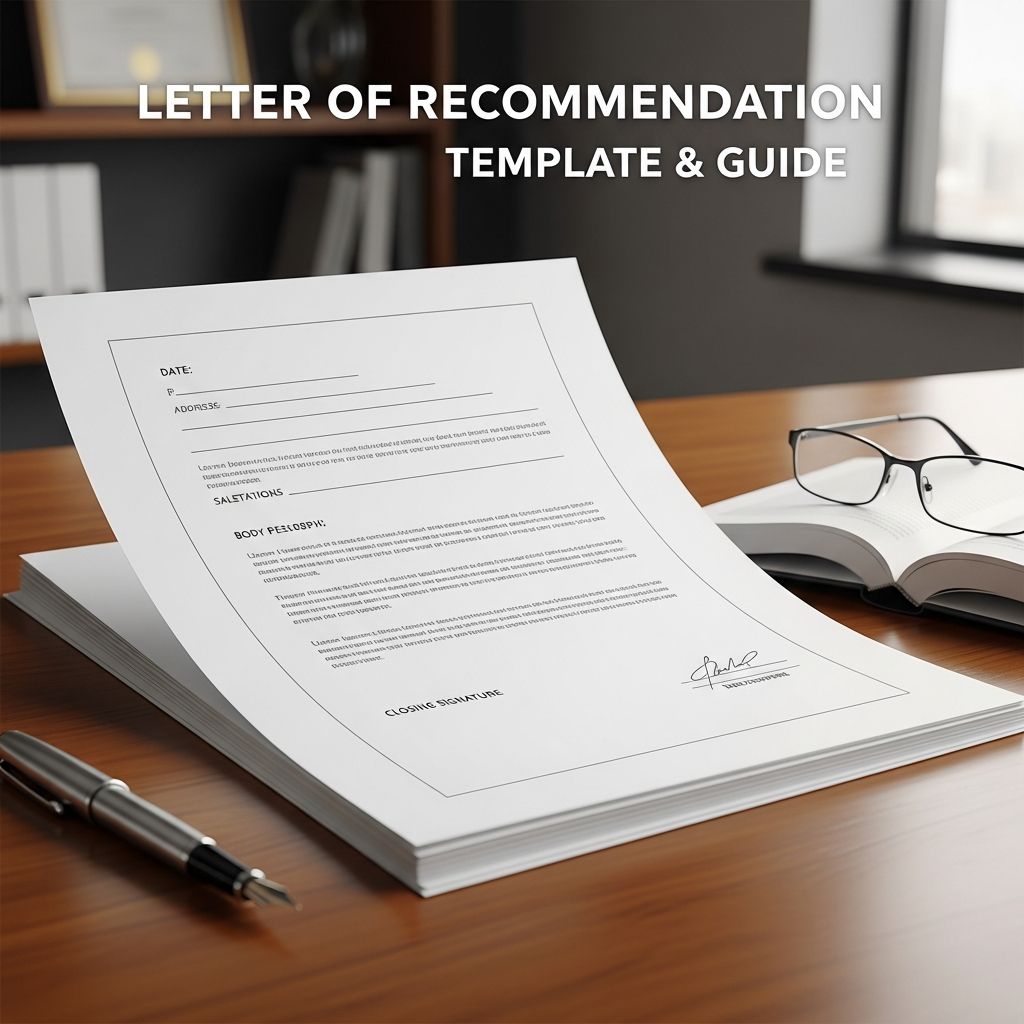
A well-organized recommendation letter typically follows a standard business letter format. The structure should include five essential components that work together to create a comprehensive endorsement.
Introduction and Your Relationship
Begin with a clear introduction that establishes who you are and your professional relationship to the candidate. State your position, how long you’ve known the person, and in what context you’ve worked together. This opening sets the stage for why your recommendation carries weight and credibility.
Specific Examples and Achievements
The body of your letter should highlight concrete examples of the candidate’s accomplishments and skills. Rather than making broad claims, provide specific instances where you witnessed their excellence. Describe the challenge, their approach, and the positive outcome. This evidence-based approach makes your recommendation far more persuasive than vague praise.
Relevant Qualities and Characteristics
Identify and elaborate on the personal and professional qualities that make this candidate stand out. Discuss how these traits directly contribute to their success in the position or program they’re pursuing. Connect their characteristics to the specific needs of the opportunity they’re seeking.
Professional Closing
Conclude your letter with a strong statement of support and offer to provide additional information if needed. Include your contact details and signature to add authenticity and accessibility to your letter.
Letter of Recommendation Template for Employees
Use this professional template when writing a recommendation for a current or former employee:
Dear [Recipient Name/To Whom It May Concern],I am writing to strongly recommend [Employee Name] for [position/opportunity]. I am [Your Title] at [Company Name], and [Employee Name] has worked with me as a [Job Title] for [duration].During [his/her/their] time with our team, [Employee Name] demonstrated exceptional [list 2-3 key qualities]. One notable example is when [provide specific achievement or project example]. This project resulted in [specific outcome].Additionally, [Employee Name] showed remarkable ability in [another relevant skill or accomplishment]. For instance, [describe another concrete example with measurable results].What sets [Employee Name] apart is [his/her/their] ability to [describe unique quality or approach]. This has made [him/her/their] an invaluable member of our team.I highly recommend [Employee Name] for this opportunity and believe [he/she/they] would be an excellent addition to your organization. Please feel free to contact me if you need any additional information.Sincerely,[Your Name][Your Title][Company Name][Contact Information]Letter of Recommendation Template for Students
Academic recommendation letters require slightly different emphasis. Use this template for recommending students for graduate programs, scholarships, or academic opportunities:
Dear [Admissions Committee/Scholarship Committee/Program Director],I am pleased to write a letter of recommendation for [Student Name], who is applying to [Program/Opportunity] at [Institution]. I am [Your Title] at [Institution Name], and [Student Name] has been my [student/research assistant/lab assistant] for [duration].During [his/her/their] time in my [class/lab/program], [Student Name] demonstrated intellectual curiosity, strong work ethic, and exceptional academic performance. Specifically, [he/she/they] worked on [specific project or research], where [he/she/they] [describe the accomplishment, methodology, or insight]. The results of this work were [describe outcome - e.g., published, presented at conference, received recognition].[Student Name] possesses outstanding qualities including [list 2-3 academic or personal qualities]. For example, [provide concrete example of how these qualities were demonstrated].I am confident that [Student Name] will excel in your program and make meaningful contributions to [his/her/their] field. I recommend [him/her/them] without reservation and would be happy to discuss [his/her/their] qualifications further.Sincerely,[Your Name][Your Title][Institution Name][Contact Information]Real-World Recommendation Letter Examples
Employee Recommendation Example
Here’s a completed sample recommendation letter for an employee:
Dear Ms. Richardson,I am writing to strongly recommend Marcus Chen for the Senior Project Manager position at Technology Innovations Inc. I am the Director of Operations at Digital Solutions Corp, where Marcus has worked as a Project Manager for the past four years.During his tenure with our team, Marcus demonstrated exceptional leadership, strategic thinking, and project management expertise. One outstanding example was when he led the redesign of our client management system. This project was initially six months behind schedule and significantly over budget. Marcus restructured the team, implemented new workflows, and implemented agile methodologies. He delivered the project two weeks early and 15% under budget, resulting in improved client satisfaction scores that increased by 40%.Additionally, Marcus showed remarkable ability in managing difficult client relationships. When one of our largest accounts threatened to leave due to service inconsistencies, Marcus personally intervened, analyzed the issues, and implemented a comprehensive improvement plan. The client not only renewed their contract but increased their annual spending by 35%.What truly sets Marcus apart is his ability to inspire and develop his team members. Three junior staff members have been promoted to senior roles under his mentorship, and he has consistently received the highest employee satisfaction ratings in our department.I highly recommend Marcus for this position and am confident he will make significant contributions to your organization. Please feel free to contact me at (555) 123-4567 or mcarter@digitalsolutions.com.Sincerely,Michelle CarterDirector of OperationsDigital Solutions CorpAcademic Recommendation Example
Here’s a sample recommendation letter for a graduate program:
Dear MIT Graduate Admissions Committee,It is my pleasure to recommend Dr. Elena Rodriguez for admission to your PhD program in Biomedical Engineering. I am Professor James Wilson, Chair of the Biomedical Engineering Department at State University, where Elena was my student and research assistant for two years.Elena stands out as one of the most exceptional students I have encountered in my 20 years of teaching. Her intellectual curiosity, combined with rigorous analytical thinking, marks her as an outstanding candidate for advanced study. During her time in my laboratory, Elena conducted independent research on biomaterial scaffolding for tissue engineering. She designed novel polymer compositions, conducted comprehensive testing, and published two first-author papers in peer-reviewed journals, including one in the prestigious Journal of Biomedical Materials Research.What distinguishes Elena is not merely her technical competence but her ability to think creatively about complex problems. When initial experiments failed to produce expected results, rather than becoming discouraged, she questioned fundamental assumptions and developed an entirely new approach that ultimately proved far more effective than the original methodology.Elena possesses exceptional qualities including intellectual rigor, creative problem-solving, collaborative spirit, and genuine passion for advancing biomedical science. She consistently demonstrated these qualities through her research contributions, her willingness to mentor undergraduate students, and her presentations at national conferences.I recommend Elena without reservation for your PhD program. She has the intellectual capacity, research experience, and personal qualities necessary to become an outstanding biomedical engineer and researcher. Should you wish to discuss her qualifications in greater detail, please contact me at (555) 987-6543.Sincerely,James Wilson, PhDProfessor and ChairDepartment of Biomedical EngineeringState UniversityEssential Tips for Writing Compelling Recommendation Letters
Use Specific Examples Rather Than Generic Praise
Avoid vague statements like “John is a hard worker” or “Sarah is very intelligent.” Instead, provide concrete examples with measurable outcomes. For instance: “During the Q3 marketing campaign, Sarah identified a market gap that led to a new product line generating $500,000 in first-year revenue.”
Tailor Your Letter to the Opportunity
If the candidate is applying for a position requiring specific skills, emphasize their expertise in those areas. A recommendation for a sales position should highlight customer relationship skills and revenue achievements, while a recommendation for an academic program should emphasize research capability and intellectual curiosity.
Be Honest and Balanced
While a recommendation letter should be positive, maintaining credibility is essential. If you cannot write a genuinely strong letter, politely decline the request and suggest the candidate seek a recommender who knows their work better. A lukewarm or obviously obligatory letter can harm the candidate’s prospects.
Include Quantifiable Results When Possible
Specific numbers add credibility to your claims. Instead of saying someone “improved efficiency,” state they “reduced processing time by 30%” or “increased team productivity by 45%.”
Maintain Professional Tone and Formatting
Use professional business letter format with proper grammar, punctuation, and spelling. The letter should be printed on official letterhead if possible and signed by hand or with a digital signature. Avoid casual language, slang, or overly flowery descriptions.
Common Mistakes to Avoid
When writing recommendation letters, avoid these common pitfalls that can undermine their effectiveness:
- Exaggeration or Dishonesty: Overstating qualifications or making false claims damages your credibility and can harm the candidate if discovered.
- Vague Language: Statements like “excellent all-around” or “great person” lack the specificity that makes letters compelling.
- Exceeding Length Guidelines: While there’s no rigid limit, most recommendation letters should be one page. Excessive length may not be read thoroughly.
- Focusing on Personality Over Performance: While personal qualities matter, emphasize professional accomplishments and relevant skills.
- Missing Contact Information: Always include how the recipient can reach you for follow-up questions.
- Failing to Proofread: Typos and grammatical errors diminish the professionalism of your letter.
Comparison: Employee vs. Academic Recommendation Letters
| Aspect | Employee Recommendation | Academic Recommendation |
|---|---|---|
| Primary Focus | Work performance, professional skills, workplace achievements | Intellectual ability, academic performance, research potential |
| Key Qualities to Highlight | Leadership, problem-solving, teamwork, reliability | Intellectual curiosity, analytical thinking, research skills |
| Evidence Type | Project results, revenue impact, efficiency improvements | Research contributions, academic achievements, publications |
| Tone | Professional and business-focused | Academic and intellectually rigorous |
| Relevant Details | Job titles, departments, specific work accomplishments | Courses taken, research conducted, academic standing |
| Typical Length | 3/4 to 1 page | 3/4 to 1 page |
When to Decline a Recommendation Request
Not every request for a recommendation letter should be accepted. Consider declining politely if:
- You don’t know the person well enough to provide genuine insights
- You cannot honestly provide a strong, positive recommendation
- You lack direct knowledge of their work or abilities
- Too much time has passed since you worked with them (typically more than 5-7 years)
- You’re uncomfortable with the opportunity they’re pursuing
When declining, be respectful and honest. Suggest the candidate seek a recommender who knows their work better. This approach is far preferable to writing a weak or obligatory letter that won’t effectively support their application.
Preparing to Write Your Letter
Before you begin drafting, take time to prepare:
- Review the Request: Understand what position or program the candidate is seeking and what qualifications are most relevant.
- Gather Information: Ask the candidate for details about the opportunity and any specific points they’d like highlighted.
- Reflect on Specific Examples: Think of concrete examples that demonstrate the candidate’s relevant strengths and accomplishments.
- Consider the Recipient: Tailor your language and examples to what matters most to the hiring manager or admissions committee.
- Allocate Sufficient Time: Don’t rush the process. A thoughtfully written letter takes time and consideration.
Frequently Asked Questions About Recommendation Letters
How long should a recommendation letter be?
Most recommendation letters are one page or slightly less. Aim for three to four substantial paragraphs that provide specific examples and supporting details. A well-crafted one-page letter is far more effective than a rambling two-page document.
Should I send the letter directly to the candidate or the recipient?
This depends on the specific application process. Many programs now use online portals where recommenders submit letters directly. Ask the candidate for specific submission instructions. Never send letters through the candidate unless that’s explicitly requested, as it may raise concerns about the letter’s authenticity.
How specific should I be about the candidate’s weaknesses?
A recommendation letter is meant to be positive, so avoid listing weaknesses. However, if asked directly about areas for growth, you can frame them constructively. For example: “While Sarah initially needed to develop her public speaking skills, she took a course and now presents confidently.”
What if I haven’t worked with the candidate recently?
If it’s been several years, acknowledge this in your opening. You might write, “Although Sarah has not worked directly on my team for three years, we’ve maintained professional contact, and I can speak to her enduring qualities.” However, try to include more recent examples if possible.
Can I use a recommendation letter template for multiple candidates?
While you can use a template structure, each letter should be highly personalized. Simply changing names and a few details creates an inauthentic letter that recommenders and recipients can often detect. Invest the time to make each letter unique.
Should the letter be typed or handwritten?
In today’s professional environment, typed letters are standard and expected. Handwritten signatures add authenticity, but the body should be typed for readability and professionalism.
Final Thoughts on Writing Strong Recommendation Letters
A strong recommendation letter can significantly impact a candidate’s success. By following these templates and guidelines, providing specific examples, and maintaining professional standards, you can write recommendation letters that truly support your candidates’ advancement. Remember that the time you invest in writing a thoughtful, detailed letter can make a meaningful difference in someone’s career trajectory or educational future.
References
- Letter of Recommendation Template Sample — Workable. 2025. https://resources.workable.com/letter-of-recommendation-template-sample
- How To Write a Letter of Recommendation (With Example) — Indeed Career Advice. 2025. https://www.indeed.com/career-advice/career-development/how-to-write-a-letter-of-recommendation-with-examples
- 3 Letter of Recommendation Templates for People Managers — TalentHR. 2025. https://www.talenthr.io/blog/letter-of-recommendation-template/
- Recommendation Letter Template — University of Washington Bothell Career Services. 2025. https://www.uwb.edu/career-services/people-we-serve/faculty-and-staff/reference-letters/reference-letter-template
- Letter of Recommendation Examples of 2025 — ResumeBuilder. 2025. https://www.resumebuilder.com/career-center/letter-of-recommendation-examples/
Similar Articles








Read full bio of Sneha Tete