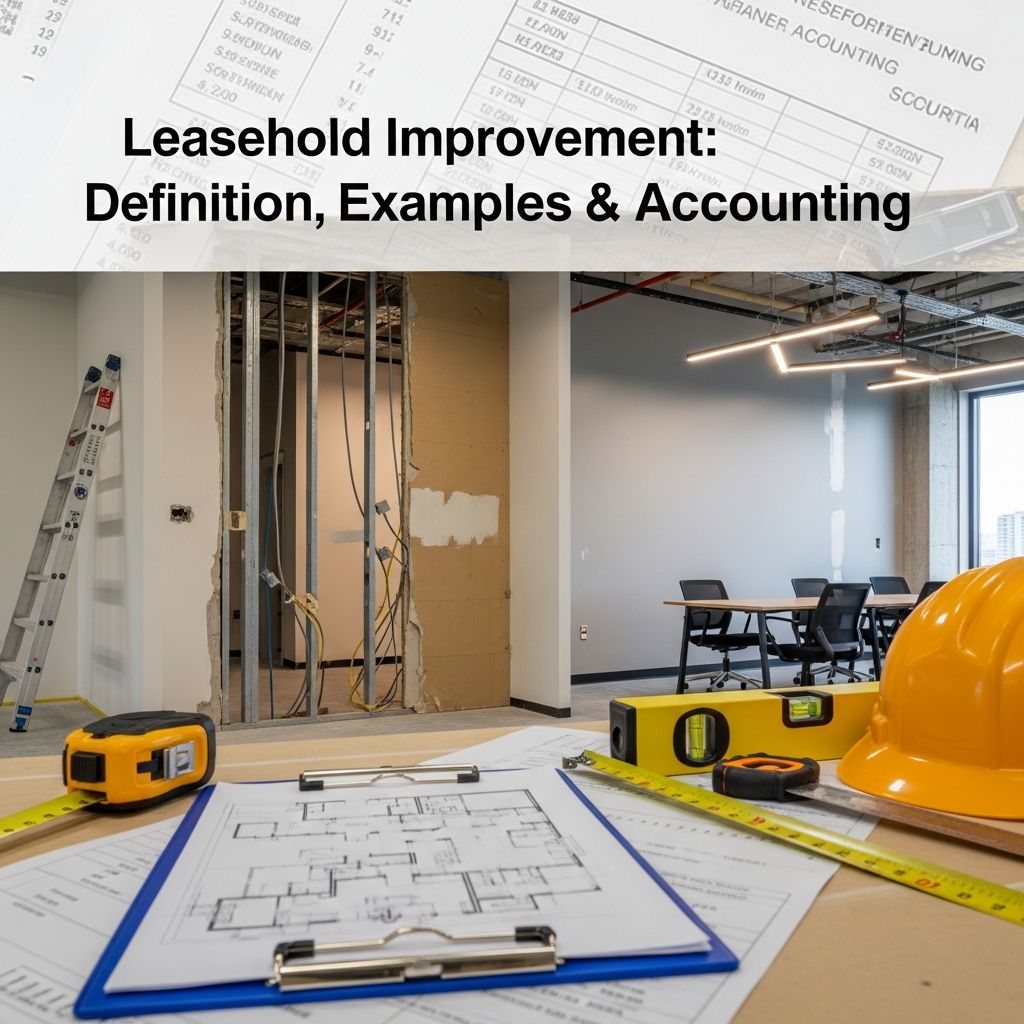
Leasehold Improvement: Definition, Examples & Accounting
Complete guide to leasehold improvements, accounting treatment, and tax implications for tenants and landlords.
Understanding Leasehold Improvements
A leasehold improvement is a customization or alteration made to rental property by a tenant to suit their specific business or operational needs. These improvements represent physical changes to a leased space that enhance its functionality, aesthetics, or suitability for the tenant’s purposes. Unlike moveable assets or personal property, leasehold improvements are permanently affixed to the property and cannot be removed without causing significant damage or reducing the property’s value.
Leasehold improvements are distinct from regular maintenance or repairs related to ordinary wear and tear. They represent substantial investments by tenants to transform a generic rental space into a customized environment tailored to their unique requirements. Understanding leasehold improvements is essential for both tenants and landlords, as they have significant accounting, tax, and financial implications.
Key Characteristics of Leasehold Improvements
Leasehold improvements possess several defining characteristics that distinguish them from other types of property modifications:
Permanently Affixed to Property: Improvements must be permanently attached to the leased premises. If an asset can be removed without damaging the property, it is not considered a leasehold improvement. This permanence is crucial for accounting and classification purposes.
Owned by Tenant During Lease Term: Although the improvements become part of the property, the tenant maintains asset ownership for accounting and depreciation purposes during the lease period. This allows tenants to capitalize and amortize the costs.
Revert to Lessor at Lease Termination: Upon expiration or termination of the lease agreement, all leasehold improvements automatically revert to the landlord. The tenant loses all rights to the improvements and cannot remove or retain them unless the lease agreement explicitly states otherwise.
Cannot Be Removed Without Damage: Leasehold improvements typically cannot be removed without causing substantial damage to the premises or significantly reducing the property’s value, making them effectively permanent.
Enhance Functionality and Aesthetics: These improvements are generally designed to increase the property’s functionality, attractiveness, or suitability for the tenant’s specific business operations.
Common Examples of Leasehold Improvements
Leasehold improvements are diverse and vary based on the type of commercial space and tenant requirements. Here are the most prevalent examples:
Structural and Interior Modifications: Interior walls, partitions (drywall, glass, or metal), ceiling work (acoustic, drywall, or plaster), and floor finishing (carpeting, vinyl, or tile) are among the most common improvements.
Electrical and Lighting: Installation of lighting fixtures, wiring, and electrical systems to meet the tenant’s operational needs falls under qualified leasehold improvements.
Plumbing and Restrooms: Addition of plumbing systems, restroom fixtures, and accessories represent significant improvements, particularly in office and retail spaces.
Built-In Features: Custom cabinetry, countertops, shelving units, and other built-in fixtures designed for the tenant’s specific use are classified as leasehold improvements.
Security and Access Systems: Installation of security equipment, access control systems, and surveillance infrastructure qualifies as improvements if permanently affixed.
Display and Storage Solutions: Display shelves, storage systems, and organizational fixtures designed for retail or warehouse operations constitute leasehold improvements.
HVAC and Climate Control: Modifications to heating, ventilation, and air conditioning systems to suit the tenant’s environmental requirements are considered improvements.
Accounting Treatment of Leasehold Improvements
Proper accounting treatment of leasehold improvements is essential for accurate financial reporting and tax compliance.
Capitalization: Once leasehold improvements are confirmed and the cost exceeds the tenant’s capitalization threshold, the total expense is recognized as a long-term asset on the balance sheet. The capitalized cost includes construction costs, architectural and design fees, permit fees, and other direct project expenses.
Asset Classification: Leasehold improvements are recorded as fixed assets or tangible property on the tenant’s balance sheet. This classification reflects their permanent nature and long-term utility to the business.
Depreciation and Amortization: Rather than expensed immediately, capitalized leasehold improvement costs are depreciated or amortized over the shorter of two periods: the estimated useful life of the improvement or the remaining lease term.
Depreciation and Amortization Rules
Shorter of Two Periods: The fundamental rule for depreciating leasehold improvements requires using the shorter timeframe between the improvement’s estimated useful life and the remaining lease term. This approach recognizes that the tenant loses the improvement when the lease expires.
Zero Salvage Value: Unlike other fixed assets, leasehold improvements are assumed to have zero salvage value. This reflects the reality that ownership reverts to the lessor upon lease termination, providing no residual value to the tenant.
Lease Renewal Considerations: If the lease contains a renewal option and the probability of renewal is reasonably assured, the depreciation period may extend to cover the adjusted lease term, including anticipated renewals, provided the total period does not exceed the useful life assumption.
No Residual Value: Because improvements revert to the lessor, the entire capitalized cost is amortized with no consideration for residual or salvage value recovery by the tenant.
Practical Example of Leasehold Improvement Depreciation
Consider a tenant who invests in leasehold improvements immediately upon occupying an office space under a ten-year lease agreement. The qualified improvements cost $200,000, and the estimated useful life is 40 years.
The calculation would be:
Amortization Expense = $200,000 ÷ 10 Years = $20,000 per year
Since the lease term (10 years) is shorter than the useful life (40 years), the tenant amortizes the improvement over the 10-year lease period. Each year, the tenant recognizes $20,000 in amortization expense, gradually writing off the asset’s cost over the lease duration.
Impact on Property Value and Rental Rates
Leasehold improvements significantly affect property valuation and future rental income potential:
Enhanced Property Value: Approved leasehold improvements increase the property’s value and marketability, directly benefiting landlords by enabling higher future rental rates.
Increased Marketability: A customized property with functional improvements becomes more attractive to current and prospective tenants, expanding the landlord’s potential tenant pool.
Tenant Retention: Quality leasehold improvements increase the likelihood of tenant renewals, even if rental rates increase. The customized space creates strong incentives for tenants to extend their leases rather than relocate.
Pricing Power: Properties with existing improvements demonstrate increased pricing power, allowing landlords to command premium rental rates for subsequent tenants.
Tax Implications and Qualified Improvement Property
Leasehold improvements receive special tax treatment under certain circumstances:
Qualified Improvement Property (QIP): Many leasehold improvements qualify as Qualified Improvement Property under U.S. tax law, enabling favorable tax treatment.
Recovery Period: QIP generally receives a 15-year recovery period for depreciation purposes, making it eligible for accelerated tax deductions.
Bonus Depreciation Eligibility: Qualified leasehold improvements may be eligible for 100% bonus depreciation when applicable, allowing tenants to deduct the entire improvement cost in the year incurred.
Nonresidential Real Property: To qualify for preferential tax treatment, improvements must be made to the interior of nonresidential real property after it is first placed in service.
Distinguishing Leasehold Improvements from Other Expenses
| Item Type | Treatment | Examples |
|---|---|---|
| Leasehold Improvements | Capitalized and amortized over lease term or useful life | Partitions, flooring, lighting, plumbing |
| Routine Maintenance | Expensed immediately | Painting, cleaning, minor repairs |
| Repairs and Maintenance | Expensed in period incurred | Fixing damaged walls, replacing fixtures |
| Moveable Assets | Capitalized separately, not leasehold improvements | Furniture, equipment, appliances |
| Improvements in Lieu of Rent | Expensed in period incurred | Landlord-funded improvements |
Who Pays for Leasehold Improvements
Tenant-Funded Improvements: In most cases, tenants bear the cost of leasehold improvements to customize the space for their specific needs. These costs are capitalized on the tenant’s balance sheet.
Landlord-Funded Improvements: Landlords may sometimes pay for improvements to attract or retain quality tenants. When landlords fund improvements, they are expensed as operating expenses or capitalized on the landlord’s books.
Negotiated Arrangements: Some lease agreements specify that landlords will provide improvement allowances or tenant improvement (TI) funds to offset the tenant’s improvement costs, particularly in competitive commercial real estate markets.
Qualified Leasehold Improvements
Not all improvements to leased properties qualify for favorable accounting and tax treatment. Qualified leasehold improvements generally have specific characteristics:
Interior Improvements Only: Qualified improvements are restricted to the interior of the property. Exterior modifications, structural changes, or roof replacements typically do not qualify.
Nonresidential Real Property: The property must be nonresidential (commercial, industrial, or retail rather than residential).
After Initial Placement in Service: Improvements must be made after the property is first placed in service, not as part of the original construction.
Examples of Qualified Improvements: Interior walls, floor finishing, ceiling work, lighting fixtures, restrooms and plumbing, and carpentry modifications qualify. However, ordinary wear-and-tear repairs do not qualify as improvements.
Frequently Asked Questions
Q: Do leasehold improvements revert to the landlord at lease termination?
A: Yes, unless the lease agreement explicitly provides otherwise, all leasehold improvements automatically become the property of the landlord upon lease expiration or termination. The tenant has no claim to the improvements after the lease ends.
Q: Can leasehold improvements be removed by the tenant?
A: Leasehold improvements cannot be removed without causing substantial damage to the property or significantly reducing its value. By definition, they are permanently affixed to the premises. Removeable items like furniture or equipment do not qualify as leasehold improvements.
Q: What is the appropriate depreciation period for leasehold improvements?
A: Leasehold improvements are depreciated over the shorter of two periods: the remaining lease term or the estimated useful life of the improvement. This ensures the asset is fully amortized by the time the lease terminates.
Q: Are leasehold improvements eligible for bonus depreciation?
A: Yes, many leasehold improvements qualify as Qualified Improvement Property (QIP) and may be eligible for bonus depreciation. Under current U.S. tax rules, qualified improvements may receive 100% bonus depreciation when specific criteria are met.
Q: What is the difference between leasehold improvements and capital repairs?
A: Leasehold improvements are permanent modifications that enhance the property’s functionality or aesthetics for the tenant’s specific needs. Capital repairs address existing damage or wear and tear. Routine repairs are expensed immediately, while significant improvements are capitalized.
Q: Can a landlord pay for leasehold improvements?
A: Yes, landlords sometimes fund leasehold improvements to attract or retain desirable tenants. When landlords pay for improvements, the cost is typically expensed or capitalized on the landlord’s financial statements, not the tenant’s.
Q: How do lease renewal options affect depreciation of improvements?
A: If a lease includes a renewal option and the probability of renewal is reasonably assured, the depreciation period may extend to cover the anticipated renewal term, provided it does not exceed the improvement’s estimated useful life.
References
- Leasehold Improvements: Definition + Examples — Wall Street Prep. 2024. https://www.wallstreetprep.com/knowledge/leasehold-improvements/
- Leasehold Improvement Definition — Becker Professional Education. 2024. https://www.becker.com/accounting-terms/leasehold-improvement
- Leasehold Improvement Definition — AccountingTools. 2024. https://www.accountingtools.com/articles/leasehold-improvement
- Capital Asset Categories: Leasehold Improvements — Texas Comptroller of Public Accounts. 2024. https://fmx.cpa.texas.gov/fmx/pubs/afrrptreq/cap_assets/index.php?section=categories&page=leasehold
- Leasehold Improvements — University of Michigan Finance Office. 2024. https://finance.umich.edu/finops/accounting/construction/leaseholdimprovements
Similar Articles








Read full bio of medha deb