Law of Diminishing Marginal Returns: Definition & Examples
Understand how additional inputs eventually lead to decreased output in production.

Law of Diminishing Marginal Returns: Definition and Explanation
The law of diminishing marginal returns is a fundamental principle in economics that describes what happens when additional units of a variable input are added to a production process while keeping other factors constant. Specifically, this economic law states that at some point, adding one more unit of input will result in a smaller increase in output than the previous unit, and eventually may lead to a decrease in total output. This principle is also referred to as the law of diminishing returns, the law of increasing costs, or the principle of diminishing marginal productivity.
Understanding this concept is essential for business managers, economists, and policymakers because it helps explain why production efficiency cannot increase indefinitely and why costs eventually rise as production expands. The law has practical implications across various industries, from agriculture and manufacturing to services and marketing.
Understanding the Core Concept
At its most basic level, the law of diminishing marginal returns reveals a fundamental truth about production: the additional output generated by each new unit of input decreases as more of that input is added. Imagine a small café with limited kitchen space. Hiring the first employee dramatically increases output because tasks are distributed and efficiency improves. The second employee also adds significant value. However, as more employees are hired, they begin to get in each other’s way, and the additional output from each new hire becomes smaller and smaller.
This principle applies universally across different types of production and industries. Whether in agriculture, manufacturing, technology, or services, the law of diminishing marginal returns eventually takes hold. The key requirement for this law to apply is that at least one factor of production must remain fixed while the variable factor increases. In the short run, this condition almost always exists in real-world production scenarios.
Key Assumptions for the Law to Apply
For the law of diminishing marginal returns to be valid, several important assumptions must be met:
Constant Technology: The technology used in the production process must remain unchanged. If technological improvements are introduced, they would alter both marginal and average costs, which would violate the conditions necessary for the law to apply. Technology acts as a multiplier that can shift the entire production curve.
Fixed Other Inputs: Only one input variable can change; all other factors of production must remain constant. This assumption is crucial because if multiple inputs vary simultaneously, it becomes impossible to isolate the effect of the single variable input on output. Economists call this the ceteris paribus assumption, meaning “all else being equal.”
Short-Term Analysis: The law operates within a short-term timeframe when at least one production factor is truly fixed. In the long run, even factors considered fixed in the short term can become variable, potentially altering the dynamics.
The Three Stages of Production
The law of diminishing marginal returns is best understood through its three distinct stages of production, each characterized by different patterns of output and efficiency:
Stage 1: Increasing Returns
In the initial stage of production, adding more units of the variable input (such as labor) results in increasing marginal returns. This occurs because the fixed inputs are underutilized relative to the variable input. When a factory has expensive equipment sitting idle, hiring the first few workers allows those machines to be used more efficiently. Each additional worker significantly increases total output because they help the fixed capital work at higher capacity. This stage is characterized by increasing marginal product, where each new worker produces more output than the previous worker.
Stage 2: Diminishing Returns
As more units of the variable input are added, the production process enters stage two, where diminishing returns begin to appear. Total output continues to increase, but at a progressively slower rate. The marginal product of each additional unit of input begins to decline. Eventually, the marginal product reaches its peak and then starts decreasing. This is where the law of diminishing marginal returns truly manifests itself. Optimum production typically occurs somewhere within this stage, representing the point where the marginal product is still positive but beginning to decline. Adding more variable inputs beyond this optimal point leads to inefficiency.
Stage 3: Negative Returns
If production continues beyond the optimal point, the process may enter a third stage where total output actually decreases as more inputs are added. The marginal product becomes negative, meaning each additional unit of input reduces total output. While this stage is rarely intentional in business operations, it illustrates the extreme consequences of violating the principles of efficient production allocation.
Practical Real-World Examples
Manufacturing and Factory Operations
Consider a factory that operates a machine requiring two employees for basic operation and is capable of running 24 hours daily. Initially, the company hires four employees: two work the first shift and two work the second shift, meaning the machine operates 16 hours per day. When the company hires two more employees to work a third shift, the machine now operates all 24 hours, fully utilizing its capacity and significantly increasing returns. However, hiring additional employees beyond this point produces no further increases in output because the machine has reached its maximum capacity. Any additional workers only create congestion and inefficiency, demonstrating the law of diminishing marginal returns.
Service Industry Application
An auto repair shop provides another clear example. With two technicians each capable of servicing 25 vehicles per day, the shop completes 50 oil changes daily. Adding a third technician increases total output to 75 oil changes per day—a gain of 25 services. However, adding a fourth technician increases output only to 90 oil changes per day—a gain of just 15 services. This slower increase reflects diminishing returns caused by limited workspace, insufficient equipment, or lack of customer demand. The marginal product of the fourth technician is lower than that of the third technician, clearly demonstrating the principle at work.
Agricultural Production
Agriculture provides perhaps the most intuitive illustration of diminishing returns. A farmer with a fixed plot of land can increase crop yields by adding more fertilizer. Initially, small amounts of fertilizer significantly boost production. However, continuously adding more fertilizer eventually leads to diminishing increases in output. Beyond a certain point, excess fertilizer may actually damage crops or create environmental runoff, reducing rather than increasing yields. This example clearly demonstrates how marginal returns diminish and eventually become negative.
Education and Study Time
Even academic learning demonstrates this principle. A student studying for an exam sees dramatic score improvements with the first few hours of study. However, studying late into the night produces progressively smaller score improvements, and excessive sleep deprivation may actually harm performance. The marginal benefit of each additional study hour declines as fatigue accumulates.
The Relationship Between Marginal Product and Marginal Cost
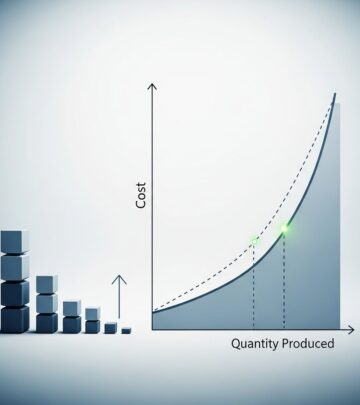
The law of diminishing marginal returns has a direct inverse relationship with marginal cost. As the marginal product of an input decreases, the marginal cost of production increases. To illustrate this relationship, consider a factory where each worker costs $20 per day. If the first worker produces 2 units, the marginal cost per unit is $10 (20 divided by 2). If the fifth worker produces 10 units, the marginal cost per unit is only $2 (20 divided by 10). However, after the fifth worker, if the sixth worker produces only 8 units due to diminishing returns, the marginal cost rises to $2.50 per unit ($20 divided by 8). This inverse relationship means that businesses must balance the desire to increase production with the rising costs that inevitably accompany diminishing returns.
Why This Law Matters for Business Decisions
Understanding the law of diminishing marginal returns is crucial for making optimal production and resource allocation decisions. Businesses must identify the point of optimal production—where marginal revenue equals marginal cost—to maximize profitability. Operating beyond this point increases costs without proportional increases in revenue. Managers who grasp this principle can better allocate resources, avoid wasteful spending on excessive inputs, and maintain competitive efficiency.
The law also explains why simply hiring more workers, purchasing additional equipment, or increasing marketing spending does not necessarily lead to proportional increases in profit. Each strategic input has an optimal level, and exceeding that level creates inefficiency and rising costs.
Distinguishing from Long-Run Economies and Diseconomies of Scale
It is important to distinguish between diminishing marginal returns and diseconomies of scale. Diminishing marginal returns is a short-run phenomenon that occurs when at least one factor of production is fixed. Diseconomies of scale, by contrast, occur in the long run when all factors of production can be varied. In the long run, a company might overcome diminishing returns by investing in new technology or expanding facilities, thereby shifting the entire production function. However, if the company continues expanding beyond an optimal size, it may encounter diseconomies of scale, where coordination problems, management inefficiencies, and communication breakdowns lead to rising average costs despite higher output.
Applications in Modern Business and Marketing
The law of diminishing marginal returns applies beyond just manufacturing. In marketing, increased advertising spending eventually produces smaller incremental returns as audience saturation is reached. In software development, adding more programmers to a project doesn’t always reduce completion time proportionally due to communication overhead and coordination complexity. Companies must recognize these limitations and allocate resources strategically rather than assuming that “more is always better.”
Frequently Asked Questions
Q: Is the law of diminishing marginal returns permanent?
A: No, the law applies in the short run when at least one production factor is fixed. In the long run, companies can introduce new technology or expand facilities to shift the production curve and overcome short-run diminishing returns. However, they may eventually encounter long-run diseconomies of scale.
Q: At what point do diminishing returns begin?
A: This varies by industry and specific production process. It depends on the ratio of fixed to variable inputs, the efficiency of the variable input, and other operational factors. Managers must analyze their specific operations to determine the optimal production level.
Q: Can diminishing returns be avoided?
A: Not entirely in the short run, but companies can delay them through better management, technology improvements, or expanding fixed capital. Understanding where diminishing returns begin allows companies to optimize production before inefficiency sets in.
Q: How does this law affect pricing strategies?
A: Understanding diminishing returns helps companies set optimal production volumes and pricing. Operating at the point where marginal revenue equals marginal cost maximizes profit, accounting for the rising costs from diminishing returns.
Q: Does this law apply to all industries?
A: Yes, the law of diminishing marginal returns is a universal economic principle that applies across all industries and production types whenever one input is varied while others remain fixed.
References
- The Law of Diminishing Marginal Returns Definition — Indeed.com. Accessed 2025. https://www.indeed.com/career-advice/career-development/law-of-diminishing-marginal-returns
- The Law of Diminishing Marginal Returns — Economics Help. Accessed 2025. https://www.economicshelp.org/microessays/costs/diminishing-returns/
- Diminishing Returns — OECD Statistics. Accessed 2025. https://stats.oecd.org/
- Law of Diminishing Returns: AP Economics Review — Albert.io. Accessed 2025. https://www.albert.io/blog/law-diminishing-returns-ap-economics-review/
- Principles of Economics — U.S. Bureau of Labor Statistics. Accessed 2025. https://www.bls.gov/
Similar Articles








Read full bio of Sneha Tete