Laffer Curve: Tax Rates and Government Revenue
Understanding how tax rates affect government revenue collection and economic growth.
Understanding the Laffer Curve
The Laffer Curve is a theoretical economic model that illustrates the relationship between rates of taxation and the resulting levels of government tax revenue. Named after economist Arthur Laffer, who popularized the concept in the 1970s, the curve represents one of the most debated ideas in modern fiscal policy and supply-side economics. The fundamental premise of the Laffer Curve is that there exists an optimal tax rate that maximizes government revenue, and that raising tax rates beyond this point can paradoxically lead to lower total tax revenue.
The curve provides a visual representation of how government revenue changes in response to different tax rates. Unlike traditional economic thinking that assumes higher tax rates automatically generate more revenue, the Laffer Curve suggests a more nuanced relationship where excessive taxation can discourage economic activity and reduce the tax base.
The Basic Principles of the Laffer Curve
At its core, the Laffer Curve operates on two fundamental economic effects: the arithmetic effect and the economic effect. Understanding these principles is essential to grasp how the curve functions and why it matters in fiscal policy discussions.
The Arithmetic Effect
The arithmetic effect is the straightforward mathematical relationship where tax revenue equals the tax rate multiplied by the tax base. This can be expressed as R = t × B, where R represents revenue, t is the tax rate, and B is the taxable base. At face value, this suggests that increasing the tax rate should proportionally increase revenue. However, this static analysis does not account for behavioral changes in the economy.
The Economic Effect
The economic effect recognizes that tax rates influence not just revenue collection but also the tax base itself. When tax rates increase significantly, taxpayers change their behavior in response. They may reduce work effort, invest less, or seek ways to avoid taxation, thereby shrinking the tax base. At the extreme of a 100% tax rate, the government would collect zero revenue because no one would have an incentive to work or engage in economic activity. Conversely, at a 0% tax rate, the government also collects zero revenue simply because there are no taxes to collect.
How the Laffer Curve Works
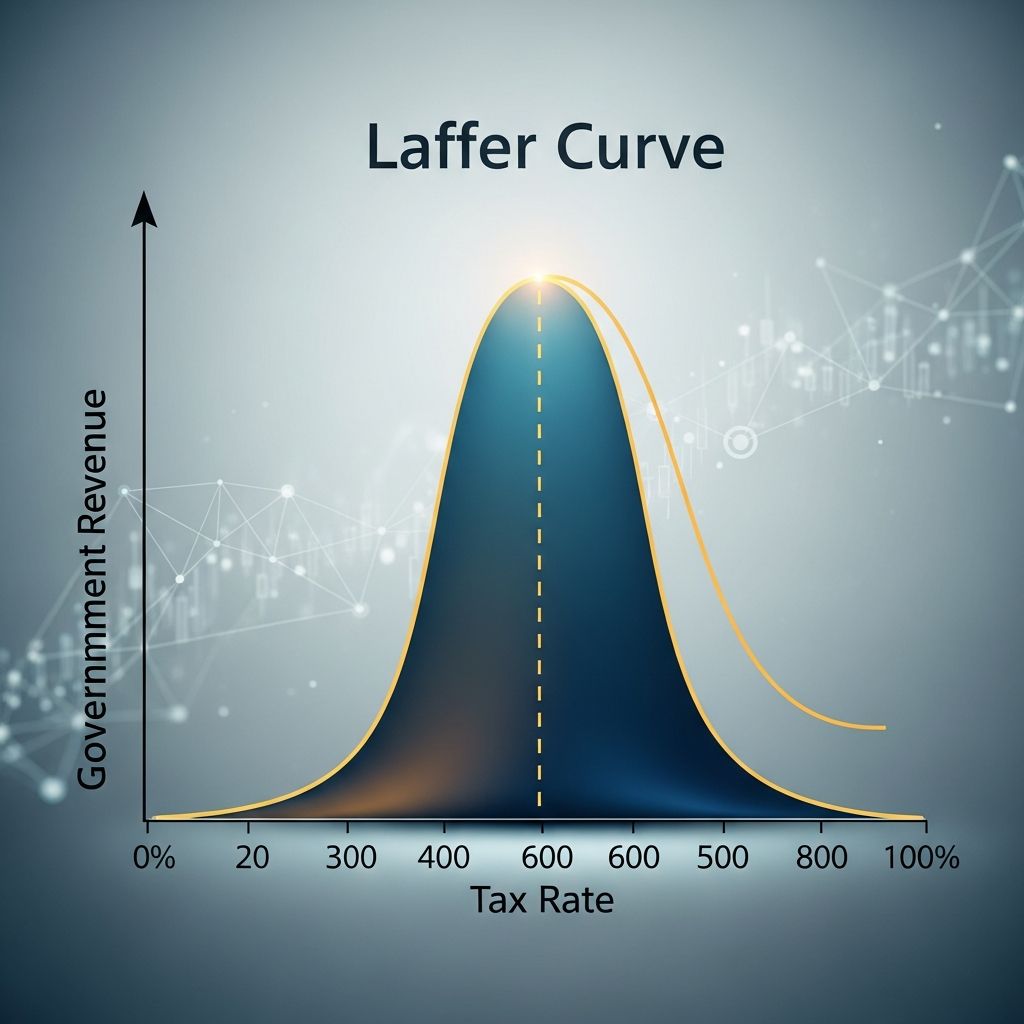
The Laffer Curve is typically represented as a parabolic graph that visualizes the relationship between tax rates and government revenue. The horizontal axis represents the tax rate (from 0% to 100%), while the vertical axis represents government revenue from taxation.
Key Points on the Curve
The curve begins at the origin, where a 0% tax rate produces zero revenue. As the government increases tax rates, revenue also increases. This initial phase represents the typical expectation that higher tax rates generate more revenue. However, the curve reaches an optimal point, often referred to as T*, which represents the tax rate that maximizes government revenue. Beyond this optimal rate, further increases in tax rates result in declining revenue. At a 100% tax rate, revenue returns to zero because there is no incentive for economic activity.
The Revenue-Maximizing Rate
The exact location of the revenue-maximizing rate on the Laffer Curve remains subject to considerable debate among economists. While some representations suggest it occurs around 50%, the actual rate depends on various economic factors including taxable income elasticity, the progressivity of the tax system, and the size of the informal economy. The revenue-maximizing rate could theoretically be any percentage greater than 0% and less than 100%, and the curve itself may not necessarily follow a parabolic shape.
Historical Development and Implementation
Arthur Laffer introduced his concept to policymakers in 1974, during a period when Keynesian economics dominated policy discussions. At that time, most economists advocated for increased government spending to stimulate demand, which required higher tax rates to fund such spending. However, this approach was proving ineffective in addressing economic stagnation. Laffer argued that the problem was not insufficient demand but rather the burden of heavy taxes and regulations that discouraged producers from increasing output.
The 1980s and Supply-Side Economics
The Laffer Curve gained significant prominence during the 1980s when supply-side economists embraced its principles. Supply-siders argued that in high-tax environments, lowering tax rates would result in either increased revenues or smaller revenue losses than static estimates predicted. This theory led advocates to propose substantial reductions in marginal income and capital gains tax rates to encourage greater investment and economic growth. The supply-side dynamic Laffer curve suggests that increased aggregate supply resulting from lower tax rates would eventually increase aggregate demand and overall tax revenues.
The Economic Mechanisms Behind the Curve
Several economic mechanisms explain why tax rates beyond the optimal point become counterproductive for revenue collection.
Reduced Work Incentives
When tax rates are excessive, taxpayers believe their additional efforts result in lower net income. This discourages work effort and productivity. Workers may choose to work fewer hours, retire earlier, or seek informal employment to avoid taxation. Over time, this reduction in labor supply shrinks the overall tax base available for government collection.
Decreased Consumption and Investment
Higher tax rates reduce the disposable income available to consumers and businesses. Lower disposable income leads to reduced consumption expenditure, which decreases aggregate demand in the economy. Simultaneously, higher effective tax rates discourage business investment and capital formation, further reducing economic activity and the tax base.
Tax Avoidance and Evasion
Excessive tax rates incentivize taxpayers to seek legal and illegal methods to reduce their tax burden. This may include moving to lower-tax jurisdictions, restructuring income, or engaging in outright tax evasion. All these activities effectively reduce the taxable base and government revenue.
Unemployment and Lower Growth
As aggregate demand falls due to reduced consumption and investment, producers create fewer goods and services. This contraction leads to higher unemployment and slower economic growth, further diminishing the tax base and government revenue collection.
Criticisms and Limitations of the Laffer Curve
Despite its influential position in economic policy debates, the Laffer Curve faces significant criticism from economists and policymakers.
Empirical Evidence Challenges
One fundamental criticism is that the revenue-maximizing tax rate cannot be observed directly and can only be estimated. Such estimates are often controversial and vary widely depending on the methodologies and assumptions employed. Empirical research has produced mixed results regarding the actual location of this optimal rate, with substantial disagreement among scholars about whether it lies at 30%, 50%, 70%, or some other percentage.
Context-Dependent Nature
The shape and position of the Laffer Curve depend on numerous factors including the strength of supply-side effects, the progressivity of the tax system, economic structure, and the size of the informal economy. Different countries and different time periods may have fundamentally different Laffer Curves, making it difficult to apply universal conclusions from the theory.
Distinguishing Revenue-Maximizing from Optimal Rates
Economists caution against confusing the revenue-maximizing tax rate with the optimal tax rate. The optimal tax rate is one that raises a given amount of revenue with the fewest distortions to the economy, which is a distinct concept from simply maximizing total revenue. A government might deliberately choose a tax rate below the revenue-maximizing point to encourage more economic activity and growth.
Limitations of Static Analysis
The simplified static Laffer Curve assumes a linear relationship between tax base changes and tax rate changes. However, real economic relationships are often more complex and nonlinear. The dynamic effects of tax changes unfold over time and depend on numerous other policy variables and economic conditions.
Practical Applications in Modern Fiscal Policy
Modern policymakers and economists use the Laffer Curve as one tool among many for analyzing tax policy impacts, though with appropriate caveats about its limitations.
Tax Policy Analysis
Governments can use Laffer Curve analysis to estimate whether current tax rates are below or above the revenue-maximizing point. If rates appear to be above this point, tax reduction might increase revenue without requiring compensating spending cuts or increased borrowing. Conversely, if rates are below the optimal point, increases in tax rates would increase revenue.
Supply-Side Policy Advocacy
Supply-side economists continue to reference the Laffer Curve when advocating for lower marginal tax rates on high earners and capital gains. They argue that such reductions would stimulate investment, increase productivity, and ultimately increase tax revenues through economic growth.
Revenue Projections
Tax authorities use Laffer Curve concepts to project revenue impacts of proposed tax changes. Rather than simple mechanical calculations, modern revenue estimates attempt to account for behavioral responses to tax rate changes, informed by empirical studies of tax elasticity.
Important Nuances and Clarifications
Arthur Laffer himself has emphasized that the curve should be understood as a pedagogical device rather than a precise predictive tool. In 2007, Laffer stated that the curve should not be the sole basis for raising or lowering taxes. The concept is most useful for illustrating the principle that tax policy affects economic behavior and that optimal tax rates exist, rather than for determining exact tax rates.
Additionally, economists note that even at very high tax rates, economic activity may not cease entirely but might shift from formal monetary exchange to barter systems. In extreme circumstances such as wartime economies, economic activity can continue at near 100% taxation rates through different organizational structures.
Comparison: Static vs. Dynamic Laffer Curves
| Aspect | Static Laffer Curve | Dynamic Laffer Curve |
|---|---|---|
| Time Frame | Short-term analysis | Long-term effects |
| Tax Base Assumption | Tax base remains relatively fixed | Tax base adjusts to behavioral changes |
| Economic Growth Effects | Minimal consideration | Accounts for growth from lower taxes |
| Revenue Impact | Tax reduction reduces revenue | Tax reduction may increase total revenue |
| Policy Application | Conservative estimates | Optimistic about tax cuts |
Frequently Asked Questions
Q: Does the Laffer Curve prove that lower taxes always increase revenue?
A: No. The Laffer Curve only suggests that if current tax rates are above the revenue-maximizing point, tax rate reductions could increase revenue. Whether this is actually the case depends on empirical analysis of where the current rate falls on the curve.
Q: What is the actual revenue-maximizing tax rate?
A: The revenue-maximizing tax rate varies by country, time period, and economic conditions. It cannot be directly observed but must be estimated, and estimates typically range widely depending on methodology and assumptions.
Q: Is the Laffer Curve accepted by mainstream economists?
A: The Laffer Curve is recognized as an important theoretical concept, but economists debate its practical applicability and the empirical validity of its predictions. It remains one tool among many for fiscal policy analysis.
Q: How does the Laffer Curve relate to economic inequality?
A: The Laffer Curve analysis typically focuses on revenue maximization rather than income distribution. Progressive tax systems may have different optimal rates than flat systems, and the curve does not address distributional concerns directly.
Q: Can the Laffer Curve be applied to specific taxes rather than overall tax rates?
A: Yes, Laffer Curve principles can be applied to individual taxes such as capital gains taxes, corporate income taxes, or excise taxes. Each specific tax may have its own revenue-maximizing rate.
References
- Laffer Curve — Wikipedia. Accessed November 2025. https://en.wikipedia.org/wiki/Laffer_curve
- Definition, History, Laffer Curve — Corporate Finance Institute. Accessed November 2025. https://corporatefinanceinstitute.com/resources/economics/laffer-curve/
Similar Articles








Read full bio of medha deb