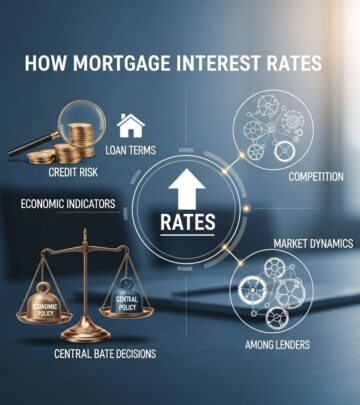
Key Factors Shaping Your Loan Interest Rates
Discover the critical elements lenders evaluate to set your interest rates and learn strategies to secure more favorable borrowing terms.

Lenders determine interest rates through risk-based pricing, where your financial profile dictates the cost of borrowing. A strong profile signals low risk, leading to lower rates, while weaker elements prompt higher charges to offset potential losses.
Understanding Risk-Based Pricing in Lending
At its core, lending involves balancing profit with protection against defaults. Lenders analyze data to predict repayment likelihood, adjusting rates accordingly. Borrowers deemed reliable receive preferential terms, as their history suggests timely payments and minimal issues. Conversely, higher-risk profiles face elevated rates to cover statistical default probabilities.
This system ensures lenders maintain viability while rewarding responsible behavior. For instance, on a typical mortgage, even small rate differences compound significantly over decades.
The Dominant Role of Credit Scores
Your credit score serves as the primary gateway for rate decisions, ranging from 300 to 850 on FICO models. Scores above 740 often unlock the best rates, reflecting consistent positive financial habits.
- Exceptional (800-850): Lowest rates, highest approval odds.
- Very Good (740-799): Competitive terms with minimal premiums.
- Good (670-739): Solid access but slightly higher costs.
- Fair (580-669): Limited options, elevated rates.
- Poor (300-579): High rates or denials common.
Higher scores correlate directly with reduced rates because they indicate low default risk. Data shows borrowers with 760+ scores save thousands on mortgages compared to those at 650.
Payment History: The Foundation of Trust
Payment history weighs heaviest in scoring models, comprising about 35% of your FICO score. On-time payments build lender confidence, while delinquencies signal unreliability. Late payments, collections, or bankruptcies linger for years, inflating future rates.
Even one missed payment can drop your score enough to raise rates by 0.5% or more on home loans. Consistent punctuality, however, steadily lowers borrowing costs over time.
Debt Levels and Utilization Ratios
Amounts owed represent 30% of your score. High credit card balances relative to limits (utilization over 30%) suggest overextension, prompting lenders to hike rates.
Maintaining low utilization demonstrates control, qualifying you for better terms. For mortgages, total debt-to-income (DTI) ratios under 36% are ideal; exceeding 43% often leads to denials or penalties.
Length and Mix of Credit Accounts
Credit history length (15% of score) favors established profiles. New users face higher scrutiny and rates due to unproven track records. A diverse mix of credit types (mortgages, autos, cards) shows versatility, positively influencing scores if managed well.
Recent inquiries (10% of score) from multiple applications can temporarily ding scores, signaling desperation. Space out applications to preserve scoring.
Income Stability and Employment
Beyond scores, lenders verify income via pay stubs and tax returns. Steady employment and verifiable earnings reassure repayment capacity. Self-employed borrowers may need extra documentation, potentially facing higher rates without strong history.
DTI calculations integrate income against debts. Lenders prefer ratios below 36%, adjusting rates upward for higher burdens.
Loan-to-Value Ratio and Collateral
For secured loans like mortgages, the loan-to-value (LTV) ratio matters. Lower LTV (larger down payment) reduces lender exposure, yielding better rates. An 80% LTV or less often avoids private mortgage insurance (PMI), further cutting costs[10].
| Credit Score | 30-Year Fixed Rate (Avg.) | Monthly Payment ($300K Loan) | Total Interest (30 Yrs) |
|---|---|---|---|
| 760-850 | 6.44% | $1,925 | $392,892 |
| 700 | 6.63% | $1,950 | $402,000 |
| 640 | 7.02% | $2,015 | $425,400 |
| 620 | 7.14% | $2,040 | $434,400 |
Table illustrates rate impacts on a $300K loan with 20% down; data approximated from recent averages. A 100-point score drop can add over $40K in interest.
Market Conditions and Lender Policies
External factors like Federal Reserve rates influence baselines. Lenders overlay personal risk assessments atop these. Shopping multiple quotes reveals variances; even excellent credit benefits from comparison.
Strategies to Lower Your Rates
Improving your profile pays dividends. Pay bills promptly, reduce debts below 30% utilization, avoid new credit pre-application, and build history patiently.
- Review reports for errors at Equifax, Experian, TransUnion.
- Pay down high-utilization cards first.
- Increase down payments for secured loans.
- Boost income or cut expenses to lower DTI.
- Consider rate buydowns if closing costs allow.
Pre-approval clarifies your standing, often locking competitive rates.
Real-World Rate Impacts Across Loan Types
Mortgages amplify differences: A 0.5% hike on $250K over 30 years adds $40K+ in interest. Auto loans and cards follow suit; prime scores secure 3-4% rates versus 10%+ for subprime.
Personal loans for fair credit might hit 20% APR, versus 7% for excellent profiles. Cumulative savings justify proactive credit management.
FAQs
What credit score gets the best mortgage rates?
Scores of 740+ typically qualify for prime rates, often under 6.5% on conventional loans.
Can I get a good rate with a 700 score?
Yes, 700 is ‘good’ and yields competitive rates, though slightly above exceptional tiers.
How much does a low score raise my rate?
A drop from 760 to 650 can increase mortgage rates by 0.5-1%, adding hundreds monthly.
Do all lenders weigh factors equally?
No, policies vary; some emphasize DTI more, others scores. Compare offers.
How long until improvements affect rates?
Positive changes appear in 1-2 months; full impacts take 3-6 months.
Mastering these factors empowers better borrowing. Proactive steps today yield substantial long-term savings.
References
- The Link Between Credit Score And Interest Rates — Loqbox. 2023. https://www.loqbox.com/en-gb/blog/the-link-between-credit-score-and-interest-rates
- How Does Your Credit Score Affect Your Interest Rate? — Experian. 2024. https://www.experian.com/blogs/ask-experian/why-do-people-with-higher-credit-scores-get-lower-interest-rates/
- Credit Score Will Impact Your Home Loan — Peoples State Bank. 2024. https://www.bankpeoples.com/learn/your-credit-score-will-impact-your-home-loan
- Does credit score affect mortgage rate? — Rocket Mortgage. 2025. https://www.rocketmortgage.com/learn/how-credit-score-affects-mortgage-rate
- Does My Credit Score Impact My Interest Rate? — AAFMAA. 2024. https://www.aafmaa.com/resource-center/does-my-credit-score-impact-my-interest-rate
- How Credit Scores Affect Loan Rates — Fort Bragg FCU. 2024. https://www.fortbraggfcu.org/blog/how-credit-scores-affect-loan-rates
- How Credit Scores Affect Your Mortgage Rate — Bank of America Better Money Habits. 2025. https://bettermoneyhabits.bankofamerica.com/en/home-ownership/how-credit-affects-mortgage-rate
Similar Articles








Read full bio of Sneha Tete