Jumbo Mortgage Rates Today: Current Rates & Trends
Compare current jumbo mortgage rates and find the best loan options for your home purchase or refinance.
Today’s National Jumbo Mortgage Interest Rate Trends
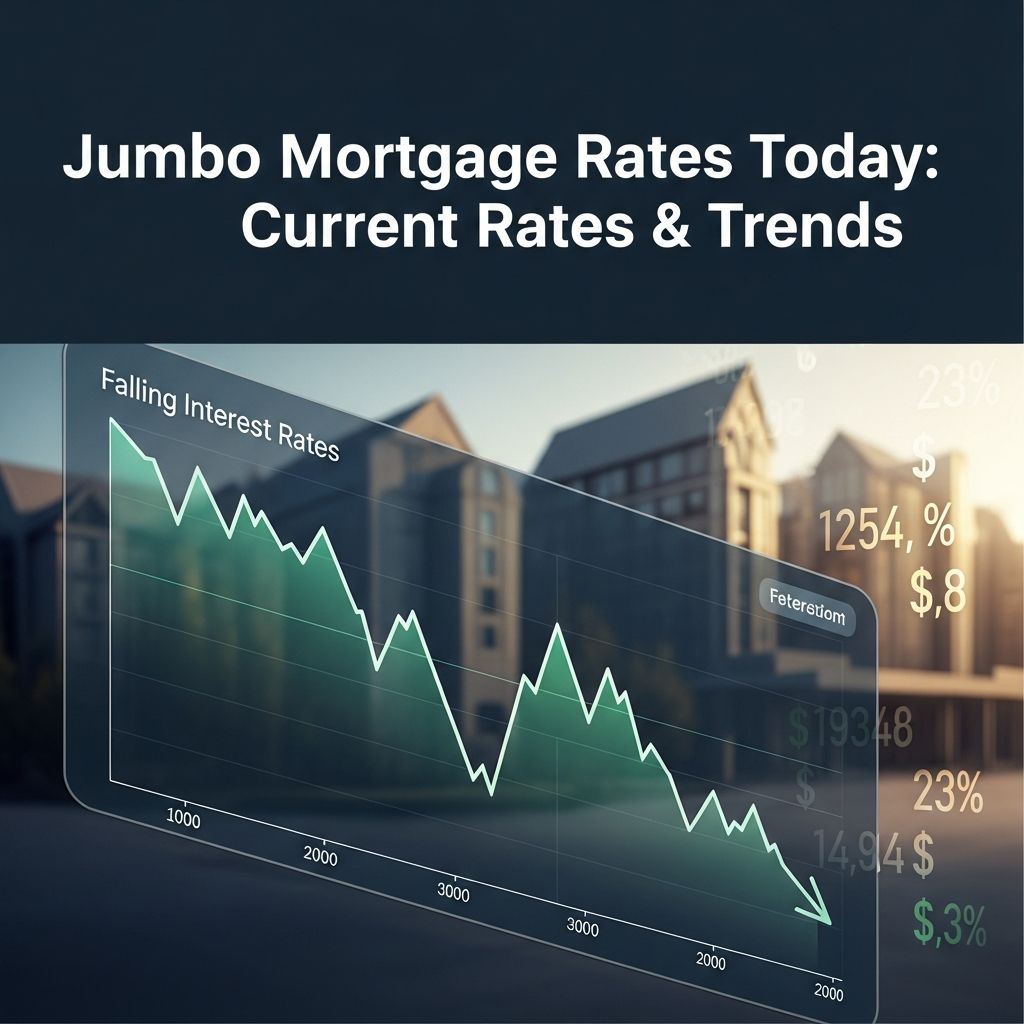
As of Saturday, November 29, 2025, the national average 30-year fixed jumbo mortgage interest rate stands at 6.41%, reflecting a slight decrease from last week’s rate of 6.46%. The national average 30-year fixed jumbo refinance interest rate is 6.55%, down from the previous week’s 6.73%. These rates are calculated from Bankrate’s comprehensive survey of the nation’s largest mortgage lenders, providing borrowers with accurate, up-to-date information to guide their financing decisions.
Mortgage interest rates are inherently volatile and fluctuate based on market conditions, economic indicators, and Federal Reserve policy. Bankrate’s daily rate surveys capture these movements at the close of business, including both annual percentage rates (APRs) and annual percentage yields. Understanding these daily trends helps consumers identify market momentum and make informed decisions about the timing of their mortgage applications or refinancing transactions.
Current Jumbo Mortgage Rates
A jumbo loan is a mortgage for an amount that exceeds the conforming loan limit established for the area where you’re purchasing a home or refinancing your loan. These loans are essential for borrowers seeking financing on higher-value properties or in expensive real estate markets. Jumbo mortgages can be used for primary residences, investment properties, or vacation homes, providing flexibility for various real estate needs.
| Product | Interest Rate | APR |
|---|---|---|
| 30-Year Fixed Rate Jumbo | 6.41% | 6.44% |
| 15-Year Fixed Rate Jumbo | 5.73% | 5.81% |
| 30-Year Fixed Rate | 6.25% | 6.31% |
| 15-Year Fixed Rate | 5.60% | 5.69% |
| 30-Year Fixed Rate FHA | 6.04% | 6.10% |
| 30-Year Fixed Rate VA | 6.23% | 6.28% |
| 3/1 ARM Rate | 5.48% | 6.15% |
| 7/1 ARM Rate | 6.03% | 6.26% |
Rates listed above are as of Saturday, November 29, 2025 at 6:30 AM. These rates represent the national averages calculated from surveys of the nation’s largest mortgage lenders. Individual rates may vary based on creditworthiness, loan amount, down payment, and other qualifying factors.
Understanding Jumbo Loan Limits
Jumbo loan limits vary by location and property type. For 2025, the conforming loan limit in most areas of the United States is $806,500. However, in areas with higher costs of living, this limit increases to $1,209,750. These limits apply specifically to one-unit or single-family properties. Any mortgage exceeding these thresholds is classified as a jumbo loan.
For properties with multiple units, conforming loan limits break down differently:
Two units (duplex): $1,032,650 to $1,548,975
Three units (triplex): $1,248,150 to $1,872,225
Four units: $1,551,250 to $2,326,875
Understanding these limits is crucial for borrowers in high-cost areas or those seeking to purchase multi-unit investment properties. The specific limit applicable to your situation depends on your property type and geographic location.
Jumbo Loan Qualification Requirements
Because jumbo loans are for higher amounts, they generally require stricter qualification standards than traditional conforming loans. Lenders impose these requirements to mitigate risk associated with larger loan amounts. To qualify for a jumbo loan, borrowers typically need to meet the following criteria:
Credit Score: 680 or higher (many lenders prefer 700+)
Debt-to-Income (DTI) Ratio: 45% or lower
Down Payment: 10% to 15% or more
Cash Reserves: Six to 12 months’ worth of mortgage payments in savings
It’s important to note that some lenders maintain stricter requirements than these minimums. Your ability to qualify for favorable rates improves significantly with better credit scores and a stronger overall financial profile. Lenders view borrowers with excellent credit and low debt levels as lower-risk candidates, rewarding them with more competitive interest rates and potentially more flexible loan terms.
Down Payments and Closing Costs
Down payment requirements for jumbo loans are substantially higher than those for conforming mortgages. Most lenders require between 10% and 20% down, though some may demand even larger down payments depending on market conditions and borrower qualifications. For example, on a $1 million jumbo loan, you would need between $100,000 and $200,000 for the down payment alone.
Beyond the down payment, borrowers must maintain significant cash reserves. Lenders typically require reserve funds equal to six to 12 months’ worth of mortgage payments in liquid or easily accessible assets. Using the $1 million loan example with current average rates, borrowers should expect to maintain $40,000 to $80,000 in reserves, in addition to funds needed for closing costs.
Closing costs for jumbo loans generally range from 2% to 6% of the home’s purchase price, which is comparable to conforming loan closing costs. However, the higher purchase price of jumbo loan properties means significantly higher total closing costs. On a $1 million property, closing costs would range from $20,000 to $60,000, compared to $10,000 to $30,000 on a $500,000 property.
Expert Perspectives on Jumbo Loans
Mark Hamrick, Washington Bureau Chief and Senior Economic Analyst at Bankrate, notes that jumbo loans have evolved significantly in recent years. While jumbo loans were historically associated with higher interest rates, their rates now often track closely with those of conforming loans. There is no automatic benefit or penalty associated with staying just below the jumbo threshold. The interest rate you receive depends on your specific loan size, qualifications, and the competitive landscape of available lender offerings.
According to Bankrate’s analysis, credit scores are critical inputs in jumbo lending decisions. Lenders may employ compensating factors such as higher income or significant assets to offset deficiencies in credit scores, a practice that is more common in jumbo lending than in conforming or government-backed loan markets. This flexibility can work to your advantage if you have compensating strengths in other areas of your financial profile.
Advantages of Jumbo Loans
Attractive Interest Rates: Contemporary jumbo rates in the market are competitive with conforming loan rates. Borrowers no longer pay a penalty for taking out a larger loan amount, making jumbo financing a practical option for expensive properties.
Potentially More Flexible Terms: Many lenders retain jumbo loans in their portfolios rather than selling them to secondary market investors. This portfolio retention allows for greater flexibility in loan terms and conditions. Some lenders may agree to lower down payment requirements, such as 10% instead of the typical 20%, or offer other customized terms.
Benefits for Returning Customers: Banks play a significant role in the jumbo loan market and often extend private-banking perks to jumbo borrowers. These benefits may include relationship pricing, expedited processing, and access to specialized mortgage professionals.
Factors Affecting Jumbo Mortgage Rates
Several key factors influence the jumbo mortgage rates you’ll receive. Your credit score and financial profile are paramount considerations. Borrowers with excellent credit scores and low debt-to-income ratios qualify for the best available rates. The amount of home equity you possess also impacts your rate—substantial equity can result in better refinance rates.
Prevailing market conditions significantly influence jumbo rates. When market interest rates increase, jumbo mortgage rates typically follow, resulting in higher borrowing costs. Your geographic location affects rates as well, as regional economic strength varies across the country. Lenders may adjust rates slightly to account for perceived default risk in weaker economies.
The Federal Reserve’s benchmark federal funds rate serves as a foundational influence on all mortgage rates, including jumbo mortgages. Additionally, Fannie Mae and Freddie Mac’s guarantee fees on conforming loans influence the jumbo market, as lenders factor these costs into their pricing strategies.
Jumbo Loans vs. Conforming Loans
Jumbo loans and conforming loans differ significantly in their requirements and characteristics. Conforming loans are mortgages that meet the lending guidelines established by Fannie Mae and Freddie Mac, with loan amounts not exceeding the conforming limit. Jumbo loans exceed these limits and fall outside the secondary mortgage market.
Conforming loans typically require minimum credit scores around 620, with down payments as low as 3% to 5%. Jumbo loans demand minimum credit scores of 700 or higher and down payments of 20% to 25%. Debt-to-income ratios for conforming loans can reach 43% to 50%, while jumbo loans limit DTI to 36% to 43%. Cash reserves for conforming loans typically extend to six months, while jumbo loans require up to 12 months of reserves.
Interest rates on jumbo loans have historically been higher than conforming rates, though this gap has narrowed considerably in recent years. Today, competitive market conditions mean jumbo rates may actually be lower than some conforming loan offers, depending on borrower qualifications and lender competition.
Frequently Asked Questions
Q: What exactly is a jumbo loan?
A jumbo loan is a mortgage that exceeds the conforming loan limit in your geographic area. For 2025, this threshold is $806,500 in most areas, though it reaches $1,209,750 in high-cost regions. Jumbo loans serve borrowers purchasing expensive homes or refinancing high-value properties.
Q: How do jumbo loan rates compare to conventional mortgage rates?
Jumbo loan rates have become increasingly competitive with conventional conforming loan rates. While jumbo rates were historically higher, market conditions have evolved to make them comparable or even lower than some conforming offers, depending on borrower qualifications and current market dynamics.
Q: What credit score do I need for a jumbo loan?
Most lenders require a minimum credit score of 700 for jumbo loans, though some may consider scores as low as 680 if other compensating factors are strong. Excellent credit scores above 750 typically secure the most competitive rates.
Q: How much down payment is required for a jumbo loan?
Down payments for jumbo loans typically range from 10% to 20%, depending on the lender and borrower qualifications. Some borrowers with exceptional financial profiles may qualify with 10% down, while others may need 20% or more.
Q: What debt-to-income ratio is needed for jumbo loan approval?
Lenders generally prefer debt-to-income ratios of 45% or lower for jumbo loans, though this can vary by lender. A lower DTI ratio demonstrates strong debt-management capability and improves your chances of approval at favorable rates.
Q: Can I use a jumbo loan to purchase investment properties?
Yes, jumbo loans can finance primary residences, investment properties, and vacation homes. The flexibility to use jumbo financing across different property types makes these loans valuable for real estate investors and property buyers with diverse needs.
Q: How often do jumbo mortgage rates change?
Jumbo mortgage rates fluctuate daily based on market conditions, economic data, and Federal Reserve policy. Bankrate surveys major lenders daily to capture rate movements, providing borrowers with current information for timing their applications or refinancing decisions.
References
- Compare Current Jumbo Mortgage Rates — Bankrate. 2025-11-29. https://www.bankrate.com/mortgages/jumbo-loan-rates/
- What Is A Jumbo Loan? — Bankrate. 2025. https://www.bankrate.com/mortgages/what-is-jumbo-mortgage/
- Jumbo Loan Limits by State — Bankrate. 2025. https://www.bankrate.com/mortgages/jumbo-loan-limits/
- Jumbo vs. Conventional Loans: What’s The Difference? — Bankrate. 2025. https://www.bankrate.com/mortgages/jumbo-vs-conventional-loans/
- Fannie Mae and Freddie Mac Conforming Loan Limits — Federal Housing Finance Agency. 2025. https://www.fhfa.gov/
Similar Articles








Read full bio of medha deb