Jumbo Loans: DTI, LTV and Qualification Guide
Master the essentials of jumbo loans by understanding debt-to-income ratios, loan-to-value limits, and key qualification criteria for high-value home financing.
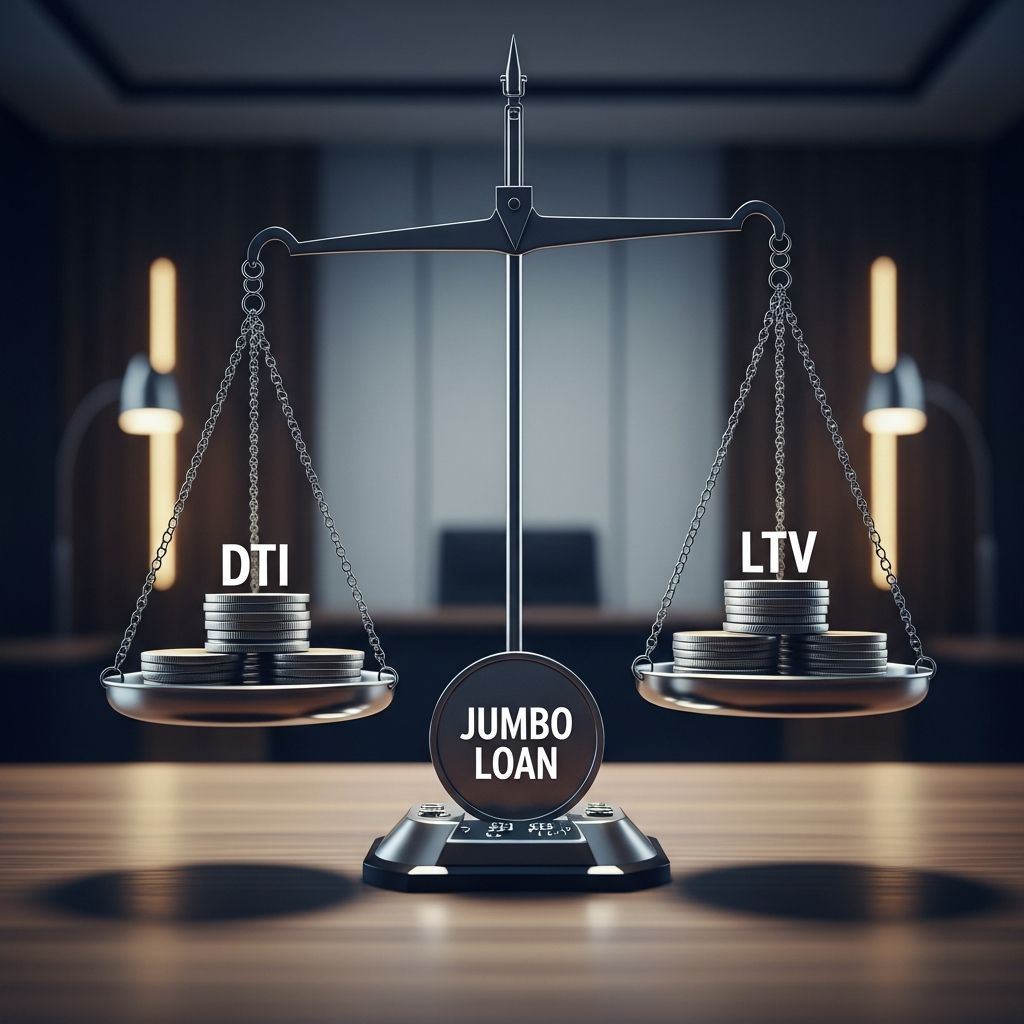
Jumbo loans enable buyers to finance high-value properties exceeding standard conforming loan limits set by the Federal Housing Finance Agency (FHFA). These mortgages surpass the 2026 baseline limit of $832,750 for most single-family homes, demanding stricter financial scrutiny including debt-to-income (DTI) ratios and loan-to-value (LTV) assessments.
Defining Jumbo Mortgages in Today’s Market
A jumbo mortgage finances properties valued beyond FHFA conforming limits, which vary by county but generally start at $832,750 for one-unit homes in standard areas. In high-cost regions, limits can reach higher thresholds, yet loans above these still classify as jumbo. Unlike conforming loans backed by Fannie Mae or Freddie Mac, jumbo loans rely on private lender guidelines, increasing risk and qualification rigor.[10]
These loans suit purchasers of luxury estates, waterfront homes, or urban penthouses where prices outpace conventional financing caps. For 2026, understanding local limits is crucial; tools from FHFA help identify if a property triggers jumbo status.[10]
Core Financial Metrics: DTI and Its Role
The debt-to-income (DTI) ratio measures monthly debt obligations against gross income, expressed as a percentage. Lenders favor jumbo applicants with DTI below 43%, ideally under 36% for optimal terms. This metric ensures borrowers maintain capacity for mortgage payments amid other liabilities like car loans or credit cards.
Calculate DTI by dividing total monthly debts (including proposed mortgage) by pretax income. For instance, $10,000 monthly income with $4,000 debts yields 40% DTI. High earners with controlled debts excel here, as jumbo loans demand proof of sustained affordability.
- Front-end DTI: Housing costs alone (principal, interest, taxes, insurance).
- Back-end DTI: All debts combined.
Lenders scrutinize back-end DTI rigorously, often capping at 43% unlike conforming loans allowing up to 50%.
Loan-to-Value Ratio: Balancing Equity and Risk
Loan-to-value (LTV) ratio compares loan amount to property appraised value, with jumbo lenders preferring 80% or lower to mitigate default risk. An 80% LTV on a $1.2 million home means a $960,000 loan maximum, requiring 20% down.
Lower LTV signals strong borrower equity, reducing lender exposure. Some institutions demand combined loan-to-value (CLTV) under 75% if secondary liens exist. Achieving low LTV demands substantial down payments or assets.
| LTV Range | Typical Requirement | Implication for Borrowers |
|---|---|---|
| ≤80% | Standard for approval | 20%+ down payment |
| 75-80% | Preferred | Better rates possible |
| >80% | Rarely approved | Needs compensating factors |
Credit Profile Demands for Jumbo Approval
Jumbo loans typically require FICO scores of 700+, with many lenders setting 720-740 minima—far above conforming loan thresholds of 620. Exceptional scores (760+) unlock competitive rates despite larger principal balances.
Veterans may access VA jumbo options with scores in the mid-600s, a notable exception. Building credit involves timely payments, low utilization, and diverse accounts. Manual underwriting often verifies histories deeply.
Down Payment and Reserve Mandates
Expect 10-20% down payments on jumbo loans, translating to $100,000-$200,000 on $1 million properties. Reserves covering 6-24 months of payments post-closing prove liquidity, often $40,000-$80,000 extra beyond down payment and costs.
Cash reserves exclude retirement funds unless penalty-free; verifiable liquid assets like savings or stocks qualify. Dual appraisals may verify high-end property values, adding costs.
Navigating Underwriting for Jumbo Loans
Jumbo applications undergo manual underwriting, where experts review finances holistically. Automated systems rarely apply, emphasizing reserves, employment stability, and income verification.
Self-employed borrowers face extra hurdles, needing two-year tax returns. Compensating factors like low DTI offset moderate credit; high reserves balance elevated DTI.
Interest Rates and Cost Comparisons
Historically riskier, jumbo rates now often match or undercut conforming loans due to strong borrower profiles. However, stricter terms persist, with private mortgage insurance rare but possible above 80% LTV.
Tax implications shifted post-2018; interest deductibility caps at $750,000 debt, potentially reducing benefits for jumbos.
Strategic Steps to Secure Jumbo Financing
- Assess Eligibility: Compute DTI, check credit, tally reserves.
- Shop Lenders: Compare rates from banks like Chase, Bank of America.
- Gather Documents: Tax returns, pay stubs, asset statements.
- Get Pre-Approved: Strengthens offers in competitive markets.
- Consider Alternatives: Piggyback loans or asset-based qualification.
Regional Variations and 2026 Limits
FHFA adjusts limits annually; 2026’s $832,750 baseline rises in high-cost areas (e.g., California counties exceed $1.2 million).[10] Verify via FHFA tools for precise county data.
Pros and Cons of Jumbo Mortgages
- Advantages: Access luxury homes, potential rate parity, flexible property types (primary, vacation, investment).
- Disadvantages: Stringent quals, higher upfront cash, manual review delays, limited government backing.
FAQs on Jumbo Loans
What loan amount triggers jumbo status in 2026?
Above $832,750 in most areas, higher in designated high-cost counties per FHFA.[10]
Can I qualify with a 680 credit score?
Rarely; most require 700+, though VA options lower the bar.
What’s the minimum down payment?
Typically 10-20%, lender-dependent.
How much reserves are needed?
6-12+ months of payments, post-down payment.
Are jumbo rates always higher?
Not anymore; often comparable to conforming.
Final Considerations for Buyers
Jumbo loans demand disciplined finances but open doors to premium properties. Prioritize DTI under 43%, LTV at 80%, scores above 700, and ample reserves. Consult lenders early for personalized guidance in evolving 2026 markets.
References
- What Is a Jumbo Loan? — Bankrate. 2023. https://www.bankrate.com/mortgages/what-is-jumbo-mortgage/
- What Are Jumbo Loans? How They Work and Who Qualifies — Ally. 2023. https://www.ally.com/stories/home/what-is-a-jumbo-mortgage/
- Jumbo Loans: What You Need to Know — NerdWallet. 2023. https://www.nerdwallet.com/mortgages/learn/jumbo-loans-what-you-need-to-know
- Jumbo loan limits and requirements for 2026 — Rocket Mortgage. 2026. https://www.rocketmortgage.com/learn/jumbo-loan-limits
- What Is a Jumbo Loan? — Experian. 2023. https://www.experian.com/blogs/ask-experian/what-is-a-jumbo-loan/
- FHFA Conforming Loan Limit Values — FHFA. 2026. https://www.fhfa.gov/data/conforming-loan-limit
Similar Articles








Read full bio of Sneha Tete