John Maynard Keynes: Economist & Economic Theory
Discover how John Maynard Keynes revolutionized economic theory and shaped modern macroeconomics.
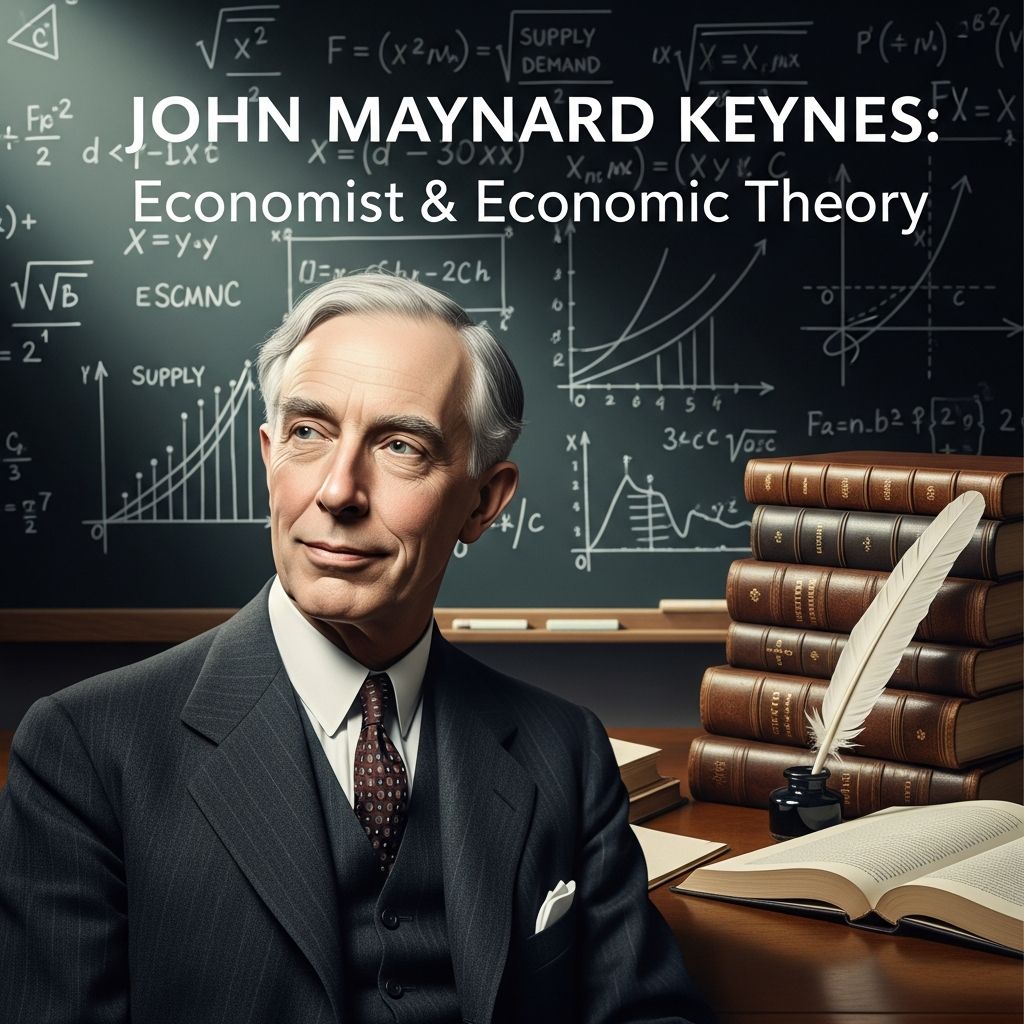
John Maynard Keynes: The Father of Modern Macroeconomics
John Maynard Keynes stands as one of the most influential economists of the twentieth century, fundamentally reshaping how governments and economists understand and manage economies. Born on June 5, 1883, in Cambridge, England, Keynes would go on to develop revolutionary economic theories that challenged centuries of classical economic thought and established the foundation for modern macroeconomics. His groundbreaking ideas not only influenced academic discourse but also transformed practical economic policy worldwide, from managing the Great Depression to financing World War II and establishing the international financial order.
Originally trained in mathematics at King’s College, University of Cambridge, where he graduated in 1904 with a B.A. in mathematics, Keynes brought a unique quantitative perspective to economic analysis. This mathematical background would prove instrumental in his ability to build upon and refine earlier work on business cycles, ultimately producing writings that became the basis for Keynesian economics and its various offshoots. His intellectual journey from pure mathematics to economics demonstrates the power of interdisciplinary thinking in advancing human knowledge.
Early Life and Career Development
Keynes’s early career reflected his broad intellectual interests and growing influence in economic circles. In 1906, he briefly left Cambridge to work in the India Office, gaining practical experience in economic administration. Upon his return to Cambridge in 1909, he had already published his first professional economics article in The Economic Journal, which examined the effect of a recent global economic downturn on India. This publication marked the beginning of his ascent as a serious economic thinker.
A pivotal moment in Keynes’s career came in October 1911, when he became editor of The Economic Journal, a position he would hold for thirty-three years. This editorship proved extraordinarily influential, as it permitted him to support the work of numerous young economists and shape the direction of economic discourse. During this period, he also founded the Political Economy Club, a weekly discussion group that became an important forum for economic debate and intellectual exchange.
Keynes’s first major published work, Indian Currency and Finance (1913), emerged from his experiences in the India Office and established him as a serious scholar of monetary economics. The book demonstrated his ability to combine theoretical insights with practical understanding of economic systems, setting a pattern he would follow throughout his career.
World War I and the Path to Fame
The First World War provided Keynes with an opportunity to exercise influence on a grand scale. In 1915, he was hired by the Exchequer to join its finance team, where he consulted and negotiated with Great Britain’s allies on matters of loans, currency, and economic planning during the war. This role made his first trip to the United States, broadening his international perspective and introducing him to American economic policymakers. For his efforts during the war, Keynes was made a Commander of the Bath (K.C.B.) in 1919, and he acquired his permanent London residence in Bloomsbury at 46 Gordon Square.
However, Keynes’s most significant contribution to public discourse came through his critique of the Treaty of Versailles. Having accompanied Prime Minister David Lloyd George to France as an economic adviser, Keynes witnessed the political negotiations that would shape post-war Europe. Troubled by the burdensome policies to be imposed upon defeated Germany, he resigned his post and channeled his concerns into The Economic Consequences of the Peace (1919). This work has been described as Keynes’s best book, where he brought all his gifts to bear—his passion as well as his skill as an economist—combined with appeals to the reader’s sense of compassion. The book’s analysis of the predicted damaging effects of the treaty became highly influential, establishing Keynes as a public intellectual concerned not merely with academic theory but with real-world consequences of economic policy.
The Interwar Period and Evolving Economic Thought
During the 1920s, Keynes advocated for policies to address Britain’s persistent unemployment problem, which reached levels as high as 20 percent. He recommended the depreciation of sterling to boost jobs by making British exports more affordable. From 1924 onward, he was also advocating a fiscal response, where the government could create jobs by spending on public works. These recommendations, however, had only limited effect on policymakers and mainstream academic opinion at the time. According to economist Hyman Minsky, one reason was that Keynes’s theoretical justification was “muddled” during this period.
Keynes’s economic thinking underwent significant evolution during the 1920s. Initially, he was a believer in the quantity theory of money, today called monetarism. His writings on monetary policy, including Tract on Monetary Reform (1923), were built on principles learned from his mentors, Marshall and Pigou. His major policy view during this period was that the way to stabilize the economy was to stabilize the price level, and that the government’s central bank must lower interest rates when prices tend to rise and raise them when prices tend to fall.
Keynes also underwent a dramatic shift in his views on international trade during this period. After the 1929 crisis, he turned away from a fundamental pillar of neoclassical economics: free trade. He criticized Ricardian comparative advantage theory, considering its initial assumptions unrealistic, and became definitively protectionist. In 1931, in an article entitled “Proposal for a Tariff Revenue” published in the New Statesman and Nation, he pointed out that reductions in wages led to reductions in national demand, which constrained markets. He proposed instead an expansionary policy combined with a tariff system to neutralize effects on the balance of trade. By 1933, in an article titled “National Self-Sufficiency,” Keynes was proposing that nations seek a certain degree of self-sufficiency rather than pursue the specialization of economies advocated by traditional trade theory.
The Treatise on Money and Pre-General Theory Work
Treatise on Money, published in 1930 in two volumes, represented the most scholarly of Keynes’s writing to that point. The seven books into which he divided the treatise were filled with insights, though the whole proved nearly impossible to comprehend. Nevertheless, the work contained hints of the ideas that later came to encompass Keynesian economics. In the treatise, Keynes noted the effect of the Depression on investments: lost profitability caused money to be saved, not invested. A central idea of the work was that if the amount of money being saved exceeds the amount being invested—which can happen if interest rates are too high—then unemployment will rise. This insight proved crucial to Keynes’s development of a more general economic theory that would eventually revolutionize the discipline.
The General Theory of Employment, Interest, and Money
After six years of drafting, seeking advice and criticism from others, and revising his ideas, Keynes published The General Theory of Employment, Interest, and Money (1936), arguably the most important economics book of the twentieth century. This work effectively destroyed the classical capitalist idea that economies automatically function optimally. Keynes argued that unequal income distribution in a period of growth produces more saving and less investment, which then result in underconsumption and unemployment.
The solution, for Keynes, was to have government use its taxing and spending powers to manage the level of investment and savings for the purpose of maintaining full employment and a stable economy. This argument challenged the neoclassical consensus that free markets would, in the short to medium term, automatically provide full employment as long as workers were flexible in their wage demands. During the Great Depression of the 1930s, Keynes spearheaded a revolution in economic thinking that offered hope and practical remedies when traditional economic theory seemed bankrupt.The General Theory created a school of thought that dominated economic thinking in the mid-twentieth century and continues to exercise potent influence today. His seminal work laid the foundation for Keynesian economics, which emphasizes the role of aggregate demand in determining the level of economic activity. The ideas gained prominence during the Great Depression and were further applied in the context of World War II, when governments adopted measures to finance war efforts through taxation and low interest rates—policies directly inspired by Keynesian principles.
Later Career and International Economic Order
Keynes began to recover from health difficulties in 1939, but for the rest of his life, his professional energies were directed largely toward the practical side of economics. He focused on problems of ensuring optimum allocation of resources for war efforts, post-war negotiations with America, and the new international financial order. His work was instrumental in establishing the Bretton Woods Conference, which created the International Monetary Fund and the World Bank after World War II. These institutions reflected Keynesian principles of international economic cooperation and coordination.
Keynes’s concern for world economic health made him equally important in the arena of public affairs from World War I through the establishment of these international institutions. His practical contributions to economic management proved as significant as his theoretical innovations, demonstrating his belief that economic theory should serve the real world.
Legacy and Influence
John Maynard Keynes died on April 21, 1946, in Firle, Sussex, England. Though his life was relatively brief—ending at age 62—his intellectual legacy proved immense and enduring. He is known as the “father of macroeconomics,” having fundamentally changed both the theory and practice of macroeconomic analysis. His ideas, reformulated as New Keynesianism, are fundamental to mainstream macroeconomics today.
The Keynesian revolution established that government intervention in the economy could be not only beneficial but necessary to maintain full employment and economic stability. This principle became the intellectual foundation for the welfare state and active fiscal policy throughout the developed world. While Keynesian economics has been challenged and modified over the decades, its core insights about the importance of aggregate demand, the possibility of equilibrium with unemployment, and the role of government in stabilizing the economy remain central to economic policy and analysis.
Frequently Asked Questions
Q: What is Keynesian economics?
A: Keynesian economics is the school of macroeconomic thought founded on the ideas of John Maynard Keynes. It emphasizes the role of aggregate demand in determining economic output and employment, and advocates for government intervention through fiscal and monetary policy to manage economic cycles and maintain full employment.
Q: What was Keynes’s main critique of classical economics?
A: Keynes argued that classical economics was wrong in assuming that free markets automatically achieve full employment. He demonstrated that economies could remain in equilibrium with involuntary unemployment if aggregate demand was insufficient, and that government intervention was necessary to restore full employment.
Q: How did Keynes’s ideas influence World War II policy?
A: Keynesian principles directly influenced how governments financed war efforts through taxation and maintained low interest rates to stimulate investment and production. His theories provided intellectual justification for the massive government spending required to mobilize economies for war production.
Q: What role did Keynes play in establishing the International Monetary Fund?
A: Keynes was instrumental in the Bretton Woods Conference negotiations that created both the International Monetary Fund and the World Bank after World War II. These institutions reflected his commitment to international economic cooperation and represented practical applications of his economic theories.
Q: Why did Keynes change his views on free trade?
A: After observing the effects of the Great Depression and Britain’s persistent unemployment crisis, Keynes came to believe that the assumptions underlying comparative advantage theory were unrealistic. He advocated for protectionist measures and a degree of national economic self-sufficiency as more practical approaches to managing economies.
References
- John Maynard Keynes — EBSCO Research Starters. Accessed 2025. https://www.ebsco.com/research-starters/history/john-maynard-keynes
- John Maynard Keynes — Britannica. 2024. https://www.britannica.com/money/John-Maynard-Keynes
- John Maynard Keynes: His Life and Influence on Economics — The Library of Economics and Liberty. https://www.econlib.org/library/Enc/bios/Keynes.html
- John Maynard Keynes — Wikipedia. 2025. https://en.wikipedia.org/wiki/John_Maynard_Keynes
Similar Articles








Read full bio of Sneha Tete