J-Curve Effect: Definition, Economics & Private Equity
Understanding the J-Curve effect in economics, trade balance, and private equity fund performance.
Understanding the J-Curve Effect
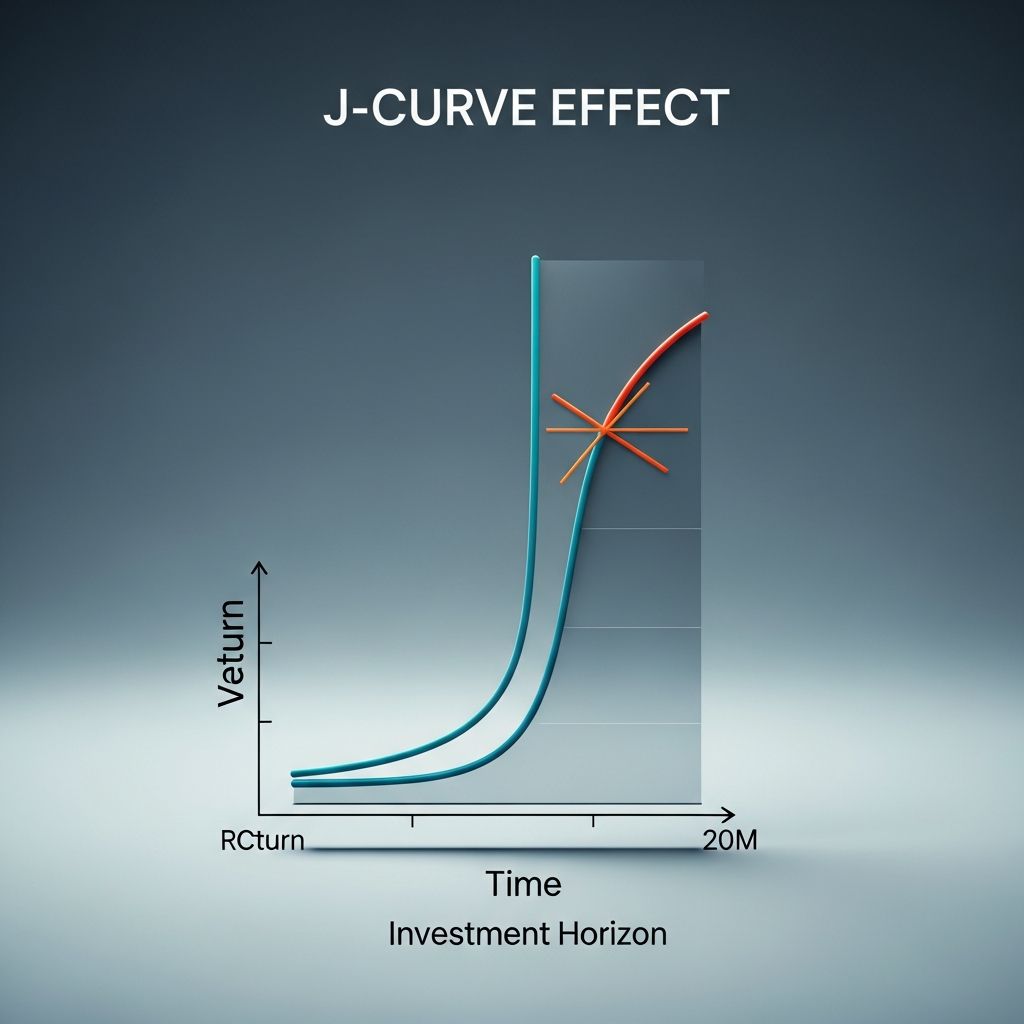
The J-Curve effect is a fundamental concept in economics and finance that describes a pattern where a variable initially declines before gradually recovering and rising above its starting point, creating a shape resembling the letter “J.” This phenomenon appears across multiple disciplines, including international trade, currency economics, private equity investing, and even medical research. The J-Curve effect illustrates a common principle: situations often worsen before they improve, and understanding this temporal pattern is crucial for investors, policymakers, and business professionals.
The concept gained prominence in international economics when scholars observed that currency devaluation initially worsens a country’s trade balance before eventually improving it. In private equity, the J-Curve represents the typical fund performance trajectory, where investors experience negative returns during the early years before receiving significant gains as portfolio companies mature and exit.
The J-Curve in International Economics and Trade
In the context of international economics, the J-Curve effect describes how a country’s balance of trade responds to currency depreciation or devaluation. When a country’s currency weakens, the immediate effect appears counterintuitive: the trade balance actually worsens rather than improves. This occurs because of several interconnected factors.
Why the Trade Balance Initially Worsens
When currency depreciation occurs, existing contracts and trade agreements often cannot be renegotiated immediately. Companies have already committed to purchasing goods at previously agreed prices, and these obligations must be fulfilled. Additionally, consumer habits and preferences do not shift overnight. Both domestic consumers and foreign buyers continue their existing purchasing patterns despite the changed currency values, preventing immediate adjustment in trade flows.
Furthermore, the valuation of imports becomes more expensive when denominated in the local currency. Although the physical quantity of imports may remain similar in the short term, their monetary value increases, causing the trade balance to deteriorate. This initial deterioration forms the downward slope of the J-Curve.
The Recovery Phase and Long-Term Improvements
Over time, the J-Curve’s characteristic upward slope emerges as market participants adjust to the new currency reality. Consumers gradually shift their purchasing behavior, switching to comparably cheaper locally-produced products. Foreign traders begin purchasing more products exported from the country, attracted by the now-competitive pricing made possible by the weakened currency. Exporters gain competitive advantage as their products become relatively cheaper in international markets.
As these adjustments accumulate, the country’s trade balance improves significantly, eventually surpassing its initial position. This recovery aligns with the Marshall-Learner condition, which states that currency depreciation will improve the trade balance only if demand for exports and imports is sufficiently elastic—meaning consumers and businesses are willing and able to change their purchasing patterns in response to price changes.
The J-Curve in Private Equity
In private equity investing, the J-Curve effect represents a critical characteristic of how private equity funds deliver returns to their limited partners (LPs) over a fund’s lifecycle. Understanding this pattern is essential for investors evaluating private equity opportunities and fund managers planning deployment strategies.
The Three-Stage Fund Lifecycle
Private equity fund performance typically follows three distinct stages:
Stage 1: Capital Calls and Fund Formation
During the initial stage, fund managers focus on identifying and acquiring target investments. Rather than holding undeployed capital that would dilute returns, managers call capital from investors as needed during this period. During this phase, investors commit capital but have not yet received meaningful returns, and the fund begins incurring expenses. Initial negative returns stem from several sources: management fees that reduce available capital for investment, transaction costs associated with acquiring portfolio companies, and the portfolio’s carrying value, which reflects unrealized losses from underperforming investments identified and written down early in the fund’s life.
Stage 2: Investment Period and Value Creation
As the fund progresses into the investment period, the fund manager executes value creation strategies at portfolio company level. Valuations of underlying companies begin growing, often at accelerated rates typical of leveraged buyouts and other private company investments. During this stage, distributions to investors commence as the fund begins realizing gains. This acceleration in valuation enhancement drives the steep upward slope characteristic of the J-Curve. As portfolio companies mature and strategies are successfully implemented, the fund’s cumulative performance improves dramatically.
Stage 3: Harvesting and Distribution
The harvesting stage typically begins around year six of a fund’s lifecycle. During this final stage, the fund manager exits remaining investments through mechanisms such as leveraged IPOs, mergers and acquisitions, and secondary sales. As these exits materialize and proceeds are distributed to investors, cash flows accelerate. Excess cash from exits first pays down any remaining debt obligations, with remaining funds returned to equity investors. This stage sees cash flows flatten as the fund reaches maturity and ultimately closes, representing the leveling off of the J-Curve’s upper slope.
Factors Influencing the J-Curve Shape
The steepness and timing of a private equity fund’s J-Curve varies based on multiple factors:
Capital Deployment and Liquidity
The speed at which a fund deploys its committed capital significantly affects the curve’s trajectory. Rapid capital deployment accelerates the transition from Stage 1 to Stage 2, moving the fund more quickly into the value creation phase. Conversely, funds that maintain substantial “dry powder” (undeployed capital) experience a longer initial negative return period. As more capital deploys into portfolio companies, fund liquidity decreases, meaning holdings become less liquid and cannot be quickly sold or exited.
Investment Success and Exit Timing
The success of portfolio company operations and the timing of profitable exits determine how steeply the J-Curve rises during Stage 2 and Stage 3. A fund that achieves successful value creation and executes timely exits experiences a steeper upward curve, returning cash to investors more quickly and at higher multiples. A steep curve represents superior fund performance and management quality, as it indicates the highest returns generated in the shortest time possible.
Management and Operational Excellence
Poorly managed private equity funds exhibit J-Curves with slow upward slopes, indicating that returns were realized late and at lower multiples than expected. Fund managers who efficiently execute their investment thesis, identify underperforming assets early, and capitalize on value creation opportunities produce steeper J-Curves that reward investor confidence.
Why Negative Returns Occur in Early Years
Understanding the sources of initial negative returns helps investors contextualize early fund performance and distinguish between normal J-Curve effects and problematic fund management. Key contributors to negative returns include management fees, which are typically charged annually and reduce available capital; transaction costs and investment expenses incurred during acquisitions; portfolio companies that underperform expectations and are written down; and the accounting practice of valuing portfolio companies conservatively, especially when performance uncertainties exist.
Comparing Different Private Equity Fund Types
Not all private equity funds exhibit identical J-Curve shapes. Different fund strategies and investment types produce characteristic patterns:
| Fund Type | J-Curve Characteristics | Performance Profile |
|---|---|---|
| Buyout Funds | Deeper initial dip, steeper Stage 2 acceleration | Higher leverage creates both risks and returns; significant value creation opportunities |
| Infrastructure Funds | Flatter curve with lower initial dip and modest acceleration | Steady returns from long-term infrastructure assets; lower volatility than buyouts |
| Venture Capital Funds | Extended initial negative phase, explosive Stage 2 growth for winners | High failure rates offset by significant gains from successful exits |
Key Metrics and J-Curve Performance
The steepness of the positive portion of the J-Curve directly reflects a fund’s efficiency in returning capital to investors. A steeper upward slope indicates faster capital return, which provides investors with opportunities to reinvest funds elsewhere or redeploy capital into subsequent fund vintages. This metric becomes particularly important during periods of credit market tightening, when the ability to successfully exit portfolio companies and return capital becomes constrained.
Fund managers who can accelerate the J-Curve’s upward trajectory provide significant advantages to their limited partners. Beyond the direct benefit of quicker access to capital, fast capital returns reduce exposure to market risks and provide optionality for investors to pursue alternative investment opportunities.
Frequently Asked Questions
Q: What does the J in J-Curve represent?
A: The “J” refers to the shape of the curve when plotted on a graph, where performance initially falls (forming the downward stroke) before rising sharply above the starting point (forming the upward stroke), resembling the letter “J.”
Q: How long does it typically take for a private equity fund to move through the J-Curve?
A: Most private equity funds operate on a 10-year lifecycle. The investment and value creation phases (Stage 1 and 2) typically occur during years 1-5, while the harvesting stage (Stage 3) spans years 6-10, though this varies by fund strategy.
Q: Can the J-Curve effect be negative for private equity investors?
A: Yes, if a fund performs poorly during the value creation stage or if exits fail to materialize at expected valuations, the upward slope may flatten significantly or even reverse, resulting in poor overall returns.
Q: How does currency depreciation affect import prices according to J-Curve theory?
A: When a country’s currency depreciates, imports become more expensive when converted to the local currency, initially worsening the trade balance. Over time, as consumers shift preferences, the effect reverses.
Q: What is “dry powder” in private equity?
A: Dry powder refers to committed capital that has not yet been deployed into investments. Funds holding significant dry powder experience longer initial negative return periods as capital sits uninvested.
References
- J Curve – Understanding How J Curve Works in PE and Economics — Corporate Finance Institute. https://corporatefinanceinstitute.com/resources/economics/j-curve/
- J curve — Wikipedia. https://en.wikipedia.org/wiki/J_curve
- J-Curve Effect | Private Equity Fund Economics — Wall Street Prep. https://www.wallstreetprep.com/knowledge/j-curve/
- What is J-Curve in Private Equity and Venture Capital? — Moonfare. https://www.moonfare.com/glossary/j-curve
- J Curve: Finance Definition, Phases & Examples — Growth Equity Interview Guide. https://growthequityinterviewguide.com/private-equity/pe-vc-performance-metrics/j-curve
- The J-Curve Effect — 2012 Book Archive. https://2012books.lardbucket.org/books/policy-and-theory-of-international-finance/s11-12-the-j-curve-effect.html
Similar Articles








Read full bio of Sneha Tete