Taxation of Social Security Benefits
Understand how Social Security benefits are taxed at federal and state levels, including 2026 updates and strategies to minimize your tax liability.

Social Security benefits can be partially taxable at the federal level based on your total income, with up to 85% subject to tax depending on filing status and income thresholds. This guide examines the rules for 2026, state-specific treatments, and strategies for retirees.
Understanding Federal Taxation Rules
The Internal Revenue Service determines taxability using combined income, calculated as adjusted gross income (AGI) plus nontaxable interest plus half of Social Security benefits. If this exceeds base amounts, benefits become taxable.
Supplemental Security Income (SSI) remains nontaxable, unlike retirement, disability, or survivor benefits.
Income Thresholds by Filing Status
| Filing Status | Combined Income Range | Taxable Portion of Benefits |
|---|---|---|
| Single, Head of Household, Qualifying Widow(er) | Under $25,000 | 0% |
| $25,000 – $34,000 | Up to 50% | |
| Over $34,000 | Up to 85% | |
| Married Filing Jointly | Under $32,000 | 0% |
| $32,000 – $44,000 | Up to 50% | |
| Over $44,000 | Up to 85% | |
| Married Filing Separately (lived apart all year) | Under $25,000 | 0% – 85% |
| Married Filing Separately (lived with spouse) | Any amount | Up to 85% |
These thresholds, unchanged for decades, apply to 2026 unless legislation alters them.
2026 Legislative Developments
As of early 2026, the You Earned It, You Keep It Act remains pending, potentially eliminating federal taxes on benefits starting with 2026 returns filed in 2027. Separately, the One Big Beautiful Bill Act introduces a temporary $6,000 bonus senior deduction through 2028, reducing taxable retirees.
West Virginia completes its phase-out, fully exempting benefits on 2026 returns.
State Tax Variations in 2026
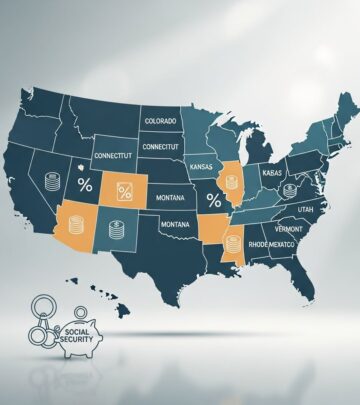
Only nine states tax Social Security in 2026, often with generous exemptions. Most states fully exempt benefits.
- Colorado: Full subtraction for 65+; partial for 55-64 if AGI ≤ $75,000 single/$95,000 joint.
- Connecticut: Full exemption if AGI < $75,000 single/$100,000 joint; 75% above.
- Minnesota: Full if AGI ≤ $84,490 single/$108,320 joint; phases out.
- Montana: Mirrors federal thresholds: 0% under $25,000 single/$32,000 joint, up to 85% above.
- New Mexico: Exempt if AGI ≤ $100,000 single/$150,000 joint; taxed at 1.7%-5.9% above.
- Rhode Island: Exempt if AGI < $104,200 single/$133,250 joint for full retirement age+; taxed 3.75%-5.99% above.
- Vermont: Full exemption < $50,000 single/$65,000 joint; partial to $60,000/$75,000; taxable above.
- West Virginia: Fully exempt starting 2026.
Other states like Pennsylvania tax other retirement income but not Social Security.
Payroll Taxes on Earnings in 2026
Distinct from income tax on benefits, the Social Security payroll tax (OASDI) applies to wages up to $184,500 in 2026, up from $176,100 in 2025. The rate is 6.2% each for employees/employers (12.4% self-employed).
For maximum earners: $11,439 per side, or $22,878 total FICA for employees.
Strategies to Minimize Taxes
Retirees can reduce combined income through:
- Timing Roth IRA conversions to manage AGI.
- Withdrawing from traditional IRAs strategically before RMDs.
- Harvesting capital losses to offset gains.
- Relocating to no-tax states like Florida or Texas.
High-net-worth individuals should plan IRMAA surcharges, with 2026 thresholds at $109,000 single/$218,000 joint.
Common Calculation Example
Single filer: AGI $30,000 + nontaxable interest $1,000 + 50% of $15,000 benefits ($7,500) = $38,500 combined income. Over $34,000, up to 85% of benefits taxable.
Frequently Asked Questions
Will Social Security benefits be tax-free in 2026?
Not guaranteed; pending legislation could change this, but current rules apply.
How do I calculate combined income?
AGI + nontaxable interest + ½ Social Security benefits.
Which states tax benefits the most?
States like Colorado and Minnesota offer tiered exemptions; Montana follows federal closely.
Does working while receiving benefits affect taxes?
Earnings above $184,500 escape OASDI tax, but all wages count toward AGI.
Are lump-sum payments taxed differently?
Use the lump-sum election to allocate to prior years, potentially lowering tax.
Planning for Future Changes
Proposals like taxing benefits as private pensions or raising thresholds to 100% for high earners could emerge. Monitor IRS and SSA updates.
The expanded senior deduction lowers effective rates by shielding more income.
References
- Is Social Security Taxed in 2026? – What Retirees Need to Know About New Rules — Mercer Advisors. 2026. https://www.merceradvisors.com/insights/retirement/is-social-security-taxed-in-2026-what-retirees-need-to-know-about-new-rules/
- Will Your Social Security Be Taxed in 2026? Here’s What to Know — Kiplinger. 2026. https://www.kiplinger.com/taxes/social-security-income-taxes
- Contribution and Benefit Base — Social Security Administration. 2026. https://www.ssa.gov/oact/cola/cbb.html
- 2026 Social Security Changes: Tax and Benefit Strategies for High-Net-Worth Individuals — Focus Partners. 2026. https://www.focuspartners.com/resources/tax-strategies/2026-social-security-changes-tax-and-benefit-strategies-for-high-net-worth-individuals
- 6 Big Social Security Changes for 2026 — AARP. 2026. https://www.aarp.org/social-security/biggest-2026-changes/
- Update (SSA Publication) — Social Security Administration. 2026. https://www.ssa.gov/pubs/EN-05-10003.pdf
Similar Articles








Read full bio of Sneha Tete