Is $750K Car Liability Enough?
Explore if high-limit car accident coverage like $750K truly safeguards your finances or if more is needed in today's risk landscape.

High liability limits like $750,000 for car accidents offer substantial protection against claims from others, but whether it’s sufficient depends on your net worth, driving habits, and state regulations. Most experts suggest tailoring coverage to your assets while considering cost-effective upgrades beyond bare minimums.
Decoding Liability Coverage Basics
Liability insurance forms the core of auto policies, covering damages you cause to others in an at-fault accident. It’s expressed as three numbers, such as 100/300/100, meaning $100,000 per person for bodily injury, $300,000 total bodily injury per accident, and $100,000 for property damage.
Bodily injury handles medical bills, lost wages, and pain compensation for injured parties, while property damage pays for vehicle repairs or replacements. This coverage excludes your own losses, which require separate collision or comprehensive options.
- Bodily injury per person: Caps payout for one individual’s claims.
- Bodily injury per accident: Total for all injured in the event.
- Property damage: Fixes to structures, cars, or other property hit.
State laws mandate minimums, but these often fall short for serious crashes where medical costs exceed hundreds of thousands.
State Minimums: The Legal Baseline
Every U.S. state requires at least liability coverage, with limits varying widely. Common minimums hover around 25/50/25, providing $25,000 per person, $50,000 per accident for injuries, and $25,000 for property.
Recent updates reflect inflation and rising repair expenses. For example, North Carolina raised limits effective July 1, 2025, from 30/60/25 to 50/100/50, mandating higher bodily injury and property damage thresholds.
| State | Bodily Injury (Per Person/Accident) | Property Damage | Notes |
|---|---|---|---|
| North Carolina (post-2025) | 50/100 | 50 | Includes underinsured motorist. |
| California (2025 update) | 30/60 | 15 | First increase since 1967. |
| Massachusetts | 25/50 | 30 | Plus PIP and UM. |
| Michigan | 50/100 | 10 (out-state) | $1M property in-state. |
These floors ensure legal driving but expose drivers to personal liability for shortfalls in major incidents.
Why Minimums Fall Short in Real Crashes
Average bodily injury claims hit $26,000 per person, but severe accidents with lifelong injuries or fatalities can surpass $1 million easily. Property damage for luxury vehicles or multi-car pileups often exceeds $50,000.
If claims top your limits, victims sue you directly, risking homes, savings, and wages. High-net-worth individuals face greater exposure, as courts can award punitive damages too.
- Medical emergencies: Hospital stays alone average $2,500 daily.
- Vehicle repairs: Modern cars cost $20,000+ to fix post-collision.
- Lawsuits: Uninsured portions lead to asset liens.
Opting for bare minimums saves upfront but amplifies long-term financial peril.
Asset-Based Coverage Recommendations
Match liability limits to your protectable wealth for adequate shielding. Financial advisors propose scaling based on total assets like savings, investments, and home equity.
| Asset Range | Recommended Limits | Rationale |
|---|---|---|
| Under $50K | 50/100/50 or state min | Basic protection for modest holdings. |
| $50K-$500K | 100/300/100 | Standard for middle-class security. |
| $500K+ | 250/500/250 or umbrella | Guards substantial wealth. |
| $1M+ | 500/500/500+ or $1M umbrella | High exposure demands excess layers. |
Umbrella policies extend liability beyond auto limits, often starting at $1 million for $150-300 annually, ideal for $750K auto caps.
Evaluating $750K Limits: Pros and Cons
$750K combined single limit (CSL) or split like 250/750/250 provides robust defense against most claims. It’s far above typical state minimums and covers 95% of scenarios per industry data.
Advantages:
- Handles multi-vehicle crashes with injuries.
- Buffers inflation in medical and repair costs.
- Peace of mind for assets over $500K.
Drawbacks:
- Premiums 20-50% higher than 100/300/100.
- Not infinite; rare catastrophic cases exceed it.
- Pair with umbrella for true high-value protection.
For drivers with $750K+ in assets, this level aligns well, but verify via net worth calculators.
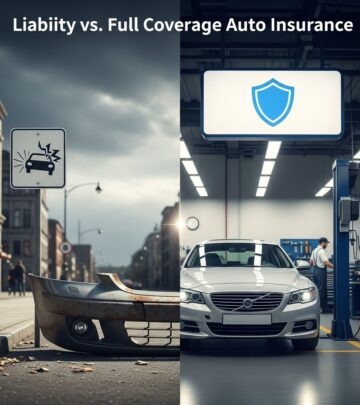
Full Coverage: Beyond Liability Essentials
Liability alone skips your vehicle’s protection. Full coverage adds collision (at-fault repairs) and comprehensive (theft, weather, hits).
Rule of thumb: Add if incremental cost is under 10% of car value. Skip for vehicles under $5K or 10 years old unless unaffordable to replace.
- Deductibles: $500-1,000 balances premiums and out-of-pocket.
- Gap insurance: For financed cars covering loan balances post-total loss.
- New car replacement: Replaces with equivalent model if under 2 years old.
New or luxury cars demand full suite: 100/300/100 liability plus comprehensive/collision at $1K deductible.
Cost Breakdown Across Coverage Tiers
Upgrading pays off modestly relative to risk reduction. Monthly averages vary by location and profile.
| Tier | Limits | Avg Monthly Cost |
|---|---|---|
| Minimum | State req (e.g., 25/50/25) | $25-75 |
| Good | 100/300/100 | $75-150 |
| Best | 250/500/250 + full | $150-250 |
Shop quotes; discounts for bundling, safe driving cut 10-25%.
Additional Protections to Consider
Enhance policies with:
- Uninsured/underinsured motorist (UM/UIM): Mirrors liability for hits by uncovered drivers; now standard in some states like NC post-2025.
- Medical payments (MedPay): $1K-10K for deductibles or no-health-insurance scenarios.
- Rideshare coverage: If using apps commercially.
Review annually as life changes (home purchase, kids) alter needs.
Strategies to Optimize Premiums
Maintain affordability without skimping:
- Higher deductibles lower rates.
- Multi-policy discounts.
- Telematics for safe driving proof.
- Compare 3-5 insurers yearly.
2026 trends show rates stabilizing post-inflation spikes.
Frequently Asked Questions
What if my state minimum is low?
Upgrade to at least 100/300/100; it’s cost-effective asset defense.
Do I need full coverage on an old car?
Only if replacement cost strains budget; otherwise, liability suffices.
How does umbrella insurance work?
Kicks in after auto limits exhaust, often $1M+ for low extra cost.
Are 2026 minimums changing more?
States like NJ, HI plan hikes; check local DOI sites.
What’s ideal for high assets like $750K home?
Match or exceed with 500/500/500 plus umbrella.
Final Thoughts on Smart Coverage Choices
Prioritize liability matching your wealth, add full for valuables, and layer umbrellas for elite protection. Regular audits ensure alignment with evolving risks and laws, securing your financial stability on the road.
References
- How Much Car Insurance Coverage Do I Need in 2026? — MoneyGeek. 2026. https://www.moneygeek.com/insurance/auto/how-much-car-insurance-do-i-need/
- Car Insurance Requirements in North Carolina (2026) — Insurify. 2026. https://insurify.com/car-insurance/north-carolina/minimum-requirements/
- Changes to the Rating of Automobile Insurance Policies, Effective July 1, 2025 — North Carolina Department of Insurance (ncdoi.gov). 2025. https://www.ncdoi.gov/changes-rating-automobile-insurance-policies-effective-july-1-2025
- State Minimum Car Insurance Requirements: Your 2026 Guide — Beach Insurance LLC. 2026. https://beachinsurancellc.com/insurance/state-minimum-car-insurance-requirements-by-state-your-2026-guide-from-beach-insurance-llc/
- How Much Car Insurance Do I Need? — Progressive. 2026. https://www.progressive.com/answers/how-much-car-insurance-do-i-need/
- The Minimum Required Car Insurance by State — NerdWallet. 2026. https://www.nerdwallet.com/insurance/auto/learn/minimum-car-insurance-requirements
Similar Articles








Read full bio of Sneha Tete