IRA vs. High-Yield Savings: Key Choices
Discover how IRAs and high-yield savings accounts differ in growth, access, taxes, and ideal uses for your financial goals.
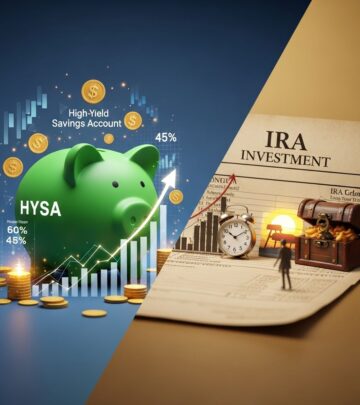
Individual Retirement Accounts (IRAs) and high-yield savings accounts serve distinct roles in personal finance strategies. IRAs prioritize long-term growth with tax incentives for retirement, while high-yield savings accounts provide liquidity and competitive interest for immediate needs.
Defining the Fundamentals
Understanding these accounts starts with their core purposes. An IRA is a tax-favored vehicle designed specifically for retirement planning, allowing investments in stocks, bonds, and funds. High-yield savings accounts, conversely, are deposit accounts offering elevated interest rates on cash balances, insured by the FDIC up to $250,000.
Core Features Comparison
| Feature | IRA | High-Yield Savings Account |
|---|---|---|
| Primary Purpose | Retirement savings | Short-term savings and emergencies |
| Access to Funds | Penalties before age 59½ | Anytime, no penalties |
| Tax Treatment | Tax-deferred or tax-free growth | Interest taxed as earned |
| Contribution Limits | Annual caps (e.g., $7,000 for 2025 under 50) | None |
| Growth Mechanism | Investments (stocks, etc.) | Variable interest (3-5% APY) |
| Risk Level | Market volatility | Principal protected |
This table highlights how IRAs suit patient savers, while high-yield options excel in flexibility.
High-Yield Savings Accounts in Depth
These accounts typically yield 3.6% to 4.4% APY as of recent data, far surpassing traditional savings at 0.41% per FDIC averages. Offered mainly by online banks, they feature low fees, no minimums in many cases, and easy transfers. Rates fluctuate with Federal Reserve policies, but remain a safe haven amid uncertainty.
- Liquidity: Withdraw freely, ideal for unexpected expenses.
- Safety: FDIC insurance protects deposits.
- Earning Power: Compounds daily, beating inflation short-term.
However, long-term, yields may lag inflation, eroding purchasing power.
Exploring IRA Options
IRAs come in traditional and Roth varieties. Traditional IRAs defer taxes on contributions and growth until withdrawal; Roth IRAs use after-tax dollars for tax-free qualified distributions post-59½ and five-year holding. Both allow diverse investments, historically averaging 7-10% annual returns via stock market exposure.
Eligibility requires earned income; 2025 limits are $7,000 under 50, $8,000 over, per IRS adjustments. Early withdrawals incur 10% penalties plus taxes, enforcing discipline.
Growth Potential Breakdown
IRAs shine in compounding: tax savings accelerate reinvestment. A $50,000 investment at 8% in an IRA grows to $73,466 in five years tax-free (Roth); the same in high-yield at 4% reaches $60,833, taxed annually. Over decades, market returns outpace fixed interest significantly.
High-yield accounts guarantee no principal loss but cap upside. In low-rate eras, they underperform; currently, they compete with bonds.
Risk and Protection Factors
High-yield savings carry negligible risk due to insurance, making them perfect for conservative portfolios. IRAs expose funds to market dips—possible 20-30% drops—but historical recoveries reward longevity. Diversification via index funds mitigates volatility.
Tax Implications Explored
IRAs’ tax edge is profound: traditional deducts contributions now, Roth exempts future gains. High-yield interest reports on Form 1099-INT, taxed at ordinary rates (up to 37%). For high earners, Roth’s backdoor strategies preserve benefits.
When to Prioritize High-Yield Savings
- Emergency Reserves: Aim for 3-6 months’ expenses; unlimited deposits and instant access.
- Upcoming Purchases: Down payments, vacations—higher yields hasten goals without market bets.
- Uncertain Timelines: Short horizons (under 5 years) avoid investment risks.
Ideal Scenarios for IRAs
- Retirement Horizon: 10+ years away leverages compounding.
- Wealth Building: Tax-free growth multiplies nest eggs.
Combining Both in Your Plan
Layer them: high-yield for liquidity (20-30% portfolio), IRA for growth (balance). Rebalance yearly; as retirement nears, shift IRA to conservative assets.
Current Rates and Trends
As of 2025, high-yield APYs hover 4-5%, influenced by Fed cuts. IRA returns vary by allocation—S&P 500 averaged 10% historically. Monitor via FDIC and IRS sites.
Frequently Asked Questions
Can I have both an IRA and high-yield savings?
Yes, they complement each other perfectly for diverse needs.
Is a high-yield savings safer than an IRA?
Yes, principal is insured; IRAs can lose value short-term.
What if rates drop—still worth high-yield?
Yes, for liquidity; they beat checking accounts.
Roth or Traditional IRA—which for high-yield comparison?
Roth for tax-free growth edges out, assuming eligibility.
Contribution limits for 2026?
Check IRS; typically inflation-adjusted annually.
Strategic Decision Framework
Assess timeline, risk tolerance, goals. Short-term/liquid: high-yield. Long-term/growth: IRA. Consult advisors for personalization.
References
- IRA vs. High-Yield Savings Account: What’s the Difference? — Experian. 2025-04. https://www.experian.com/blogs/ask-experian/ira-vs-high-yield-savings-account/
- High-Yield Savings Account vs Roth IRA — TAB Bank. 2023. https://www.tabbank.com/resource-center/blog/high-yield-savings-account-vs-roth-ira/
- Roth IRA vs. high-yield savings account: Where should you save? — Thrivent. N/A. https://www.thrivent.com/insights/budgeting-saving/roth-ira-vs-high-yield-savings-account-where-should-you-save
- Federal Deposit Insurance Corporation (FDIC) Monthly Rates — FDIC (official .gov). 2025-04. https://www.fdic.gov/resources/bankers/national-rates/
- Retirement Topics – IRA Contribution Limits — Internal Revenue Service (IRS.gov). 2025. https://www.irs.gov/retirement-plans/plan-participant-employee/retirement-topics-ira-contribution-limits
Similar Articles








Read full bio of Sneha Tete