IRA CDs vs. Traditional IRAs: Key Differences
Discover how IRA CDs and traditional IRAs differ in risk, returns, taxes, and suitability for your retirement strategy to make informed savings choices.
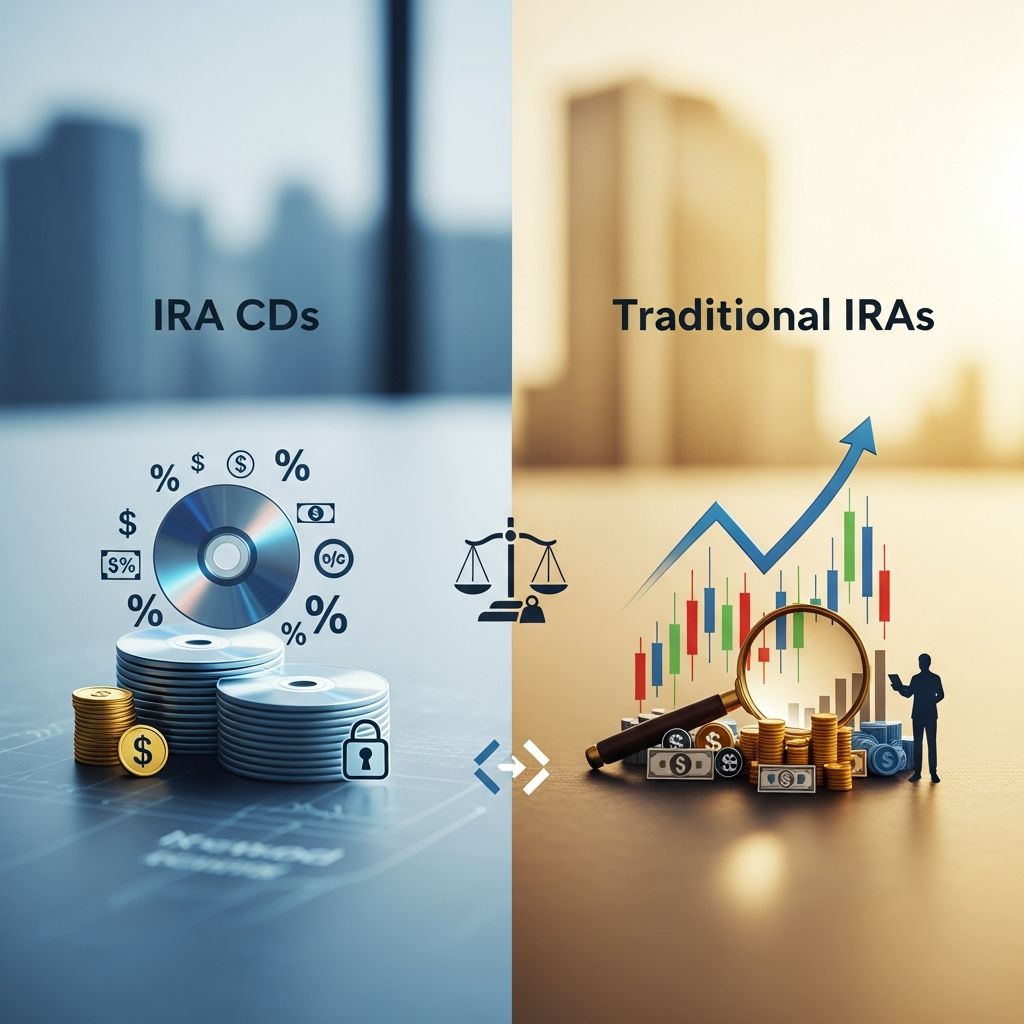
IRA CDs and traditional IRAs both support retirement savings but serve distinct purposes. IRA CDs offer fixed, guaranteed returns within a tax-advantaged wrapper, ideal for conservative investors, while traditional IRAs provide broader investment flexibility for potential higher growth.
Understanding the Fundamentals of Retirement Savings Vehicles
Retirement planning requires tools that balance growth, safety, and tax efficiency. Certificates of deposit (CDs) locked in banks provide predictable interest, but when housed in an Individual Retirement Account (IRA), they gain tax deferral benefits. This fusion creates the IRA CD, a low-volatility option for those prioritizing capital preservation.
Traditional IRAs, by contrast, act as versatile containers for diverse assets like stocks, bonds, or even CDs. Contributions often qualify for upfront tax deductions, with earnings compounding tax-free until withdrawal. This setup appeals to individuals seeking long-term wealth accumulation despite market uncertainties.
Core Features of IRA CDs
An IRA CD integrates the stability of a standard CD into an IRA framework. You deposit a lump sum for a set term—ranging from months to years—earning a fixed annual percentage yield (APY). For example, a $10,000 deposit at 4% APY over 12 months yields $400, all sheltered from immediate taxes.
These products shine in fluctuating rate environments, locking in yields before potential declines. Banks insure them via FDIC up to $250,000 per depositor, minimizing principal risk. Credit unions offer analogous IRA share certificates, backed by NCUA insurance with similar mechanics.
- Fixed terms: 3 months to 10 years, matching liquidity needs.
- Guaranteed principal: No market exposure.
- Tax deferral: Interest grows untaxed until distribution.
Exploring Traditional IRA Capabilities
Traditional IRAs accommodate annual contributions up to IRS limits—$7,000 for 2025 if under 50, plus $1,000 catch-up for older savers. Funds can invest in equities, fixed income, ETFs, or CDs, allowing tailored risk-return profiles.
Tax perks include deductible contributions for many, reducing taxable income dollar-for-dollar. Internal growth escapes annual taxation, supercharging compounding. Withdrawals post-59½ incur ordinary income tax, often at lower retirement brackets.
| Feature | IRA CD | Traditional IRA |
|---|---|---|
| Risk Level | Low (FDIC/NCUA insured) | Varies (depends on holdings) |
| Returns | Fixed APY (e.g., 3-5%) | Market-dependent (historical 7-10% avg.) |
| Tax Treatment | Deferred on interest | Deductible contributions; deferred growth |
| Liquidity | Term-locked; early withdrawal penalty | Flexible, but 10% penalty pre-59½ |
Tax Implications: A Detailed Comparison
Tax strategy differentiates these options profoundly. IRA CD interest defers taxation until withdrawal, mirroring traditional IRA growth. However, non-IRA CDs tax interest annually as ordinary income, eroding compounding.
Traditional IRA deductibility hinges on income, filing status, and employer plan coverage. High earners might face phase-outs, but Roth conversions offer backdoor access. Post-retirement, required minimum distributions (RMDs) at age 73 mandate taxable outflows.
IRA CDs sidestep RMD complexities if laddered strategically, but early access triggers 10% penalties plus taxes. Both enforce substantial equivalence tests for non-spousal beneficiaries.
Pros and Cons Breakdown
Advantages of IRA CDs
- Principal protection against economic downturns.
- Predictable income for near-retirees.
- Simplicity—no active management required.
Drawbacks of IRA CDs
- Opportunity cost: Misses equity market upside.
- Inflation erosion on fixed rates.
- Penalties for premature access.
Strengths of Traditional IRAs
- Diversification across asset classes.
- Higher long-term return potential.
- Tax optimization flexibility.
Weaknesses of Traditional IRAs
- Market volatility risks principal.
- Requires investment savvy.
- RMDs force distributions.
Strategic Applications for Each Option
Conservative portfolios nearing retirement benefit from IRA CDs. Allocate 20-40% to laddered terms—e.g., portions maturing annually—for steady income without full illiquidity. This hedges longevity risk while preserving capital.
Younger accumulators favor traditional IRAs for growth. Target-date funds or low-cost index portfolios historically outpace CDs over decades. Blend with IRA CDs for a barbell approach: aggressive growth plus safe anchors.
In rising rate periods, extend IRA CD terms; in falling rates, lock long. Monitor Fed signals via primary sources like federalreserve.gov for timing.
Step-by-Step Guide to Getting Started
- Assess eligibility: Verify IRA contribution limits and income for deductibility via IRS.gov.
- Compare rates: Shop FDIC/NCUA institutions; credit unions often lead APYs.
- Select account type: Traditional for deferral; Roth if expecting higher future taxes.
- Fund appropriately: Rollover existing retirement assets or contribute fresh dollars.
- Ladder if needed: Diversify maturities for flexibility.
Common Pitfalls to Avoid
Oversight of insurance limits exposes excess funds. Exceed $250,000? Split institutions. Ignore inflation—real yields matter. Neglect diversification—pure CDs lag diversified IRAs long-term.
FAQs
Can I hold a CD inside a traditional IRA?
Yes, creating an IRA CD with tax-deferred growth on interest.
Are IRA CDs FDIC-insured?
Yes, up to $250,000 per depositor per bank.
Which offers better returns historically?
Traditional IRAs with stocks/bonds average higher, but with volatility.
What are early withdrawal penalties?
10% IRS penalty pre-59½ plus ordinary taxes; CD issuers add interest forfeiture.
IRA CDs or share certificates—which for credit union members?
Share certificates equivalent, NCUA-insured.
Building a Hybrid Retirement Portfolio
Optimal strategies layer both: 60% traditional IRA equities for growth, 40% IRA CDs for stability. Rebalance annually, adjusting allocations by age/risk tolerance. This balances upside with downside protection.
Consult IRS Publication 590 for rules (irs.gov/publications/p590a). Financial advisors tailor via holistic planning.
References
- IRA CDs vs. IRA Share Certificates: Differences — First Tech Federal Credit Union. 2024. https://www.firsttechfed.com/articles/ira-cd-vs-ira-share-certificate
- IRA Certificates vs. Certificates — San Diego County Credit Union. 2025. https://www.sdccu.com/banking/ira-certificates-vs-certificates/
- Exploring IRA CDs: A Secure Path to Retirement Savings — Harvard Federal Credit Union. 2024. https://harvardfcu.org/blog/exploring-ira-cds-a-secure-path-to-retirement-savings/
- IRA vs. CD: Choosing the Best Option for Your Retirement Goals — Middlefield Bank. 2024. https://www.middlefieldbank.bank/blog/post/ira-vs-cd-choosing-the-best-option-for-your-retirement-goals
- IRA vs. CD: What’s The Difference? — Bankrate. 2025-03-15. https://www.bankrate.com/banking/ira-vs-cd/
- IRA vs. CD: Key Differences, Pros & Cons — Raisin. 2024. https://www.raisin.com/en-us/retirement/ira-vs-cd/
Similar Articles








Read full bio of Sneha Tete