Invisible Hand: Adam Smith’s Economic Theory Explained
Understanding how self-interest drives market efficiency and economic equilibrium without government intervention.

Understanding the Invisible Hand: Adam Smith’s Economic Theory
The invisible hand is one of the most influential concepts in economic theory, describing how individuals pursuing their own self-interest inadvertently contribute to the greater good of society and the economy as a whole. Coined by Scottish economist and moral philosopher Adam Smith, this metaphor represents the unseen forces that guide free markets toward equilibrium and efficiency without requiring government intervention or centralized planning.
The concept suggests that when people make economic decisions based on personal benefit, they naturally create supply and demand dynamics that optimize market conditions. Rather than requiring a visible hand—such as government regulation or central planning—free markets self-regulate through the collective actions of countless individuals and businesses each pursuing their own interests.
Definition of the Invisible Hand
The invisible hand is a concept stating that people act in their own best interests, yet despite their self-motivation, they end up benefiting markets and the economy as a whole. In other words, society is guided by an invisible hand toward optimal choices, as opposed to a more visible set of requirements leading to those choices.
This theory operates on the principle that individual economic agents—consumers, producers, and businesses—make decisions that prioritize their own welfare and profit. However, through the mechanism of free markets, these self-interested decisions collectively result in outcomes that benefit society. The invisible hand represents the natural equilibrium that emerges from millions of independent economic transactions without centralized coordination.
The theory is often used as a backbone to support the idea of a free market, though some have said that the idea is taken out of context or oversimplified in contemporary economic debates.
How the Invisible Hand Works
The invisible hand concept is based on the idea of free markets and is said to benefit consumers by creating market equilibrium through people pursuing their own self-interest. The mechanism works through several interconnected economic principles:
Self-Interest and Market Efficiency
When people act in their self-interest, that naturally leads to market efficiency, according to invisible hand proponents. For example, if a car manufacturer produces more minivans than they can sell in a given year, their self-interest in making a profit means they’ll adjust prices or produce fewer minivans going forward, and perhaps manufacture more sedans if that’s what consumers want. The government doesn’t necessarily have to tell the manufacturer how many models of different types of cars to make, as there’s a natural force driving efficiency—the invisible hand.
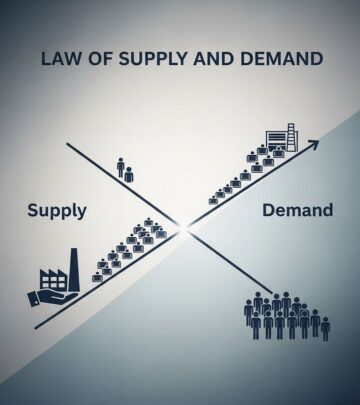
In theory, people acting based on their own interests creates supply and demand and market efficiency, creating a positive outcome for the whole of the economy. Without government intervention, the markets supposedly work on their own based on consumer preferences and actions.
Connection to Laissez-Faire Economics
The invisible hand concept is closely related to laissez-faire economics, which proposes that government interference in the economy should be minimal and markets should run their own course. According to these ideas, as people act based on their own self-interest, it creates a need for supply and demand and can create a competitive and robust marketplace.
Laissez-faire economics complements the invisible hand theory by suggesting that minimal government intervention allows markets to function most efficiently. When businesses and consumers are free to make economic decisions without regulatory constraints, the natural forces of the invisible hand can operate at their fullest potential.
Price System and Market Signals
Each free exchange creates signals about which goods and services are valuable and how difficult they are to bring to market. These signals, captured in the price system, spontaneously direct competing consumers, producers, distributors and intermediaries—each pursuing their individual plans—to fulfill the needs and desires of others. The price mechanism acts as an information system that coordinates economic activity without requiring centralized planning or management.
Examples of How the Invisible Hand Works
In theory, the invisible hand inherently creates a free marketplace that supports competition among consumers and works best for everyone. Understanding concrete examples helps illustrate how this theoretical concept operates in real-world scenarios.
The Competitive Business Example
A business owner seeking only to make themselves better off might sell an item of higher quality and at a lower price than their competitors. Keeping prices low may increase demand, and that could create competition among other suppliers offering similar products. They don’t do this for the consumer, they do so to win the business of the consumer to make themselves better off. The end result is everyone is best off in this scenario. The consumer gets a better and cheaper product, the market maximizes efficiency, and the business owner stays afloat.
The Automotive Industry
The number of people buying vehicles fluctuates based on the economy’s health. In a healthy economy, the more people looking to buy vehicles means manufacturers proportionally produce more cars to meet that demand. To create the in-demand vehicles, the manufacturer hires more employees, with pay and benefits increasing in a high-demand economy where there may be a short supply of employees and heavy competition. Here, the unseen forces led by the invisible hand predict what is likely to happen. If the car manufacturer refuses to increase employee pay, they can’t attract the necessary workforce to meet demand, so the market naturally corrects itself through wage competition.
The Bread Supply Chain
Consider the predictable supply of bread in supermarkets. As a consumer, you may predict there is bread in the supermarket before you travel there, with the supermarket predicting regular delivery of bread and manufacturers predicting that they receive the materials from farmers to make the bread. Creating bread and supplying it doesn’t require direct management, as the invisible hand maintains equilibrium in supply and demand. Each participant in this chain—the farmer, manufacturer, distributor, and retailer—acts in their own interest, yet the system naturally ensures bread is available when and where consumers want it.
The Role of Self-Interest in Economic Balance
The famous quote from Adam Smith captures the essence of the invisible hand concept: “It is not from the benevolence of the baker, brewer or butcher that puts dinner on the table, but their self-interest.” In this cyclical example, each person buys from the other so that everyone has beer, bread and meat on the dinner table, with the invisible hand guiding the economy to equalise while everyone focuses on their own gain. The butcher, baker and brewer all have unintentional guidance by the invisible hand to achieve that equilibrium.
People contribute to a healthy economy by acting with their own interests in mind. This counterintuitive principle—that selfishness leads to societal benefit—forms the foundation of free market economics and explains why markets often function efficiently without central coordination.
How the Invisible Hand Promotes Market Efficiency
The invisible hand is supposed to promote market efficiency by balancing supply and demand and adjusting prices accordingly. When there’s a need for a new type of product, the invisible hand arguably would lead companies to create that product so they can benefit from the demand. This natural process of identifying and fulfilling market needs occurs organically through the profit motive rather than through government mandates or planning.
Market efficiency under the invisible hand operates through several mechanisms:
Price Discovery: Prices adjust to reflect the true value of goods and services based on supply and demand dynamics.
Resource Allocation: Resources naturally flow toward industries and products where profit opportunities are greatest, indicating where consumer demand is strongest.
Competition: Businesses compete on price and quality, pushing them to improve products and reduce costs to attract consumers.
Innovation: The profit incentive encourages businesses to develop new products and improve existing ones to gain competitive advantages.
Criticisms and Limitations of the Invisible Hand Theory
While the invisible hand theory provides a powerful framework for understanding free markets, it faces several important criticisms and limitations in practice.
Assumption of Rational Decision-Making
The invisible hand theory assumes that consumers are rational when making economic decisions, but that’s not always the case. As humans, we don’t always behave logically; we’re often influenced by emotions or needs. Consider any time you have gone to the grocery store and overspent because you’re hungry or sleep-deprived. These emotions or needs can change, so it can be hard for businesses to anticipate demand, which could lead to inefficiencies like over- or under-production.
Market Failures and Information Asymmetry
Real markets often suffer from imperfect information, where some parties have more knowledge than others. This can prevent the invisible hand from achieving optimal outcomes. Additionally, externalities—costs or benefits not reflected in market prices—can distort market signals and lead to inefficient outcomes.
Monopolies and Market Concentration
When markets become concentrated with few competitors, the competitive forces of the invisible hand weaken. Monopolies or oligopolies can maintain above-normal profits and restrict innovation without the disciplining effect of competition.
Applications of the Invisible Hand Concept
The invisible hand concept remains valuable across multiple dimensions of economic analysis and policy-making.
Creating and Developing New Economic Theories
As a long-standing concept in economics, the invisible hand is a valuable tool that economists use to build their own theories and ideas surrounding areas of economics. Adam Smith is a standard reference for many modern studies and academic papers exploring the economy and human behaviour, explaining how equilibrium works in a free market. An economist creating a theory for a finance publication may use the invisible hand theory to describe elements of how their concept works to provide valuable context.
Understanding Predictability in Economic Processes
Predictability in the economy is an important area of study for economists. The invisible hand concept provides insight into the predictability of specific economic systems, which helps to understand how stable a particular practice is and how various elements affect trends. For instance, supply and demand is a predictable economic system that relies on human behaviour, which the invisible hand influences. Understanding the concept helps to comprehend how the market changes when supply or demand increases, decreases or fluctuates.
Deciding on Intervention in Economics
Examining economic policies from the lens of various theories is essential when considering intervention within a country or governed area. A government may invest in research into different economic theories and seek experts’ advice on what level of control they have over the market, if at all. The invisible hand concept suggests that no intervention is the ideal choice, providing government officials with one perspective on whether greater control over the economy is a valid consideration.
Frequently Asked Questions About the Invisible Hand
What does the “invisible hand” mean in economics?
The invisible hand in economics can be explained as naturally occurring market efficiency based on people and companies acting in their own self-interest. In doing so, they end up finding an equilibrium that works for the good of society, without the need for a more visible hand, like government regulation. However, not everyone agrees on the validity of the invisible hand.
How does the invisible hand promote market efficiency?
The invisible hand is supposed to promote market efficiency by balancing supply and demand and adjusting prices accordingly. When there’s a need for a new type of product, the invisible hand arguably would lead companies to create that product so they can benefit from the demand. The price system sends signals that direct resources toward their most valued uses without centralized coordination.
Is the invisible hand theory still relevant today?
Yes, the invisible hand remains a foundational concept in free market economics and continues to influence policy debates. However, modern economists recognize that markets don’t always work perfectly, and government intervention may be necessary in cases of market failures, externalities, and information asymmetries.
What is the difference between the invisible hand and laissez-faire economics?
The invisible hand is the theoretical mechanism by which markets self-regulate through individual self-interest, while laissez-faire economics is a policy approach advocating minimal government intervention to allow those market forces to operate freely. The invisible hand describes how markets work; laissez-faire is a prescription for how they should be governed.
Can the invisible hand fail?
Yes, the invisible hand can fail in situations involving market failures, such as monopolies, externalities, information asymmetries, and public goods. These situations often justify some level of government intervention to achieve more efficient outcomes than the free market alone would produce.
Conclusion
The invisible hand remains one of economics’ most enduring and influential concepts, providing a framework for understanding how individual self-interest can lead to collective economic benefit. Adam Smith’s insight that people pursuing their own advantage inadvertently serve society’s interests revolutionized economic thought and continues to shape policy debates.
While the invisible hand theory has limitations and critics point to real-world market failures, its core insight—that decentralized decision-making through price signals can coordinate complex economic activity—remains powerful. Understanding the invisible hand helps explain how markets function, why competition benefits consumers, and why excessive government intervention can sometimes produce inefficient outcomes.
The invisible hand concept applies to all industries as a general concept, providing a perspective on how the market can reach equilibrium without intervention. Whether applied to automotive manufacturing, agriculture, retail, or services, the principles of self-interest driving efficiency remain relevant to modern economic analysis and policy-making.
References
- What is the Invisible Hand? A Guide to Adam Smith’s Economic Theory — Business Insider. 2024. https://www.businessinsider.com/personal-finance/investing/invisible-hand
- What is invisible hand economics? (Definition and examples) — Indeed Career Advice. 2024. https://uk.indeed.com/career-advice/career-development/invisible-hand-economics
- Invisible Hand – Economy101 — Economy SG. 2024. https://economysg.wordpress.com/invisible-hand/
Similar Articles








Read full bio of Sneha Tete