Investment Quiz: Low to High Risk Investor
Discover your investor risk profile with this quiz: from no-risk conservative to high-risk aggressive strategies for smarter investing.
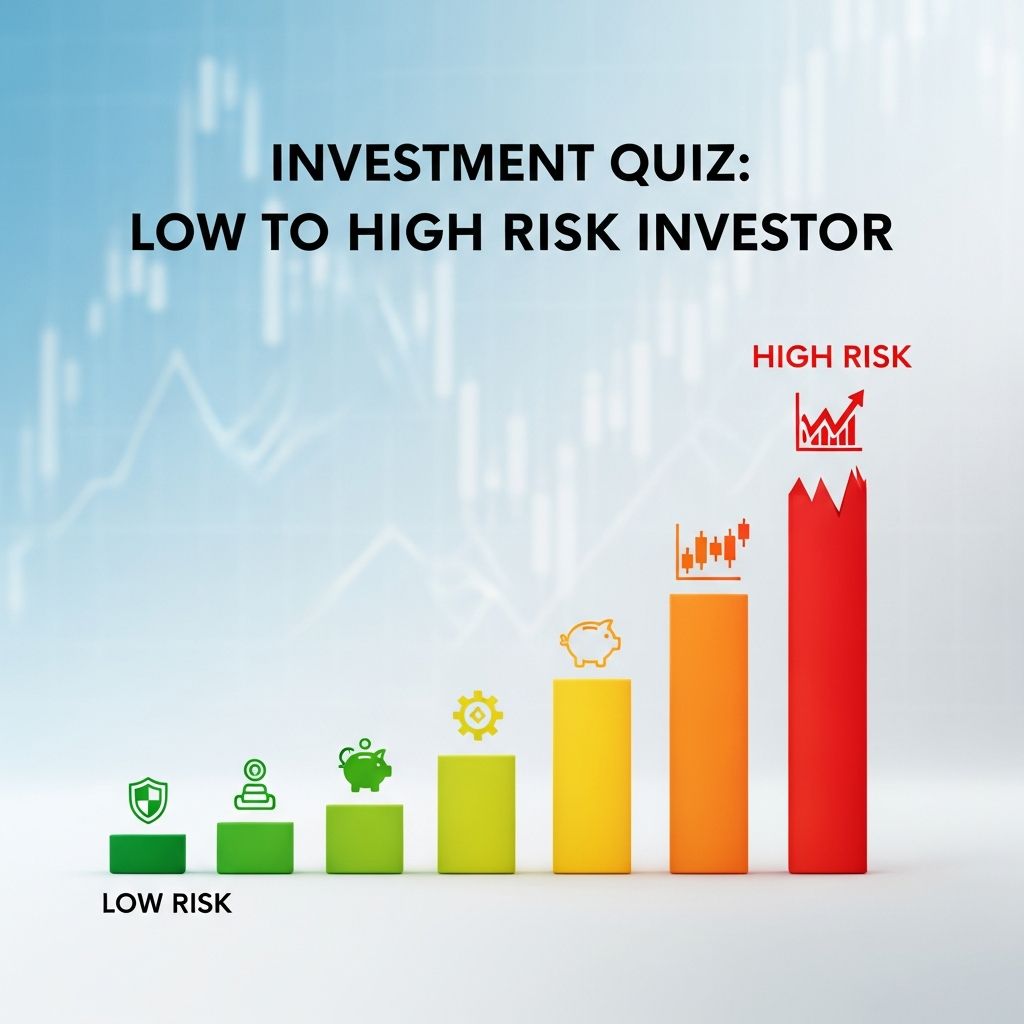
This quiz is designed to help you understand your investing
risk tolerance
and identify the best investment approach for your needs. While no general investment quiz is an exact science, answering key questions can help estimate where you fall on the spectrum fromhigh-risk
tolow-risk investor
. These questions also guide you in assessing your comfort level with investment risk, helping you make smarter, more informed decisions.How to Assess Your Own Risk Tolerance?
This quiz helps you gauge your
investing risk tolerance
by evaluating factors like your financial goals, time horizon, income surplus, and emotional response to market volatility. Answer honestly to each question by selecting A, B, C, or D that best matches your situation. Tally your responses at the end to determine your profile: Mostly A’s (no-risk/low-risk), Mostly B’s (low/moderate), Mostly C’s (moderate), or Mostly D’s (high-risk).Risk tolerance is influenced by your age, investment horizon, financial stability, and psychological comfort with losses. For instance, younger investors with long horizons can often afford more risk, while those nearing retirement prioritize capital preservation.
Take The Quiz to Find Out Your Investor Profile
Take your time and answer carefully—it’s about finding the right investment strategy for you! Match your result to the corresponding risk profile recommendation.
1. What is your investment time horizon?
- A. Less than 3 years
- B. 3 to 10 years
- C. 10 to 20 years
- D. More than 20 years
Longer horizons allow recovery from downturns, supporting higher risk for potential growth.
2. What is your investment experience?
- A. None
- B. Limited
- C. Moderate
- D. Extensive
Experience builds confidence in handling volatility.
3. When the value of your investment drops by 25%, what would you do?
- A. Sell everything immediately
- B. Hold but feel very uneasy
- C. Hold and wait for recovery
- D. Buy more
This reveals your emotional risk tolerance.
4. What rate of return do you expect from your investments over the next 10 years?
- A. To preserve my capital
- B. To keep pace with inflation
- C. To modestly exceed inflation
- D. To significantly exceed inflation
Higher return expectations correlate with higher risk appetite.
5. What is your age?
- A. 65 or older
- B. 55-64
- C. 35-54
- D. Under 35
Younger investors can tolerate more risk due to time for compounding.
6. How well does your “after-taxes” household income meet your current spending needs?
- A. My annual spending currently exceeds after-tax income.
- B. My after-tax income is roughly equal to annual spending.
- C. My after-tax income provides a modest margin over annual spending ($10,000 or less per year).
- D. My after-tax income provides for a substantial (more than $10,000 per year) margin over annual spending.
The more your income exceeds spending, the better positioned you are for riskier investments.
7. What portion of your assets are you considering for investment?
- A. I’m thinking about investing over 50% of my assets.
- B. I’m thinking about investing between 25% and 50% of my assets.
- C. I’m thinking about investing between 10% to 25% of my assets.
- D. I’m thinking about investing less than 10% of my assets.
The smaller the investment relative to total assets, the less harm volatility can cause.
8. Given the best and worst case returns of the four investment choices below, which would you prefer? (Hypothetical $10,000 investment)
- A. $200 gain best case; $0 gain/loss worst case
- B. $800 gain best case; $200 loss worst case
- C. $2,600 gain best case; $800 loss worst case
- D. $10,000 gain best case; $2,600 loss worst case
This tests preference for reward vs. potential loss.
Scoring Your Results
Count your A’s, B’s, C’s, and D’s. The dominant letter determines your profile. For numeric scoring like in some quizzes: 18 or below = low risk; 19-22 = below average; 23-28 = average.
Investor Profiles and Recommendations
Mostly A’s – Your Risk Profile Recommendation: No-Risk Investor
Your answers suggest you are a
no-risk investor
. With your emphasis on stability, your investments won’t earn much, but they can provide the safety and liquidity you need. The best investments for you may beFDIC-guaranteed deposit accounts
like savings and money market accounts.Certificates of deposit (CDs)
are also a possibility if you can match the length of the CD to the timing of your cash flow requirements.**Sample Allocation**: 100% cash equivalents or CDs. Focus on principal protection.
Mostly B’s – Low-Risk Investor
Your answers suggest you lean toward stability with a
low tolerance for volatility
. As a low-risk investor, your priority is preserving your capital while earning modest returns. You might consider investments such ashigh-quality bonds
,bond mutual funds
, orconservative balanced funds
.FDIC-insured CDs
andmoney market accounts
could also fit well, especially if you want minimal risk with predictable returns. These options allow you to grow your money steadily without exposing yourself to large fluctuations.**Sample Allocation**: 60% low-risk (bonds/CDs), 30% medium-risk, 10% high-risk. Or 24% stocks, 71% bonds, 5% cash.
Mostly C’s – Moderate-Risk Investor
Your answers suggest you are a
moderate-risk investor
. Your best approach might be to balance some higher-risk investments with more stable ones. This can increase your return potential but also open the possibility of some losses. You can pursue this by buying individual stocks and bonds or mutual funds through anonline broker
. Keep a portion in stable accounts like CDs. Arobo-advisor
can tailor the blend.**Sample Allocation**: 58% stocks, 41% bonds, 1% cash; or 50/50 stocks/bonds. Includes moderate-risk mutual funds, small-cap stocks, real estate.
Mostly D’s – High-Risk Investor
Your answers suggest you are comfortable with
high-risk investments
. This may include a heavy concentration ofstocks
and possibly riskier approaches such asoptions
andmargin trading
. Such an approach allows pursuing higher returns but means accepting wide fluctuations and possible permanent losses. A robo-advisor emphasizes stocks; an online broker offers targeted high-risk vehicles.**Sample Allocation**: 91% stocks, 8% bonds, 1% cash; or growth stocks, options.
Risk Tolerance Asset Allocation Table
| Profile | Stocks | Bonds | Cash/CDs | Example Investments |
|---|---|---|---|---|
| No/Low Risk | 0-25% | 70-100% | 5-20% | CDs, Treasuries, Money Markets |
| Moderate | 40-60% | 40-60% | 1-5% | Balanced Funds, Dividend Stocks |
| High/Aggressive | 75-90% | 5-25% | 1-5% | Growth Stocks, Options, REITs |
Allocations are guidelines for a 25-year horizon with low tax sensitivity.
Common Mistakes in Assessing Risk Tolerance
Avoid these pitfalls to align investments with your true tolerance.
- Focusing Only on Short-Term Goals: Mistake – Aligning investments solely with immediate goals, neglecting long-term objectives. Solution: Balance risk with short- and long-term needs. Suggestion: Stable assets for near-term, growth for retirement.
- Ignoring Investment Amount: Feelings on risk fluctuate by dollar figures. Larger sums may lower tolerance.
- Overlooking Time Horizon: Shorter horizons demand less risk to avoid losses near need.
- Not Diversifying: Even aggressive investors should spread across assets to mitigate risk.
- Chasing Past Performance: Risk tolerance isn’t about hot trends but personal comfort.
Why Risk Tolerance Matters
Understanding your profile prevents panic-selling during downturns or overly conservative choices that miss growth. All investments carry risk, but matching to tolerance optimizes returns. Conservative investors favor low-risk for stability; aggressive seek high-growth despite volatility. Diversify across stocks, bonds, commodities.
Reassess periodically as life changes (e.g., age, income).
Frequently Asked Questions (FAQs)
What is investment risk tolerance?
Risk tolerance is your ability and willingness to endure investment losses for potential gains. It combines financial capacity (e.g., horizon) and emotional comfort.
How often should I take a risk tolerance quiz?
Annually or after major life events like marriage, job change, or nearing retirement.
Can robo-advisors help with risk profiling?
Yes, they use quizzes to build customized portfolios matching your tolerance.
Are high-risk investments always better?
No, they offer higher potential returns but greater loss risk. Match to your profile.
What if my quiz results surprise me?
Reflect on answers; consult a financial advisor for personalized advice.
References
- Risk Tolerance Quiz — Ross Financial Inc. 2024-10. https://rossfinancialinc.com/wp-content/uploads/2024/10/Risk-Tolerance-Quiz-1.pdf
- Investment Risk Tolerance Quiz – Find Your Risk Level — MoneyRates. Accessed 2026. https://www.moneyrates.com/investment/investment-quiz-low-high-risk-investor.htm
- Quiz: What’s your true risk tolerance? — Merrill Edge (Bank of America). 2024-01. https://www.merrilledge.com/article/risk-tolerance-quiz
- Risk Tolerance Quiz: How Much Risk Are You Willing to Take? — SoFi. Accessed 2026. https://www.sofi.com/learn/content/risk-tolerance-quiz/
- Investment Risk Tolerance Calculator — Annuity.org. Accessed 2026. https://www.annuity.org/annuities/strategies/risk-tolerance/quiz/
Similar Articles








Read full bio of Sneha Tete