Investment Account Types: Complete Guide
Explore major investment account categories and find the right fit for your financial goals.

Building wealth requires strategic financial planning, and selecting the right investment account is a critical first step. Investment accounts serve as containers for your money and securities, each designed with specific purposes and tax treatments in mind. Understanding the distinctions between account types can significantly impact your long-term financial success, tax liability, and access to funds when you need them most.
Understanding Investment Account Fundamentals
Investment accounts are financial vehicles that hold stocks, bonds, mutual funds, exchange-traded funds (ETFs), and other securities. The primary distinction between different account types lies in their tax treatment, contribution limits, withdrawal rules, and intended use. Some accounts offer tax advantages for specific financial goals, while others provide maximum flexibility with fewer restrictions. Your choice of account should align with your financial objectives, time horizon, and income level.
The investment landscape has evolved significantly over the past two decades, with institutions now offering diverse account structures to meet various needs. Whether you’re planning for retirement, funding a child’s education, or building general wealth, a suitable investment account likely exists for your situation.
General-Purpose Investing Through Brokerage Accounts
Brokerage accounts represent the most flexible investment vehicle available to individual investors. These accounts allow unrestricted access to a broad spectrum of securities without the limitations imposed by tax-advantaged retirement or education accounts. With a brokerage account, you can invest in stocks, bonds, ETFs, mutual funds, and other securities through individual stockbrokers, online investment platforms, or robo-advisors that use algorithms to manage your investments on your behalf.
Key Characteristics of Brokerage Accounts
- Taxation: Any interest, dividends, or capital gains are subject to taxes in the year they are earned or realized
- Contribution flexibility: No annual contribution limits exist, and investors of any income level can participate
- Withdrawal rules: Funds can be withdrawn penalty-free at any time without restrictions
- Investment options: Access to a comprehensive range of investment products, including options and derivatives if permitted by your financial institution
Ownership Structures for Brokerage Accounts
Brokerage accounts can be structured in multiple ways depending on your needs and circumstances. Individual accounts are opened and owned by a single person who bears sole responsibility for all taxes generated within the account. Joint accounts, by contrast, are shared between two or more individuals—typically spouses, but potentially any parties—and offer a mechanism for collaborative investing.
When establishing a brokerage account, you’ll encounter a choice between cash accounts and margin accounts. Cash accounts suit most investors, allowing you to purchase investments using only the cash you’ve deposited. Margin accounts, designed for experienced traders, permit borrowing from the broker to amplify investment positions, though this strategy carries substantially higher risk.
When Brokerage Accounts Make Sense
Brokerage accounts serve investors with several distinct needs. They’re ideal for those who want complete flexibility in adding or withdrawing funds without tax penalties or restrictions. They’re also essential for investors who’ve maximized contributions to tax-advantaged retirement accounts and seek additional investment opportunities. Additionally, if your savings goal doesn’t fit retirement, health care, or education categories, a brokerage account provides the appropriate investment vehicle.
Tax-Advantaged Retirement Accounts
Retirement accounts represent some of the most powerful wealth-building tools available, offering significant tax advantages that accelerate long-term growth. These accounts fall into two primary categories: Individual Retirement Accounts (IRAs) and employer-sponsored plans, each with distinct characteristics and benefits.
Individual Retirement Accounts (IRAs)
IRAs function similarly to general investing accounts in their asset diversity, allowing investments in stocks, bonds, and other securities. However, they distinguish themselves through meaningful tax benefits that vary by account type.
Traditional IRAs provide an immediate tax advantage through pre-tax contributions. When you contribute to a traditional IRA, you may deduct the contribution amount from your taxable income in the year the contribution is made, reducing your current tax burden. This deduction allows your money to grow tax-deferred within the account, with taxes owed only when you withdraw funds during retirement.
Roth IRAs operate on the opposite principle. You fund a Roth IRA with after-tax dollars, meaning contributions don’t provide an immediate tax deduction. However, the account’s true power emerges during retirement. Your balance grows entirely tax-free, and withdrawals taken after age 59½—provided you’ve maintained the account for at least five years—are completely tax-free. Additionally, Roth IRAs offer more flexible withdrawal rules than traditional accounts; you can withdraw your contributions at any time, tax- and penalty-free. Notably, Roth IRAs are exempt from Required Minimum Distributions (RMDs) throughout the account holder’s lifetime (with the exception of inherited accounts).
Employer-Sponsored Retirement Plans
For employees, 401(k) plans represent primary retirement savings vehicles. These accounts allow employees to contribute pre-tax salary directly to employer-established plans, with many employers supplementing contributions through matching formulas. This employer match represents immediate, guaranteed returns on your contributions—a benefit particularly valuable when maximizing such opportunities.
401(k)s typically feature higher annual contribution limits compared to IRAs, making them powerful accumulation vehicles for those fortunate enough to have employer access. However, investment options within 401(k) plans tend to be more constrained than IRAs. Employers select available investment options—usually a curated selection of mutual funds spanning fixed income, equity, and money market categories.
Many employers now offer Roth 401(k) options, maintaining identical structural features as traditional 401(k)s except that contributions are made with after-tax dollars. This option appeals to employees anticipating higher retirement tax brackets or those who value tax-free growth and withdrawals in retirement.
Self-Employed Retirement Options
Self-employed individuals and small-business owners access specialized retirement account structures unavailable to traditional employees. SEP IRAs (Simplified Employee Pensions), SIMPLE IRAs, and Solo 401(k)s provide pathways for building retirement savings while operating independent businesses. These accounts accommodate higher contribution limits than standard IRAs, recognizing the self-employed individual’s responsibility for generating their own retirement security.
Education-Focused Investment Accounts
Planning for educational expenses requires specialized account types that balance tax efficiency with flexibility. Multiple options exist, each with distinct characteristics and advantages.
529 College Savings Plans
529 plans represent the most popular education savings vehicles in the United States. These accounts offer tax-advantaged growth for education expenses, with investment earnings growing tax-free when used for qualified educational expenses. While 529 plans typically feature more limited investment choices compared to other account types, they provide substantial tax benefits that accelerate education savings accumulation.
Coverdell Education Savings Accounts
Coverdell ESAs offer more diverse investment options than 529 plans, including stocks, bonds, ETFs, mutual funds, and real estate. This flexibility appeals to investors seeking broader asset allocation choices. However, Coverdell contributions don’t qualify for state tax deductions or credits, and annual contribution limits remain modest at $2,000 per beneficiary. The beneficiary receives the funds if education isn’t pursued, though they face tax consequences on investment earnings in that scenario.
Health-Focused Investment Accounts
Health Savings Accounts (HSAs) serve dual purposes as both healthcare funding vehicles and long-term investment accounts. These accounts allow tax-deductible contributions, tax-free growth, and tax-free withdrawals for qualified medical expenses. For investors not requiring healthcare funds immediately, HSAs function as powerful retirement investment vehicles, as withdrawals after age 65 can be made for any purpose (though non-medical withdrawals trigger income taxes).
Investment Accounts for Minors and Gift Recipients
Transferring wealth to younger generations requires appropriate account structures. Two primary mechanisms exist for this purpose: Uniform Gift to Minors Act (UGMA) accounts and Uniform Transfers to Minors Act (UTMA) accounts.
Both account types allow adults to transfer assets to minors while retaining investment control until the child reaches the designated transfer age. The key distinction lies in asset types: UTMAs accommodate real estate in addition to traditional investments like cash, stocks, bonds, and mutual funds, while UGMAs restrict contributions to conventional securities. Once assets enter these accounts, they cannot be transferred to another beneficiary, making careful consideration important during account establishment.
ABLE Accounts
ABLE accounts represent a specialized option for individuals with disabilities or their families, providing tax-advantaged savings without the severe asset limitations that characterize certain benefit programs. These accounts combine elements of retirement account tax efficiency with healthcare account flexibility, creating a unique option for disability-related savings.
Comparative Analysis of Account Types
| Account Type | Primary Purpose | Tax Treatment | Contribution Limits | Withdrawal Flexibility |
|---|---|---|---|---|
| Brokerage Account | General investing | Taxable annually | None | Unrestricted, penalty-free |
| Traditional IRA | Retirement | Tax-deferred growth | Annual limits apply | Restricted until 59½ |
| Roth IRA | Retirement | Tax-free growth | Annual limits apply | Contributions anytime, earnings at 59½+ |
| 401(k) | Retirement | Tax-deferred growth | Higher annual limits | Restricted until 59½ |
| 529 Plan | Education | Tax-free for education | High aggregate limits | Education expenses only (generally) |
| HSA | Healthcare/Retirement | Tax-free for medical | Annual limits apply | Medical expenses anytime |
| UGMA/UTMA | Gift to minors | Minor’s tax rate | Annual gift tax limits | Restricted until adulthood |
Strategic Account Selection Framework
Selecting appropriate investment accounts requires evaluating several key factors. First, identify your primary financial goal—retirement, education, healthcare, or wealth building—as this determines which accounts offer relevant tax advantages. Next, assess your time horizon, as accounts with withdrawal restrictions suit longer-term objectives better than shorter-term savings needs. Consider your current and projected income levels, as some accounts feature income restrictions or phase-outs. Finally, evaluate contribution capacity, recognizing that accounts with higher limits and no income restrictions serve high-income earners differently than those with modest earnings.
Many successful investors utilize multiple account types simultaneously, creating a diversified account structure that optimizes tax efficiency across various goals. This approach—sometimes called “account stacking”—maximizes the benefits available through different account structures while maintaining flexibility for changing circumstances.
Frequently Asked Questions
What’s the primary difference between taxable and tax-advantaged accounts?
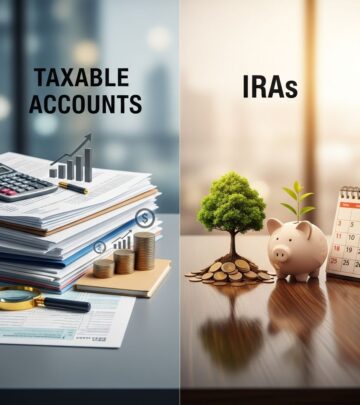
Taxable brokerage accounts require you to pay income tax on earnings in the year received, while tax-advantaged accounts like IRAs and 401(k)s either defer taxes until withdrawal or eliminate taxes entirely on qualifying withdrawals, accelerating long-term growth.
Can I withdraw from retirement accounts before retirement age?
Generally, early withdrawals from retirement accounts trigger taxes and 10% penalties before age 59½. However, Roth IRAs allow penalty-free withdrawal of contributions at any age, and some plans offer exceptions for specific hardships.
Should I prioritize 401(k) contributions over IRA contributions?
Financial professionals typically recommend maximizing employer 401(k) matching before funding IRAs, as the employer match represents immediate guaranteed returns. After capturing full matching, comparing contribution limits and investment options helps determine subsequent allocation.
Who should use UGMA or UTMA accounts?
Adults transferring assets to minors while maintaining investment control benefit from these account structures. They’re particularly valuable for larger gifts or when parents wish to guide investment decisions until children reach adulthood.
Are investment account fees important in selection?
Yes, investment account fees—including trading commissions, expense ratios, and account maintenance charges—meaningfully impact long-term returns. Careful research on fee structures at different providers helps minimize drag on investment growth.
References
- What Is an Investment Account? 5 Types to Know — NerdWallet. Accessed March 2026. https://www.nerdwallet.com/investing/learn/types-investment-accounts-know
- Types of Investment Accounts: Pros, Cons & Examples — Quicken. Accessed March 2026. https://www.quicken.com/blog/types-of-investment-accounts/
- Three of the Most Common Investment Account Types — Franklin Templeton. Accessed March 2026. https://www.franklintempleton.com/planning-and-learning/learn-about-investing/investing-basics/three-of-the-most-common-investment-account-types
- Types of Investment Accounts — Experian. Accessed March 2026. https://www.experian.com/blogs/ask-experian/types-of-investment-accounts/
- 13 Types of Investment Accounts to Know — Fidelity. Accessed March 2026. https://www.fidelity.com/learning-center/smart-money/investment-accounts-types
- Investment Accounts — FINRA.org. Accessed March 2026. https://www.finra.org/investors/investing/investment-accounts
- Investment Accounts: Types, Uses & How to Choose — Vanguard. Accessed March 2026. https://investor.vanguard.com/investor-resources-education/how-to-invest/investment-accounts
Similar Articles








Read full bio of medha deb