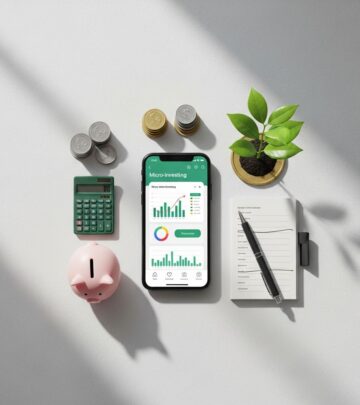
How to Start Investing With $100 or Less in 2026
Discover practical ways to grow your money starting with just $100 using apps, robo-advisors, and low-minimum investments in 2026.

You don’t need substantial wealth to begin investing. Modern tools like robo-advisors and user-friendly apps make it possible to launch an investment portfolio with $100 or even less. This accessibility democratizes wealth-building, allowing everyday people to participate in financial markets without high barriers to entry.
Contrary to the myth that investing is reserved for the affluent, numerous platforms now support micro-investments. From workplace retirement plans to bank accounts and innovative apps, your initial $100 can compound over time. Robo-advisors simplify the process by offering algorithm-driven recommendations, eliminating the need for deep financial expertise. While due diligence remains essential—such as reading reviews and assessing fees—several proven strategies stand out for beginners.
Contribute to Your Workplace 401(k)
One of the most effective starting points is your employer’s 401(k) plan, especially if it offers a matching contribution. Employer matches provide an instant return, independent of market performance. For instance, a common match is 50 cents per dollar up to 6% of salary, or dollar-for-dollar up to 5%. This means a $100 contribution could instantly become $200, effectively doubling your money upfront.
Within a 401(k), options abound, but simplicity reigns with target-date funds. These funds adjust asset allocation based on your expected retirement date, shifting from aggressive stocks to conservative bonds as the date approaches. They offer diversification and hands-off management, ideal for novices.
- Pros: Free matching money, tax advantages, automatic payroll deductions.
- Cons: Limited investment choices, potential fees, early withdrawal penalties.
According to the U.S. Department of Labor, over 60 million Americans participate in 401(k) plans, underscoring their popularity and reliability for long-term growth.
Compare Online Brokerages
Online brokerages and robo-advisors open doors to stocks, bonds, mutual funds, and ETFs with minimal deposits. Prioritize platforms with low or no minimums, competitive fees, and educational resources. Services like Vanguard, Fidelity, and Schwab often require little to start and support fractional shares.
| Brokerage | Minimum Deposit | Key Features | Fees |
|---|---|---|---|
| Fidelity | $0 | Fractional shares, robo-advisor, no commissions | 0% commissions |
| Vanguard | $0-$3,000 (fund-dependent) | Low-cost index funds, ETFs | Low expense ratios |
| Charles Schwab | $0 | Robo-advisor, extensive research tools | 0% commissions |
| M1 Finance | $100 | Custom pies, fractional shares, automation | No trading fees |
Shopping around ensures you select a brokerage aligning with your goals. Robo-advisors like Betterment or Wealthfront manage portfolios for a small annual fee (around 0.25%), using modern portfolio theory for optimized diversification.
Buy Fractional Shares
Fractional shares revolutionize stock investing for small budgets. Stocks from giants like Apple (often over $200/share) or Amazon were once out of reach, but now platforms allow purchases of portions—like 0.5 shares of Apple with $100.
Brokerages such as Robinhood, Fidelity, and M1 Finance enable dollar-based investing. This democratizes access to high-growth companies. For example, Warren Buffett advocates low-cost S&P 500 index funds, achievable via fractional shares in Vanguard’s VOO or SPY ETFs.
- Invest $100 across blue-chip stocks or indices.
- Benefits: Diversification, low entry, liquidity.
- Example: $30 in Apple, $30 in Microsoft, $40 in S&P 500 ETF.
Dollar-cost averaging—investing fixed amounts regularly—mitigates volatility, as emphasized by long-term investors.
Buy Real Estate
Real estate investment is feasible with $100 through Real Estate Investment Trusts (REITs). REITs pool funds to own properties, distributing rental income as dividends. They trade like stocks, offering liquidity without landlord duties.
Publicly traded REITs like Plymouth Industrial REIT (PLYW) or STORE Capital (STOR) are accessible via brokerages with no high minimums. Crowdfunding platforms like Fundrise or DiversyFund may require $500+, but brokerage-purchased shares start lower. American Homeowner Preservation offers distressed mortgage investments as a non-REIT alternative.
REITs provide diversification, inflation hedging, and yields often exceeding 4%. The SEC regulates them, ensuring transparency.
- Equity REITs: Own properties.
- Mortgage REITs: Finance real estate.
- Hybrid: Both.
High-Yield Savings Accounts
For low-risk growth, high-yield savings accounts (HYSAs) beat traditional savings (0.01-0.45% APY) with rates near 5% in 2026. No-minimum options from Salem Five Direct, American Express, Marcus by Goldman Sachs, and Discover suit $100 starters.
FDIC-insured up to $250,000, they offer liquidity and compounding. Per recent surveys, top rates are 4.5-5.25% APY, far surpassing inflation.
| Bank | APY | Minimum Deposit |
|---|---|---|
| Salem Five Direct | 5.00% | $100 |
| Marcus by Goldman Sachs | 4.40% | $0 |
| Discover | 4.25% | $0 |
| American Express | 4.30% | $0 |
Other Investment Options
Beyond the above, consider index funds/ETFs for broad market exposure. Vanguard’s S&P 500 funds mirror top U.S. companies with expense ratios under 0.05%. Roth IRAs allow tax-free growth if eligible (2026 limit: $7,000 under age 50).
Crowdfunding via platforms like Groundfloor (real estate notes, $10 min) or micro-investing apps like Acorns (rounds up purchases) add variety. Always prioritize emergency funds first (3-6 months expenses in cash/CDs yielding ~4%).
Frequently Asked Questions (FAQs)
Is it worth investing $100?
Yes, it’s a valuable first step. $100 kickstarts compounding, but commit to regular contributions via auto-transfers for meaningful growth. Habits trump initial amount.
How much money will $100 a month grow to?
At 9.2% average annual return (historical S&P 500 10-year avg per Goldman Sachs), $100/month becomes ~$19,972 in 10 years. Use long-term, low-cost funds.
Are fractional shares safe?
Yes, when bought through reputable SIPC-insured brokers. They track full shares’ value and provide diversification.
What’s the best first investment?
Prioritize employer 401(k) match, then low-cost index funds or HYSAs based on risk tolerance.
Can I lose my $100?
Possible with stocks/REITs due to volatility; HYSAs are principal-protected. Diversify and invest long-term to mitigate risks.
Starting small builds discipline. Track progress, reinvest dividends, and scale up. In 2026, fintech innovations continue lowering barriers, empowering more investors.
References
- How to Start Investing With $100 or Less in 2026 — MoneyRates. 2025. https://www.moneyrates.com/investment/invest-with-100-dollars.htm
- How To Invest $100 (the way a Billionaire recommends) — SeedTime. 2023-01-15. https://seedtime.com/how-to-invest-100/
- Retirement topics – 401(k) and profit-sharing plan contribution limits — U.S. Department of Labor. 2025-11-01. https://www.dol.gov/agencies/ebsa/about-ebsa/our-activities/resource-center/fact-sheets/401k-plan-limits
- High-yield savings accounts — FDIC. 2026-01-01. https://www.fdic.gov/resources/bankers/savings-accounts/
- REIT Basics — SEC. 2024-06-15. https://www.sec.gov/education/smallbusiness/goingpublic/reits
Similar Articles








Read full bio of medha deb