Introduction to Value at Risk (VaR) – Part 1
Master the fundamentals of Value at Risk and learn how to measure portfolio risk effectively.

Understanding Value at Risk (VaR)
Value at Risk, commonly abbreviated as VaR, has become one of the most widely used risk measurement tools in the financial industry. It represents a statistical approach to quantifying the maximum potential loss that a portfolio or investment position might experience over a specific time period, given a particular confidence level. VaR answers a fundamental question that every investor and financial institution asks: “What is the worst-case scenario for my investments?”
The concept of VaR emerged from the need for a standardized method to measure and communicate risk across different asset classes and trading desks. Before VaR became prevalent, financial institutions relied on various ad-hoc methods and subjective assessments of risk exposure, making it difficult to compare risk levels across different portfolios and business units. VaR provided a unified framework that allows risk managers, traders, and executives to understand the magnitude of potential losses in concrete, numerical terms.
The Fundamentals of VaR
At its core, VaR is defined by three key parameters: the portfolio value, the time horizon, and the confidence level. To properly understand VaR, consider a practical example: an investor might state that their portfolio has a daily VaR of $100,000 at a 95% confidence level. This statement means that there is only a 5% probability (or a 1 in 20 chance) that the portfolio will lose more than $100,000 in a single day.
The time horizon used in VaR calculations can vary significantly depending on the application. Banks and trading firms often calculate daily VaR for their trading positions, while long-term investors and pension funds might calculate monthly or annual VaR for their strategic portfolios. The confidence level represents the probability threshold—a 95% confidence level is common in industry practice, though some institutions use 99% for more conservative estimates.
Calculating VaR: Three Primary Methodologies
Financial professionals employ several established methodologies to calculate VaR, each with distinct advantages and limitations. Understanding these approaches is essential for implementing VaR effectively in risk management frameworks.
The Historical Simulation Method
The historical simulation approach represents one of the most intuitive VaR calculation methods. This methodology works by examining past market returns and assuming that historical patterns will repeat in the future. To calculate VaR using historical simulation, practitioners gather historical price data for all portfolio components over a sufficiently long period—typically several years of daily returns.
The process involves ranking past returns from worst to best, then identifying the return level that corresponds to the selected confidence interval. For instance, if calculating a 95% VaR based on five years of daily data (approximately 1,250 trading days), the analyst would look at the 63rd worst day—representing the 5% worst-case scenarios. The primary strength of this method lies in its simplicity and lack of distributional assumptions; it makes minimal theoretical assumptions about how returns are distributed.
However, historical simulation carries important limitations. It assumes that past market conditions perfectly predict future conditions, which may not hold during unprecedented market disruptions. Additionally, this method gives equal weight to all historical observations, potentially overweighting distant past events that may no longer be relevant.
The Parametric or Variance-Covariance Method
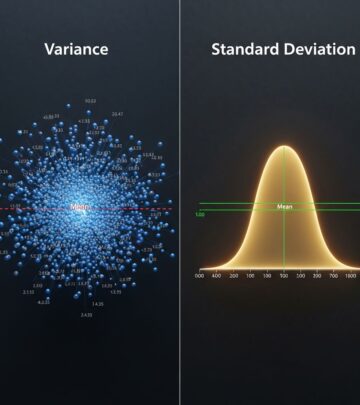
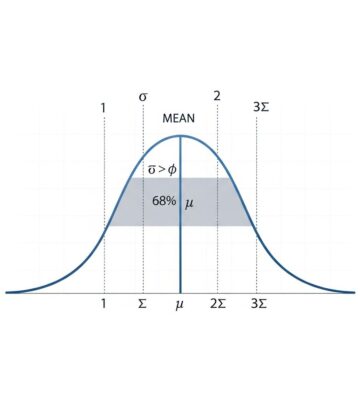
The parametric approach, also called the variance-covariance method, takes a different philosophical stance by assuming that asset returns follow a normal distribution. This method relies on two key statistical measures: the standard deviation (volatility) of returns and the correlation coefficients between different assets in the portfolio.
Under the parametric framework, VaR can be calculated using a straightforward formula. For a portfolio with multiple assets, the calculation involves constructing a variance-covariance matrix that captures how different assets move together. The methodology then applies statistical properties of normal distributions to estimate the maximum likely loss at a given confidence level. A major advantage of this approach is its computational efficiency—once volatilities and correlations are estimated, VaR can be calculated quickly using matrix algebra.
The primary drawback of the parametric method is its reliance on the normality assumption. Financial returns, particularly in extreme market conditions, often exhibit fatter tails than normal distributions would predict. This means that the parametric method may systematically underestimate the frequency of large losses during market crises, a phenomenon known as “tail risk.”
The Monte Carlo Simulation Method
Monte Carlo simulation offers a more sophisticated and flexible approach to VaR calculation. This computationally intensive method generates thousands or even millions of potential portfolio outcomes based on assumed statistical properties of asset returns. Each simulation represents a possible future market scenario, complete with randomly generated price movements for all portfolio components.
The strength of Monte Carlo simulation lies in its flexibility. Unlike the parametric method, it does not require assuming normal distributions; practitioners can incorporate any distributional assumptions deemed appropriate. Additionally, this method can easily handle complex derivatives and non-linear relationships between assets. However, the trade-off involves significant computational requirements and the need to specify numerous assumptions about future market behavior, each of which could introduce modeling error.
VaR in Risk Management Practice
Value at Risk has become integral to how financial institutions manage, measure, and report risk. Banks use VaR to set position limits for their trading desks, ensuring that no single desk or trader can expose the institution to losses exceeding predetermined thresholds. Risk committees regularly review VaR reports to understand the institution’s aggregate risk profile across all business units.
For portfolio managers, VaR provides a quantitative framework for communicating risk to investors and stakeholders. Rather than vague statements about portfolio risk, managers can provide specific numerical estimates of potential losses, enhancing transparency and facilitating informed decision-making. Insurance companies use VaR to determine capital reserves needed to protect against adverse market movements.
The regulatory framework has also embraced VaR. The Basel Accord, which sets international standards for bank capital adequacy, incorporates VaR calculations in determining minimum capital requirements. Financial institutions must maintain sufficient capital reserves to cover potential losses estimated by their VaR models.
Understanding VaR Limitations and Criticisms
Despite its widespread adoption, VaR has significant limitations that practitioners must understand. First, VaR tells you the maximum expected loss at a given confidence level but provides no information about how large losses could be when they exceed the VaR threshold. During a severe market crisis, losses could potentially far exceed the VaR estimate.
Second, VaR calculations depend critically on historical volatility and correlation estimates. During periods of market stress, correlations often increase dramatically as assets become more correlated with overall market movements. Traditional VaR models may not adequately capture these correlation changes, leading to significant underestimation of risk during the periods when risk matters most.
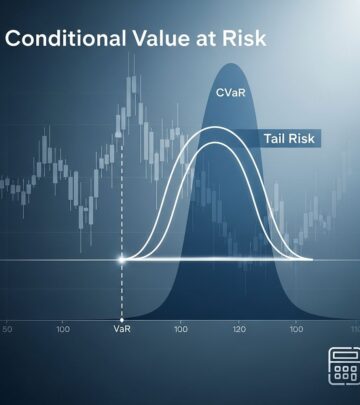
Third, VaR’s focus on a single confidence level provides an incomplete picture of risk. A portfolio with a 95% VaR of $1 million tells you nothing about potential losses in the worst 1% or 0.1% of scenarios. A complementary measure called Expected Shortfall or Conditional VaR addresses this limitation by measuring the average loss when losses exceed the VaR threshold.
The 2008 financial crisis highlighted another critical limitation: model risk. Many financial institutions relied on VaR models that failed spectacularly during the crisis, as unprecedented market conditions invalidated the models’ underlying assumptions. This experience demonstrated that VaR should not be the sole tool for risk management.
VaR and Portfolio Diversification
An important application of VaR involves understanding how portfolio diversification reduces risk. Consider that gold has demonstrated particular value in reducing portfolio VaR during periods of market stress. When equity markets experience extreme declines, gold’s correlation to traditional equities often turns negative, providing a hedge against catastrophic portfolio losses. Research indicates that relatively small allocations to gold—ranging between 2.5% and 9.0%—can reduce a portfolio’s weekly 1% and 2.5% VaR by between 0.1% and 18.5%. During the 2007-2009 financial crisis, portfolios that included an 8.5% allocation to gold were able to reduce total losses by almost 5% relative to equivalent portfolios without gold.
This illustrates how VaR can guide strategic asset allocation decisions by identifying which assets provide genuine diversification benefits during the risk periods that matter most.
Practical Application Example
To illustrate VaR in practice, consider a hypothetical investment fund with a market value of $100 million. Using historical simulation of the past three years of daily returns, the fund calculates that its daily VaR at the 95% confidence level is $2 million. This means that under normal market conditions, the fund expects that only on one day out of every 20 (5% probability) would it experience a loss exceeding $2 million. Conversely, the fund expects to experience losses greater than $2 million on approximately 13 days per year.
The fund’s risk manager uses this information to determine appropriate capital reserves and to communicate risk to investors. However, the manager also recognizes that VaR provides an incomplete picture. During periods of extreme market stress—such as the 2008 crisis or the March 2020 pandemic-driven market disruption—actual losses could easily exceed the $2 million VaR estimate. Therefore, the manager supplements VaR with stress testing, scenario analysis, and examination of tail risk to develop a more comprehensive risk picture.
Connecting VaR to Expected Shortfall
As mentioned previously, Expected Shortfall (ES), also known as Conditional VaR or Tail VaR, addresses one of VaR’s primary limitations. While VaR measures the maximum loss at a given confidence level, Expected Shortfall measures the average loss when losses exceed the VaR threshold. For the $100 million fund mentioned above, ES might indicate that on those days when losses exceed $2 million, the average loss is $3 million. This provides critical information about tail risk that VaR alone cannot capture.
VaR and Market Stress Conditions
One of VaR’s most significant limitations becomes apparent during market stress. In normal times, correlations between different asset classes remain relatively stable and predictable. However, during market crashes, correlations often converge toward 1.0, meaning that assets move together rather than providing diversification benefits. Traditional VaR models that rely on average correlations systematically underestimate risk during the exact periods when risk management is most critical.
Research demonstrates this phenomenon clearly. During periods when US equity returns fall by more than two standard deviations—representing extreme market dislocations—correlations between gold and developed market equities become negative, turning substantially negative compared to average correlations. This dynamic illustrates why risk managers must complement VaR with scenario analysis and stress testing that explicitly consider how correlations change during market crises.
Frequently Asked Questions (FAQs)
Q: What is the most commonly used confidence level for VaR calculations?
A: The 95% confidence level is most common in industry practice. This means there is a 5% probability (or a 1 in 20 chance) that losses will exceed the calculated VaR. Banks and regulators sometimes use 99% confidence levels for more conservative estimates.
Q: Which VaR calculation method is most accurate?
A: No single method is universally most accurate. Historical simulation works well when past patterns repeat but fails during unprecedented conditions. The parametric method is computationally efficient but may underestimate tail risk. Monte Carlo simulation is flexible but computationally demanding. Most sophisticated institutions use multiple methods for comparison.
Q: Can VaR ever be negative?
A: No, VaR represents a potential loss amount and is always expressed as a positive number. However, it’s calculated from a negative return perspective—a VaR of $1 million means a potential loss of $1 million, not a gain.
Q: Why did VaR fail to prevent the 2008 financial crisis?
A: VaR models rely on historical data and assumptions that break down during unprecedented market conditions. The 2008 crisis involved extreme correlations and volatility far beyond historical norms, invalidating the models’ underlying assumptions. VaR is best viewed as one tool among many, not as a complete risk management solution.
Q: How frequently should VaR be recalculated?
A: Trading firms typically calculate daily VaR because market conditions can change rapidly. Long-term investors might calculate VaR monthly or quarterly. The appropriate frequency depends on how quickly the portfolio composition and market conditions change.
Q: What time horizon should be used for VaR calculations?
A: Time horizon depends on the application. Traders use daily or intraday VaR, while institutional investors often use 10-day or monthly VaR. Longer horizons provide more conservative estimates, as losses typically compound over time.
Complementing VaR with Other Risk Measures
Sophisticated risk management frameworks recognize VaR’s limitations and employ additional measures. Stress testing involves calculating portfolio losses under specific historical or hypothetical scenarios—the 1987 stock market crash, the 1998 Russian financial crisis, or the 2008 credit crisis. Scenario analysis asks “what if” questions about market conditions that might not appear in historical data.
Value at Risk serves as an essential foundation for modern risk management, but it is most effective when combined with other tools. Expected Shortfall addresses VaR’s inability to measure tail risk. Stress testing and scenario analysis capture risks outside the model’s assumptions. Together, these complementary approaches provide a comprehensive risk management framework.
References
- Gold: Hedging against tail risk — SPDR Gold Trust. 2010. https://www.spdrgoldshares.com/media/GLD/file/WOR5963_Gold_Hedging_against_tail_risk.pdf
- A Survey of Value at Risk Methodologies — Elif Yetim, Bilgi University. 2017. https://openaccess.bilgi.edu.tr/server/api/core/bitstreams/40f44d4b-e612-43bc-a780-a91b718bbc7c/content
- Deep learning in the stock market—a systematic survey of practice and applications — Multiple Authors. 2022. https://pmc.ncbi.nlm.nih.gov/articles/PMC9245389/
Similar Articles








Read full bio of Sneha Tete