Intermediate Financial Goals: 5 Practical Goals For 1-10 Years
Achieve financial stability with intermediate goals: emergency funds, home down payments, debt payoff, and education savings over 1-10 years.
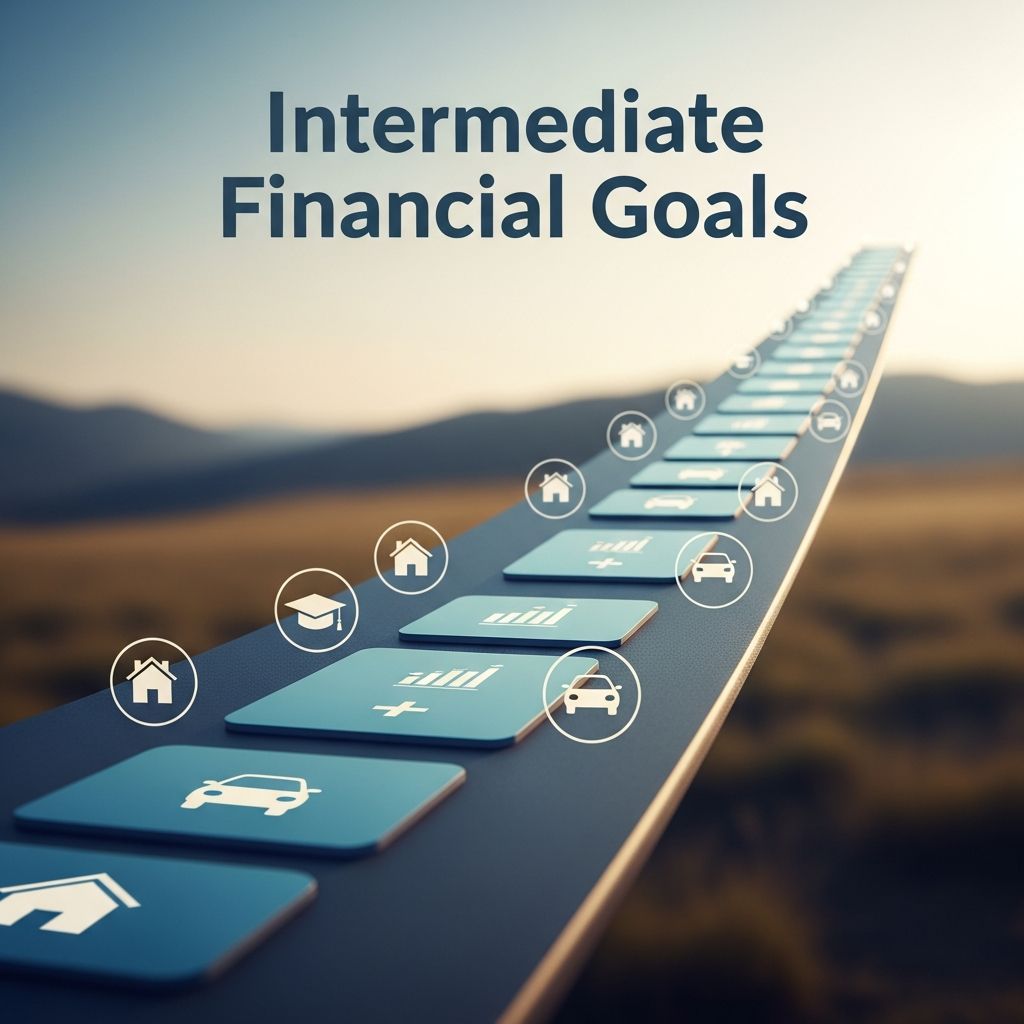
Intermediate financial goals provide a crucial bridge between immediate needs and long-term dreams, typically spanning one to ten years. These objectives, such as building an emergency fund or saving for a home, demand strategic planning to ensure financial stability and progress toward larger aspirations.
What Are Intermediate Financial Goals?
Intermediate financial goals are objectives targeted for achievement within a mid-range timeframe, generally one to five years, though some may extend up to a decade. Unlike short-term goals achieved in under a year, like paying off a credit card, or long-term goals like retirement spanning over ten years, intermediate goals align with major life milestones requiring balanced ambition and practicality.
These goals necessitate assessing your current financial status, setting clear targets, and mapping actionable steps. They maintain momentum, preventing stagnation between quick wins and distant horizons. For instance, goals-based financial planning emphasizes translating life events into concrete projections, such as estimating home purchase costs or retirement needs based on lifestyle preferences.
Examples of Intermediate Financial Goals
Here are five prominent examples of intermediate financial goals, each with strategies to pursue them effectively:
1. Building an Emergency Fund
An emergency fund acts as your financial safety net for unexpected events like job loss or medical bills. Financial experts recommend saving three to six months’ worth of living expenses, adjustable based on income stability and family size.
Start by calculating monthly essentials—housing, food, utilities, transportation—and multiply by the target months. Automate transfers to a high-yield savings account post-paycheck. If building this fund takes over a year due to tight budgets, prioritize it ruthlessly by cutting non-essentials. This goal fosters resilience, avoiding high-interest debt during crises.
2. Saving for a Down Payment on a Home
Homeownership marks a pivotal milestone, and saving for a 20% down payment minimizes mortgage costs and sidesteps private mortgage insurance (PMI). In rising markets, timelines influence targets; earlier purchases may require less due to price growth.
Research local markets to estimate costs, factoring in desired location and size. Use budgeting tools to allocate 10-20% of income monthly. High-yield savings or CDs preserve principal while earning interest. Track progress with visualizers showing scenario outcomes, adjusting for market shifts.
3. Paying Off Student Loan Debt
Student debt burdens many, averaging under $40,000 in 2023 per the Education Data Initiative. Prioritizing repayment liberates future income, reduces stress, and boosts credit health.
Strategies include extra principal payments to shorten terms, refinancing for lower rates (if credit qualifies), or consolidation for simplified management. Debt avalanche (high-interest first) or snowball (smallest balance first) methods suit different motivations. Integrate into broader plans, balancing with other goals like retirement.
4. Saving for Home Improvements
Enhancing your home boosts value, comfort, and equity without full relocation costs. Projects like kitchen remodels or energy-efficient upgrades justify dedicated savings to evade credit card debt.
Estimate costs via contractor quotes or online calculators, then fund monthly into a segregated account. Prioritize high-ROI improvements, such as roofing or HVAC, per federal guidelines on energy incentives. This goal supports sustainable living and property appreciation.
5. Saving for Your Child’s Education
Rising tuition demands early action; 529 plans offer tax-deferred growth and state incentives. Project costs using tools like the College Board’s calculator, aiming for consistent contributions.
Start small, increasing as income grows. These tax-advantaged vehicles compound effectively over intermediate horizons, aligning with goals-based planning’s outcome focus.
Intermediate Financial Goals vs. Short- and Long-Term Goals
Distinguishing goal types optimizes allocation:
- Short-term goals (under 1 year): Vacation savings, minor debt payoff, or initial emergency fund deposits. These demand liquidity-focused, low-risk strategies like checking accounts.
- Intermediate goals (1-10 years): As detailed, these permit moderate risk via bonds or balanced funds, blending growth and preservation.
- Long-term goals (over 10 years): Retirement or estate building suit equities for compounding, per comprehensive planning integrating taxes and risks.
Timelines flex by situation; an emergency fund might be short-term for high earners but intermediate otherwise.
| Goal Type | Timeline | Examples | Risk Level | Vehicle |
|---|---|---|---|---|
| Short-term | <1 year | Vacation, small debt | Low | Savings account |
| Intermediate | 1-10 years | Down payment, education | Moderate | CDs, bonds |
| Long-term | >10 years | Retirement, estate | High | Stocks, 401(k) |
How to Set and Achieve Intermediate Financial Goals
Implement via goals-based planning: Clarify objectives, project costs/deadlines, prioritize, invest accordingly, and monitor.
- Assess finances: Track income, expenses, net worth.
- Set SMART targets: Specific, Measurable, Achievable, Relevant, Time-bound.
- Prioritize: Rank by urgency (e.g., emergency fund first).
- Build plan: Budget allocations, automate savings.
- Invest wisely: Match risk to horizon; use visualizers for scenarios.
- Review quarterly: Adjust for life/market changes.
Consider risk tolerance, dependents, and buffers. A $75K couple with kids differs from a single earner, dictating aggression.
Common Challenges and Solutions
- Budget constraints: Cut discretionary spending; side hustle.
- Market volatility: Diversify; focus on long horizon.
- Motivation dips: Milestone rewards; advisor accountability.
- Inflation: Index savings to CPI; higher-yield options.
Bottom Line
Intermediate goals like emergency funds, down payments, debt payoff, improvements, and education savings fortify your financial foundation over 1-10 years. Strategic planning turns ambitions into reality, paving paths to prosperity.
Frequently Asked Questions (FAQs)
Q: What is the ideal size for an emergency fund?
A: Aim for 3-6 months of living expenses, extending to 12 for variable incomes or single earners.
Q: How much down payment is needed for a home?
A: 20% avoids PMI, but 3-5% conventional or FHA options exist for starters.
Q: Should I pay off student loans or save for retirement first?
A: Balance both; high-interest debt first if >6-7%, else prioritize tax-advantaged retirement.
Q: Are 529 plans only for college?
A: Primarily, but expandable to K-12, apprenticeships per recent laws.
Q: How often should I review goals?
A: Quarterly or post-life events; annually minimum.
References
- How to Implement Goals-Based Financial Planning — SmartAsset.com. 2024. https://smartasset.com/advisor-resources/goals-based-financial-planning
- Examples of Intermediate and Medium-Term Financial Goals — SmartAsset.com. 2023. https://smartasset.com/personal-finance/intermediate-financial-goals
- Consumer Financial Protection Bureau: Emergency Funds — U.S. Government (CFPB.gov). 2024-05-15. https://www.consumerfinance.gov/consumer-tools/emergency-funds/
- Federal Reserve: Household Debt and Credit Report — Federal Reserve Bank of New York. 2024-02-01. https://www.newyorkfed.org/microeconomics/hhdc.html
- 529 Plans: Questions and Answers — U.S. Department of Education. 2024. https://www.ed.gov/about/ed-offices/osfep/529-plans
Similar Articles








Read full bio of Sneha Tete