Interest Rate Swap: Definition, Types, and Uses
Understand interest rate swaps: derivative contracts for managing interest rate risk and optimizing financial positions.
What Is an Interest Rate Swap?
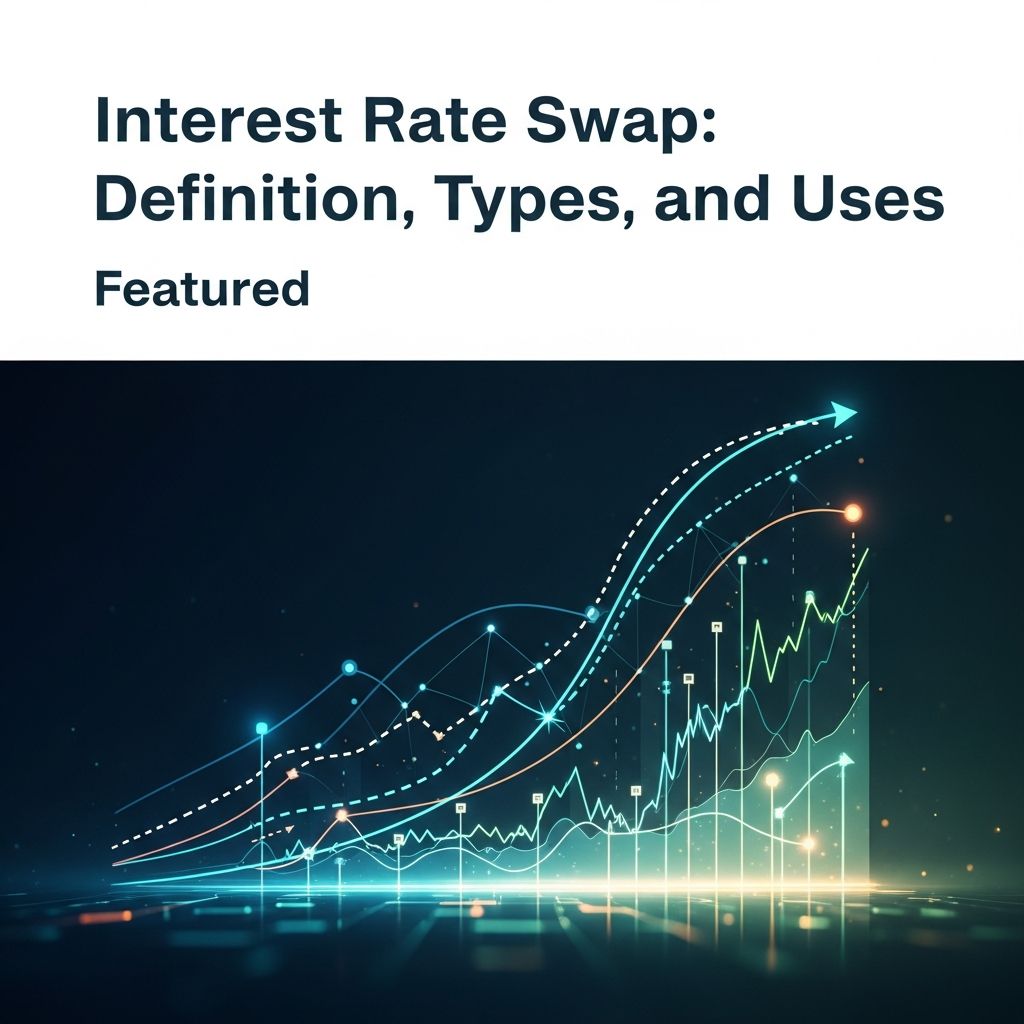
An interest rate swap is a derivative contract in which two parties exchange streams of interest payments on a notional principal for a set period. These financial instruments have become fundamental tools in modern finance, allowing participants to manage interest rate exposure, adjust portfolio duration, and express strategic views on yield curves. The most common form of interest rate swap exchanges a fixed rate for a floating rate denominated in the same currency, though numerous variations exist to meet diverse financial objectives.
Interest rate swaps represent one of the most widely used derivatives in global financial markets. They provide flexibility and efficiency for banks, corporations, institutional investors, and other market participants seeking to optimize their interest rate exposure without restructuring underlying debt obligations. By understanding the mechanics and applications of interest rate swaps, financial professionals can better manage risk and enhance portfolio performance.
History and Market Development
The evolution of interest rate swaps reflects broader developments in financial markets and regulatory frameworks. Early arrangements resembling swaps emerged in the 1970s as back-to-back or parallel loans designed to navigate exchange controls and currency restrictions. These precursor structures laid the groundwork for more sophisticated derivative instruments.
A widely cited early landmark occurred in 1981 when IBM and the World Bank arranged a currency swap through Salomon Brothers, which helped popularize swap techniques across the financial industry. The first interest rate swap is commonly dated to 1982, marking the beginning of this derivative market. Throughout the 1980s and 1990s, the interest rate swap market expanded rapidly as financial institutions recognized the value of these instruments for hedging and portfolio management.
Standard documentation and definitions from the International Swaps and Derivatives Association (ISDA) developed during the 1990s and 2000s significantly supported market growth and established common terminology. These standards enabled greater market liquidity and reduced transaction costs. Following the 2007-2008 financial crisis, pricing methodologies for collateralized swaps shifted to OIS (overnight index swap) discounting and multi-curve approaches, reflecting the increased importance of collateral and funding costs in derivative valuation.
From 2021 to 2024, regulators successfully completed a major transition from LIBOR to overnight risk-free rates. Remaining synthetic sterling and United States dollar LIBOR settings ceased in 2024, marking the end of LIBOR in mainstream use and necessitating adaptation across the swap market.
Mechanics of Interest Rate Swaps
Understanding how interest rate swaps function requires examining their structural components and operational mechanics. A standard interest rate swap contains two legs linked to the same notional amount, with each leg serving a distinct purpose in the overall transaction.
The Fixed Leg
The fixed leg of an interest rate swap pays a fixed rate on scheduled accrual periods determined at the swap’s inception. This rate remains constant throughout the swap’s life, providing certainty and predictability for parties seeking to lock in borrowing or lending rates.
The Floating Leg
The floating leg pays a rate set at each reset date by a reference index such as the SOFR (Secured Overnight Financing Rate), SONIA (Sterling Overnight Index Average), or €STR (Euro Short-Term Rate). Payments are exchanged on corresponding payment dates, with the rate adjusting periodically based on market conditions. This variable nature allows parties to benefit from favorable rate movements while hedging against adverse changes.
Day-Count and Business-Day Conventions
Day-count and business-day conventions follow market standards defined in documentation such as the ISDA Interest Rate Derivatives Definitions and relevant rulebooks for on-venue trading. These standardized conventions ensure consistency across transactions and facilitate efficient settlement processes.
Types of Interest Rate Swaps
The interest rate swap market encompasses numerous structures tailored to specific financial objectives and market conditions. Understanding these variations enables market participants to select instruments aligned with their risk management and investment strategies.
Fixed-for-Floating Swaps
Fixed-for-floating swaps exchange a fixed rate for a floating index in the same currency. This represents the most common and straightforward swap structure, widely used for hedging interest rate risk and adjusting asset-liability duration.
Basis Swaps
Basis swaps exchange a floating rate for a floating rate of a different tenor of the same index or different indices entirely. These swaps address situations where parties have exposure to different floating rate benchmarks and seek to align their cash flows or speculate on basis movements.
Overnight Index Swaps (OIS)
Overnight index swaps pay a fixed rate versus a compounded overnight risk-free rate such as SOFR, SONIA, or €STR. OIS contracts have gained prominence following the financial crisis and LIBOR transition, serving as important pricing benchmarks and hedging instruments.
Forward-Start and Deferred-Start Swaps
Forward-start and deferred-start swaps begin on a future date rather than the trade date. These structures allow parties to hedge future interest rate exposure or time transactions to coincide with specific business events or cash flow needs.
Amortising and Accreting Swaps
Amortising and accreting swaps use notionals that change over time, either decreasing or increasing throughout the swap’s life. These structures align swap cash flows with underlying loan amortization schedules or other assets and liabilities with changing principal amounts.
Constant-Maturity Swaps
Constant-maturity swaps link one leg to a constant-maturity swap rate, creating exposure to long-term interest rate movements. These structures provide sophisticated hedging capabilities for parties with complex interest rate exposure profiles.
Primary Uses and Applications
Interest rate swaps serve multiple important functions in financial markets, ranging from hedging strategies to portfolio optimization and speculative positioning.
Hedging Interest Rate Exposure
The primary use of interest rate swaps involves hedging interest rate risk. A corporation with floating-rate debt can enter a swap to pay fixed rates, effectively converting floating-rate obligations to fixed-rate liabilities. This hedging activity protects against adverse interest rate movements while allowing the organization to benefit from favorable rate declines through the floating-rate component.
Adjusting Asset and Liability Duration
Financial institutions and investors use interest rate swaps to adjust the duration of their portfolios without restructuring underlying holdings. By entering appropriate swap positions, market participants can modify interest rate sensitivity to align with their risk tolerance and investment objectives.
Expressing Yield Curve Views
Market participants use interest rate swaps to express views on the level or shape of the yield curve. Sophisticated investors and traders construct swap positions reflecting their economic outlook and profit from anticipated interest rate movements.
SOFR Futures and Swaps Ecosystem
In United States markets, the futures and swaps ecosystem now links SOFR futures and SOFR-linked swaps following the conversion of Eurodollar futures and USD LIBOR swaps in 2023. This integration has enhanced market efficiency and provided additional tools for interest rate management.
Pricing and Valuation
Interest rate swap valuation requires sophisticated mathematical frameworks that account for multiple factors including discount rates, forward curves, and collateral considerations. The swap’s mark-to-market value reflects changes in market conditions since the swap’s initiation. Valuation adjustments occur as floating rates reset and discount factors change, potentially converting positions from assets into liabilities or vice versa.
Following the 2008 financial crisis, collateralized swaps are commonly discounted using the overnight index swap curve that matches the collateral rate specified under the credit support annex. This practice reflects the importance of collateral and funding costs in derivative pricing, leading to multi-curve frameworks that separate discounting from forward-rate projection.
Risk Considerations
Interest rate swaps expose users to several categories of financial risk requiring careful management and monitoring.
Interest Rate Risk
The main market risk is interest rate risk, since changes in discount factors and forward rates alter present value and can turn a position from an asset into a liability. Market participants must continuously monitor interest rate movements and their portfolio impacts.
Basis Risk
Basis risk can arise when cash flows reference different floating rates or tenors, including in the post-LIBOR environment where differences between risk-free rates can be material. This mismatch between hedging instruments and underlying exposures can result in imperfect hedges.
Counterparty and Credit Risk
Swap transactions expose parties to counterparty credit risk, the possibility that the other party fails to meet its obligations. Credit support annexes and collateral agreements help mitigate this risk, particularly for larger or longer-dated positions.
Financial Reporting and Regulatory Compliance
Financial reporting for swaps reflects the various risks inherent in these instruments. Under IFRS 9, hedge accounting requirements replaced IAS 39 and align reporting more closely with risk management practices. Under US GAAP, ASC 815 governs derivatives and hedging, including targeted improvements issued since 2017. These accounting frameworks ensure transparent financial reporting and consistency across organizations.
Market Benchmarks and Data
ICE Swap Rate, formerly ISDAFIX, serves as a benchmark for swap rates in major currencies and is used in the valuation of some interest rate swaps and swaptions and for certain close-out calculations. These benchmarks provide market participants with reference rates and enable efficient pricing across the swap market.
Frequently Asked Questions
What is the primary purpose of an interest rate swap?
The primary purpose of an interest rate swap is to allow parties to manage and hedge interest rate risk by exchanging different types of interest payment streams. For example, a company with floating-rate debt can swap to fixed-rate payments to protect against rising interest rates.
How do interest rate swaps differ from other derivatives?
Interest rate swaps are over-the-counter (OTC) derivative contracts that function differently from exchange-traded derivatives. Unlike futures or options, swaps involve direct exchange of cash flows between parties and typically require no upfront premium, though collateral arrangements are common.
What are the main types of interest rate swaps?
The main types include fixed-for-floating swaps, basis swaps, overnight index swaps (OIS), forward-start swaps, amortising and accreting swaps, and constant-maturity swaps. Each serves different hedging and investment objectives.
How is an interest rate swap valued?
Interest rate swap valuation involves calculating the present value of expected cash flows on both legs using appropriate discount rates and forward curves. Mark-to-market calculations reflect current market conditions and changes since swap inception.
What risks do interest rate swaps present?
Key risks include interest rate risk from changing discount factors and forward rates, basis risk from mismatched floating rate indices, counterparty credit risk, and operational risks. These risks require continuous monitoring and management.
How has the transition from LIBOR affected interest rate swaps?
The transition from LIBOR to risk-free rates like SOFR, SONIA, and €STR required substantial market adaptation. New swap conventions, pricing methodologies, and benchmark rates were established to ensure continued market functioning and consistency.
What accounting standards apply to interest rate swaps?
Under IFRS 9, hedge accounting requirements govern swap reporting and align it with risk management practices. Under US GAAP, ASC 815 provides comprehensive guidance on derivatives and hedging accounting.
References
- Interest rate swap — Wikipedia. 2025. https://en.wikipedia.org/wiki/Interest_rate_swap
Similar Articles








Read full bio of Sneha Tete