Interest Rate Parity: Definition, Formula & Examples
Master interest rate parity: Learn how exchange rates and interest rates interact in forex markets.
Understanding Interest Rate Parity
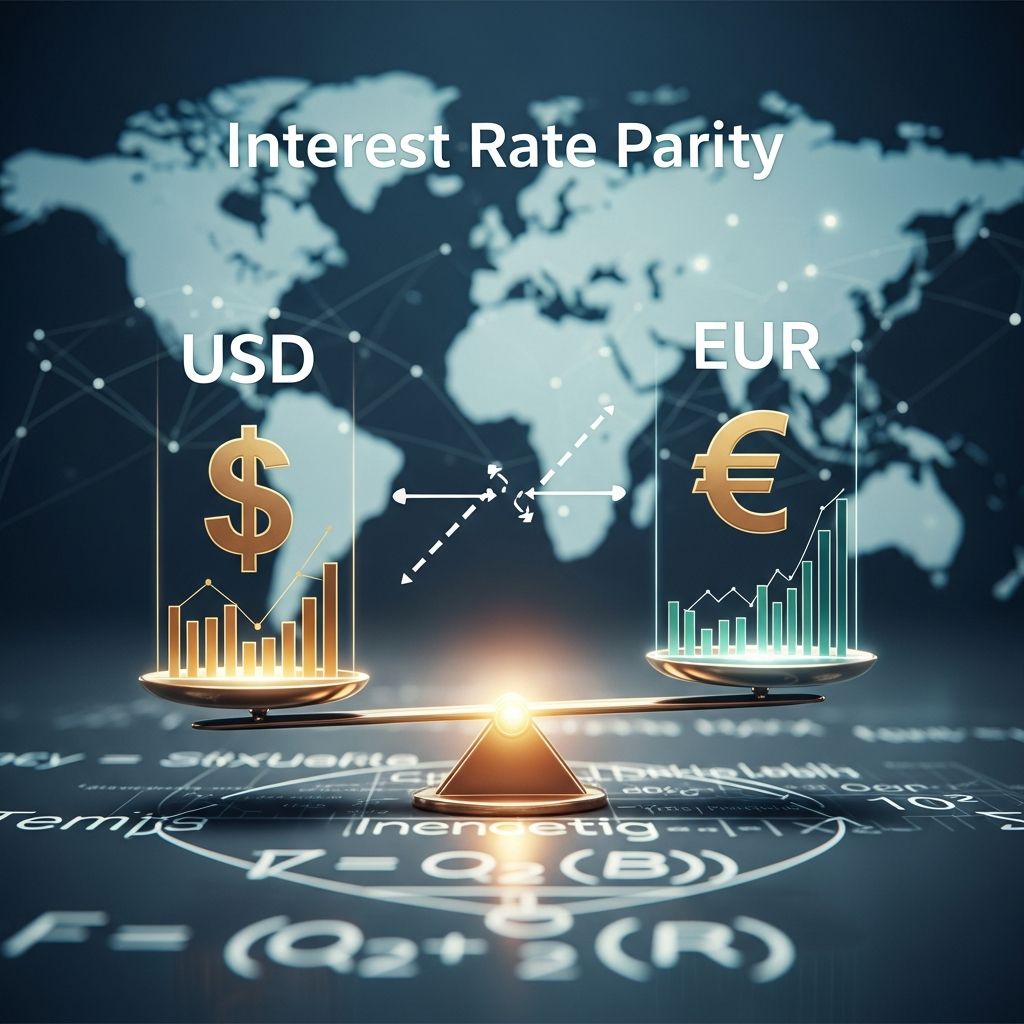
Interest rate parity (IRP) is a fundamental principle in international finance that describes the relationship between interest rates and currency exchange rates. It represents a no-arbitrage condition representing an equilibrium state under which investors compare interest rates available on bank deposits in two countries. The concept is essential for anyone involved in foreign exchange markets, international investing, or currency trading.
At its core, interest rate parity states that the interest rate differential between two countries should be equal to the differential between the forward and spot exchange rates of their currencies. This principle ensures that investors cannot earn riskless profits by exploiting differences in interest rates across borders without accounting for currency risk and exchange rate movements.
The fundamental concept behind IRP is that the interest rate differential between two countries will be equal to the differential between the spot exchange rate and the forward exchange rate. When you invest in different currencies, the hedged returns should be the same regardless of fluctuations in interest rates.
Core Concepts and Assumptions
Interest rate parity rests on two central assumptions that are crucial for the theory to function properly. Understanding these assumptions helps explain why IRP holds in most developed forex markets and under what conditions it might break down.
Capital Mobility
The first assumption is that capital is mobile, meaning investors can readily exchange domestic assets for foreign assets without significant barriers. In modern financial markets with advanced technology and relatively open capital accounts in developed countries, this assumption generally holds true. However, in countries with capital controls or restrictions on foreign investment, this assumption may not apply.
Perfect Substitutability of Assets
The second assumption is that assets have perfect substitutability, following from their similarities in riskiness and liquidity. This means that a domestic bank deposit and a foreign bank deposit of the same maturity and denomination are treated as equivalent investment opportunities by rational investors. Given capital mobility and perfect substitutability, investors would be expected to hold those assets offering greater returns, be they domestic or foreign assets.
The Two Forms of Interest Rate Parity
Interest rate parity takes on two distinctive forms, each with unique characteristics and applications in international finance. Understanding the difference between covered and uncovered IRP is essential for forex traders and international investors.
Uncovered Interest Rate Parity (UIRP)
Uncovered interest rate parity refers to the parity condition in which exposure to foreign exchange risk (unanticipated changes in exchange rates) is uninhibited. When the no-arbitrage condition is satisfied without the use of a forward contract to hedge against exchange rate risk, interest rate parity is said to be uncovered.
In uncovered interest rate parity, risk-neutral investors will be indifferent among the available interest rates in two countries because the exchange rate between those countries is expected to adjust such that the dollar return on dollar deposits is equal to the dollar return on foreign currency deposits, thereby eliminating the potential for uncovered interest arbitrage profits. Uncovered IRP helps explain the determination of the spot exchange rate.
The uncovered interest rate parity formula is expressed as:
ST(a/b) = S(a/b) × [(1 + ia) / (1 + ib)]
Where ST represents the expected spot rate at time T, S represents the current spot rate, and ia and ib represent the interest rates of countries A and B respectively.
Covered Interest Rate Parity (CIRP)
Covered interest rate parity refers to the condition in which a forward contract has been used to cover (eliminate exposure to) exchange rate risk. When the no-arbitrage condition is satisfied with the use of a forward contract to hedge against exchange rate risk, interest rate parity is said to be covered.
Investors will still be indifferent among the available interest rates in two countries because the forward exchange rate sustains equilibrium such that the dollar return on dollar deposits is equal to the dollar return on foreign deposits, thereby eliminating the potential for covered interest arbitrage profits. Furthermore, covered interest rate parity helps explain the determination of the forward exchange rate.
The covered interest rate parity formula is expressed as:
F = S × [(1 + id) / (1 + if)]
Where F represents the forward exchange rate, S represents the spot exchange rate, id represents the domestic interest rate, and if represents the foreign interest rate.
The Forward Discount and Exchange Rate Movements
When Covered Interest Parity holds strongly, which is generally the case under full capital account convertibility, the forward discount on the exchange rate will equal the nominal interest rate differential. A currency with lower interest rates is expected to trade at a forward premium relative to the higher-interest-rate currency.
The difference between a spot rate and forward rate is called a swap point. When the difference is positive, it’s called a forward premium, indicating that the currency is expected to appreciate. A negative difference is a forward discount, indicating that the currency is expected to depreciate. This relationship reflects investors’ expectations about future exchange rate movements based on interest rate differentials.
Real Interest Rate Parity
When both uncovered interest rate parity and purchasing power parity (PPP) hold together, they illuminate a relationship named real interest rate parity (RIRP). Real interest rate parity suggests that expected real interest rates represent expected adjustments in the real exchange rate.
RIRP rests on several assumptions, including efficient markets, no country risk premia, and zero change in the expected real exchange rate. The parity condition suggests that real interest rates will equalize between countries and that capital mobility will result in capital flows that eliminate opportunities for arbitrage. This relationship generally holds strongly over longer terms and among emerging market countries.
No-Arbitrage Concept and Forex Trading
Interest rate parity is fundamentally based on the no-arbitrage concept. In foreign exchange markets, this refers to the purchase and sale of a single asset enabling a trader to benefit from price differences. However, under interest rate parity, a forex trader cannot lock in the currency exchange rate from one country at a lower price while simultaneously purchasing another currency with a higher interest rate and expecting to make a riskless profit.
If interest rate parity does not hold, there may be potential opportunities to earn riskless profits from covered interest arbitrage. However, in efficient markets with low transaction costs, such arbitrage opportunities are quickly eliminated as traders exploit them, bringing the market back into equilibrium.
Practical Applications for Investors
Interest rate parity has significant practical applications for international investors and forex traders. When considering investments across different countries, understanding IRP helps investors evaluate whether the expected return compensates for the exchange rate risk. Forward exchange rates derived from IRP formulas allow investors to lock in exchange rates and eliminate currency risk through forward contracts.
For multinational corporations managing foreign currency exposure, covered interest rate parity provides a framework for determining appropriate forward contract pricing. If forward rates deviate significantly from those implied by IRP, it may signal market inefficiencies or opportunities for value arbitrage strategies.
Empirical Evidence and Market Reality
The empirical evidence on interest rate parity presents a mixed picture. Covered interest rate parity generally holds more strongly in practice than uncovered interest rate parity. Research based on actual trading data has shown that covered interest rate parity holds effectively in foreign exchange markets with efficient pricing and low transaction costs.
Uncovered interest rate parity, however, has shown weaker empirical support in many studies, suggesting that investors may require a risk premium for holding foreign currency assets. This deviation from theoretical predictions has led to the development of more sophisticated models that account for exchange rate risk premiums and other market frictions.
Comparing Covered and Uncovered Interest Rate Parity
| Aspect | Covered IRP | Uncovered IRP |
|---|---|---|
| Exchange Rate Risk | Hedged with forward contracts | Unhedged; full exposure |
| Exchange Rate Used | Forward exchange rate | Expected spot rate |
| Empirical Support | Generally holds strongly | Mixed/weaker support |
| Application | Forward rate determination | Spot rate forecasting |
| Risk Premium | Not typically relevant | May incorporate risk premium |
When Interest Rate Parity Breaks Down
While interest rate parity provides a useful framework, it doesn’t always hold perfectly in real markets. Several factors can cause deviations from the theoretical relationship:
- Capital Controls: Restrictions on international capital flows prevent the free movement of investment capital between countries.
- Transaction Costs: Fees, spreads, and other trading costs can create bands within which arbitrage is not profitable.
- Credit Risk: Differences in perceived creditworthiness between countries may create risk premiums not accounted for in basic IRP models.
- Liquidity Premiums: Assets with different liquidity characteristics may trade at different risk-adjusted returns.
- Macroeconomic Shocks: Unexpected economic events can cause sudden changes in exchange rates and interest rates, disrupting the equilibrium temporarily.
Interest Rate Parity and Exchange Rate Determination
Interest rate parity is also known as the asset approach to exchange rate determination. The interest rate parity theory assumes that the actions of international investors, motivated by cross-country differences in rates of return on comparable assets, induce changes in the spot exchange rate. This relationship highlights how investment decisions and capital flows drive currency values in foreign exchange markets.
The term “interest rate parity” developed in an era when the world operated under a system of fixed exchange rates. Under those circumstances, rate of return parity did mean the equalization of interest rates. However, when exchange rates can fluctuate, interest rate parity becomes rate of return parity, but the name was never changed.
Frequently Asked Questions
Q: What happens if interest rate parity does not hold?
A: If interest rate parity does not hold, there may be potential opportunities to earn riskless profits from covered interest arbitrage. However, in efficient markets, such opportunities are quickly eliminated as traders exploit them, bringing the market back into equilibrium.
Q: Why is covered interest rate parity more reliable than uncovered IRP?
A: Covered interest rate parity relies on actual forward contract pricing, which eliminates exchange rate risk through hedging. Uncovered IRP depends on expectations about future exchange rates, which are often uncertain and subject to forecasting errors, making it less reliable in practice.
Q: How do investors use interest rate parity in practice?
A: Investors use IRP formulas to determine whether international investments offer adequate returns relative to the exchange rate risk involved. They also use it to price forward contracts and evaluate whether current forward rates present trading opportunities.
Q: Can interest rate parity help predict exchange rates?
A: Uncovered interest rate parity theoretically helps explain spot exchange rate determination, but empirical evidence shows mixed results in actual forecasting. The relationship works better in theory than in predicting real-world currency movements.
Q: What is the international Fisher effect and how does it relate to IRP?
A: The international Fisher effect is related to real interest rate parity, which combines uncovered interest rate parity with purchasing power parity. Together, these relationships suggest that expected real interest rates equalize across countries.
References
- Interest Rate Parity — Wikipedia. https://en.wikipedia.org/wiki/Interest_rate_parity
- Overview of Interest Rate Parity — 2012 Book Archive. https://2012books.lardbucket.org/books/policy-and-theory-of-international-economics/s19-01-overview-of-interest-rate-pari.html
- What is Interest Rate Parity (IRP)? — GoCardless. https://gocardless.com/en-us/guides/posts/what-is-interest-rate-parity/
- Interest Rate Parity — Fiveable. https://fiveable.me/key-terms/principles-econ/interest-rate-parity
- Interest Rate Parity: Meaning, Types, Formula & More — Equirus Wealth. https://www.equiruswealth.com/blog/interest-rate-parity-meaning-types-formula-and-more
Similar Articles








Read full bio of medha deb