Interest Rate: Definition, Types, and Impact on Economy
Comprehensive guide to understanding interest rates, their types, and economic impact on borrowing and investing decisions.
What Is an Interest Rate?
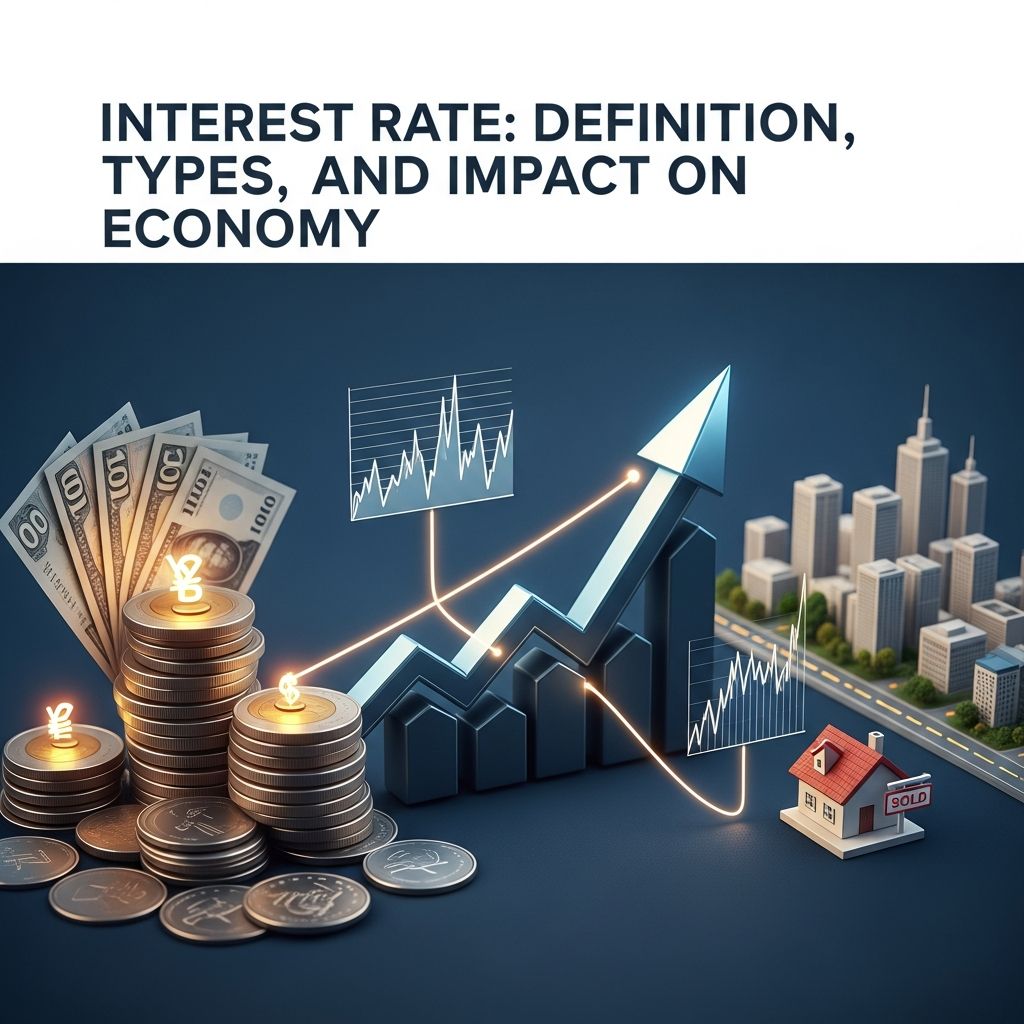
An interest rate is the percentage of principal charged as interest to the borrower for the use of assets. Interest rates are typically noted on an annual basis, known as the annual percentage rate (APR). The assets borrowed could include cash, consumer goods, or large assets such as a vehicle or building. The interest rate represents the cost of debt for the borrower and the rate of return for the lender. Different interest rates apply to different forms of debt or credit arrangements, including mortgage rates, credit card rates, and auto loan rates.
Interest rates can greatly impact the overall economy. When interest rates are low, consumers and businesses tend to borrow more, spend more, and invest more. When interest rates are high, borrowing becomes more expensive, which can slow down economic growth. Central banks, such as the Federal Reserve in the United States, use interest rates as a key tool in monetary policy to manage economic growth and inflation.
How Interest Rates Work
Interest rates compensate lenders for the use of their money and the risk they take by lending. When you borrow money from a bank or lending institution, you agree to repay the principal plus interest over a specified period. The interest rate determines how much extra you pay beyond the borrowed amount.
For example, if you borrow $10,000 at an interest rate of 5% per year, you would owe $500 in interest after one year, bringing your total debt to $10,500. Interest can be calculated as simple interest or compound interest, with compound interest being more common in modern banking and lending practices.
- Simple Interest: Calculated only on the principal amount borrowed
- Compound Interest: Calculated on both the principal and accumulated interest from previous periods
- Fixed Interest Rate: Remains constant throughout the loan term
- Variable Interest Rate: Fluctuates based on market conditions and economic indicators
Types of Interest Rates
Several key interest rates influence the broader economy and individual financial decisions. Understanding these different rates helps consumers and businesses make informed financial choices.
Federal Funds Rate
The federal funds rate is the interest rate at which commercial banks lend reserve balances to each other overnight. Although it is not directly controlled by the Federal Reserve, the Fed sets a target range for this rate, which influences all other interest rates in the economy. The federal funds rate serves as a benchmark for other short-term interest rates and significantly impacts broader economic conditions.
Prime Rate
The prime rate, also called the prime lending rate, is the interest rate commercial banks offer to their most creditworthy customers. It is typically based on the federal funds rate and serves as the foundation for many other consumer interest rates, including credit card rates, home equity loans, and adjustable-rate mortgages. When the prime rate rises, other consumer rates typically follow suit.
Discount Rate
The discount rate is the interest rate the Federal Reserve charges commercial banks when they borrow from the Fed’s “discount window.” This rate is typically higher than the federal funds rate and serves as a backstop to encourage banks to borrow from each other first. Changes in the discount rate signal the Fed’s monetary policy stance to financial markets.
Mortgage Rates
Mortgage rates are the interest rates charged on home loans. These rates can be fixed or adjustable and are influenced by the federal funds rate, market conditions, inflation expectations, and the borrower’s creditworthiness. Mortgage rates determine the monthly payment amount and total cost of homeownership.
Credit Card Rates
Credit card companies charge interest rates on outstanding balances, often referred to as Annual Percentage Rates (APRs). These rates vary based on the cardholder’s creditworthiness, economic conditions, and market factors. Credit card rates are typically higher than mortgage or auto loan rates due to the unsecured nature of credit card debt.
Factors That Influence Interest Rates
Multiple factors determine interest rates in the economy. Central banks, lenders, and market conditions all play critical roles in setting these rates.
- Inflation: Higher inflation expectations typically lead to higher interest rates as lenders seek compensation for declining purchasing power
- Central Bank Policy: Federal Reserve decisions to raise or lower rates directly impact the entire interest rate structure
- Supply and Demand: Market forces for loanable funds influence interest rates across different lending products
- Credit Risk: Borrowers with poor credit histories typically face higher interest rates to compensate lenders for increased default risk
- Loan Term: Longer-term loans typically have higher interest rates than shorter-term loans
- Economic Growth: Strong economic conditions tend to push interest rates higher as demand for credit increases
Interest Rates and Monetary Policy
Central banks use interest rates as a primary tool in monetary policy to achieve their economic objectives. By adjusting interest rates, central banks can influence borrowing costs, spending, investment, and ultimately inflation and economic growth.
When the Federal Reserve raises interest rates, borrowing becomes more expensive, which typically reduces consumer spending and business investment. This slowdown in economic activity can help combat high inflation. Conversely, when the Fed lowers interest rates, borrowing becomes cheaper, encouraging spending and investment, which can stimulate economic growth during periods of weakness.
The Fed’s Role in Setting Interest Rates
The Federal Reserve does not directly set the prime rate or other consumer interest rates. Instead, it influences interest rates throughout the economy by setting a target range for the federal funds rate and controlling the money supply. Banks and lenders then adjust their rates based on the Fed’s policy decisions and economic outlook.
Impact of Interest Rates on the Economy
Interest rates have far-reaching effects throughout the economy, influencing everything from consumer purchasing decisions to business investment to stock market valuations.
Consumer Spending and Borrowing
Lower interest rates reduce the cost of borrowing for consumers, making it more attractive to finance major purchases such as homes, vehicles, and appliances. Higher interest rates increase borrowing costs, which can discourage consumer spending and slow economic growth. The interest rate environment significantly influences consumer confidence and purchasing patterns.
Business Investment
Companies evaluate interest rates when deciding whether to invest in expansion, equipment, or research and development. Lower interest rates make it cheaper to finance business projects, potentially encouraging investment and job creation. Higher interest rates increase the cost of capital, which may prompt companies to delay or cancel expansion plans.
Savings and Investment Returns
Interest rates affect the returns savers and investors receive on their deposits and fixed-income investments. Higher interest rates typically provide better returns for savings accounts, certificates of deposit (CDs), and bonds. Lower interest rates reduce returns on these safe investments, potentially encouraging investors to seek higher returns through riskier investments such as stocks.
Real Estate Markets
Mortgage rates directly impact housing affordability and demand. When mortgage rates are low, home prices typically rise as more buyers can afford to purchase homes. Higher mortgage rates reduce purchasing power and can lead to declining home prices. The real estate market is highly sensitive to changes in interest rate environments.
Real vs. Nominal Interest Rates
It is important to distinguish between nominal and real interest rates when evaluating financial decisions and economic conditions.
Nominal Interest Rate: The stated interest rate on a loan or investment without adjusting for inflation. This is the rate lenders quote and borrowers agree to pay.
Real Interest Rate: The nominal interest rate adjusted for inflation. It represents the true increase in purchasing power gained by a saver or the true cost of borrowing for a borrower. The real interest rate is calculated by subtracting the inflation rate from the nominal interest rate.
For example, if you earn 5% interest on a savings account (nominal rate) and inflation is 2%, your real interest rate is approximately 3%. You are only gaining 3% in actual purchasing power, as 2% of your return is being offset by inflation.
Interest Rates and Bond Markets
Interest rates have an inverse relationship with bond prices. When interest rates rise, existing bond prices fall because new bonds are issued with higher yields, making existing bonds less attractive. Conversely, when interest rates fall, existing bond prices rise because their higher yields become more valuable relative to newly issued bonds with lower yields.
This relationship is critical for bond investors to understand. Investors holding bonds when interest rates rise experience a decline in the market value of their holdings, though they will still receive their scheduled interest payments and principal repayment at maturity.
Yield Curve and Economic Outlook
The yield curve plots interest rates for different maturities of bonds, typically U.S. Treasury securities. The shape of the yield curve provides important information about economic expectations.
- Normal Yield Curve: Slopes upward, with longer-term rates higher than shorter-term rates, typically indicating healthy economic growth expectations
- Flat Yield Curve: Shows similar rates across different maturities, often indicating economic uncertainty or transition
- Inverted Yield Curve: Shows shorter-term rates higher than longer-term rates, historically a predictor of economic recession
Frequently Asked Questions
Q: What is the difference between interest rates and APR?
A: Interest rate is the percentage cost of borrowing, while APR (Annual Percentage Rate) includes the interest rate plus other costs and fees associated with the loan, providing a more complete picture of the total cost of borrowing.
Q: How do rising interest rates affect stocks?
A: Rising interest rates can negatively impact stocks by increasing corporate borrowing costs, reducing consumer spending, and making bonds more attractive relative to stocks. However, some sectors benefit from higher rates.
Q: Can interest rates be negative?
A: Yes, some central banks have implemented negative interest rates in recent years to stimulate borrowing and economic activity. Negative rates penalize banks for holding reserves rather than lending.
Q: What determines my personal interest rate on a loan?
A: Your personal interest rate depends on factors including your credit score, income, employment history, loan type, loan term, down payment, and current market interest rates set by the central bank and lenders.
Q: How frequently do interest rates change?
A: The Federal Reserve typically meets eight times per year to review and potentially adjust monetary policy and interest rates. However, market-driven rates adjust continuously based on supply and demand in financial markets.
Q: Why do different lenders offer different interest rates?
A: Different lenders offer varying rates based on their cost of funds, competitive positioning, risk assessment of individual borrowers, and operational costs. Shopping around for the best rate is recommended.
References
- The Federal Reserve System: Purpose and Functions — Board of Governors of the Federal Reserve System. 2024. https://www.federalreserve.gov/aboutthefed/structure-federal-reserve-system.htm
- Monetary Policy Implementation and Overnight Rates — Federal Reserve of New York. 2024. https://www.newyorkfed.org/markets/domestic-market-operations/monetary-policy-implementation
- Understanding Interest Rates and Inflation — U.S. Bureau of Labor Statistics. 2024. https://www.bls.gov/k12/inflation-explained.htm
- The Impact of Interest Rates on Financial Markets — International Monetary Fund. 2023. https://www.imf.org/external/pubs/ft/weo/2023/02/weodata/index.aspx
- Credit Markets and Yield Curve Analysis — U.S. Department of the Treasury. 2024. https://home.treasury.gov/resource-center/data-chart-center/interest-rates
Similar Articles








Read full bio of medha deb