Interest-Only Mortgage Payment Calculator
Calculate your interest-only mortgage payments with our free calculator tool.
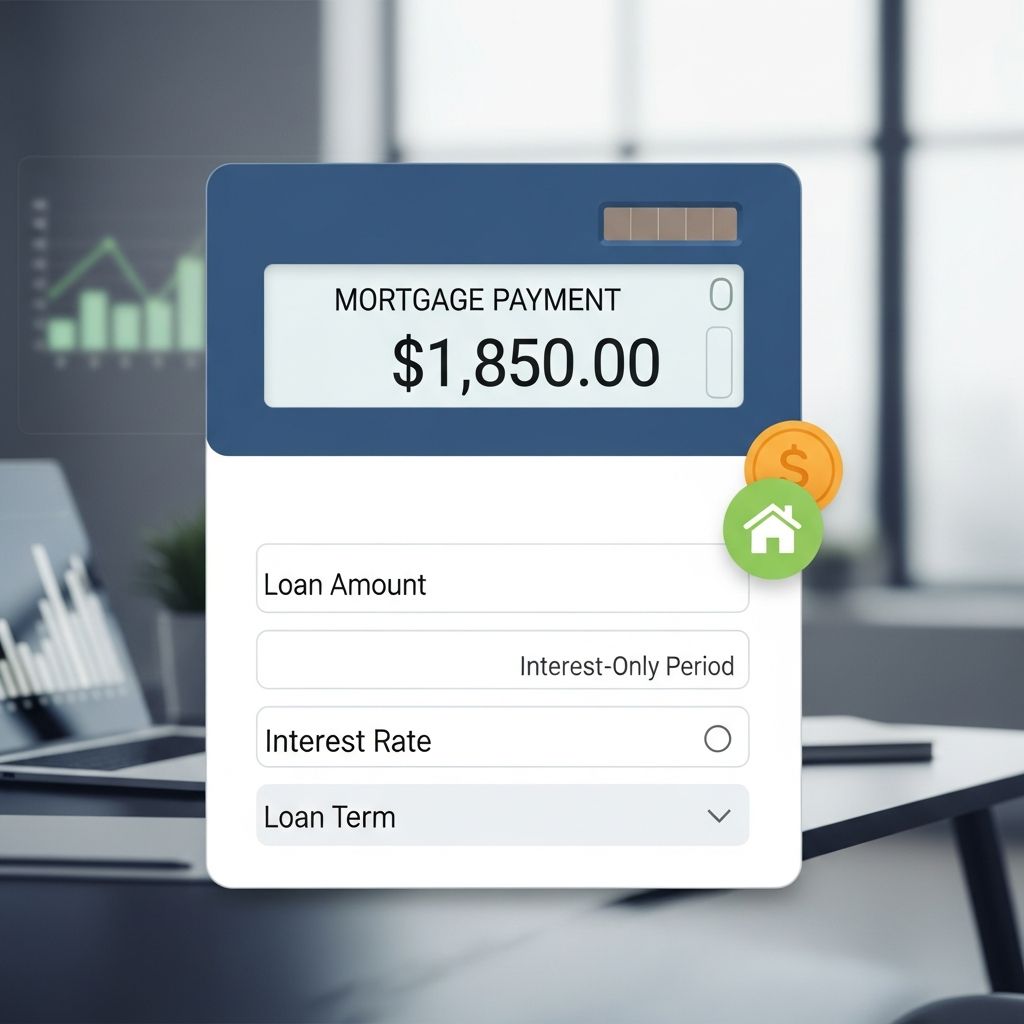
An interest-only mortgage calculator is a valuable financial tool that helps homebuyers and current homeowners estimate what their monthly mortgage payments would be during the interest-only period of their loan. By inputting your loan amount and interest rate into the calculator, you can quickly determine your monthly payment obligation. This tool is essential for anyone considering an interest-only mortgage or wanting to understand how this type of financing structure works in practice.
What Is an Interest-Only Mortgage?
An interest-only mortgage is a specialized type of home loan that offers borrowers a unique payment structure. During an introductory period, typically ranging from three to ten years, you are required to pay only the interest charges on your loan. This means your monthly mortgage payment includes interest payments but excludes any principal repayment. For example, your monthly mortgage payment might consist entirely of interest rather than the combination of principal and interest that characterizes traditional mortgages, giving you the benefit of significantly lower payments initially.
Once that introductory interest-only period concludes, your payment structure changes. The loan converts to a standard amortizing mortgage where your payments increase substantially to include both principal and interest for the remaining term of the loan. Understanding this two-phase payment structure is crucial before committing to an interest-only mortgage, as the payment increase can be significant and may impact your overall financial planning.
How Does an Interest-Only Mortgage Calculator Work?
The mechanics of an interest-only mortgage calculator are straightforward and based on a simple mathematical formula. The calculator determines the amount you’ll pay monthly during your interest-only term by multiplying your interest rate by the loan amount, then dividing the result by 12 (the number of months in a year). This formula gives you a clear picture of what your monthly obligation will be during the initial interest-only phase.
Here’s the calculation formula:
(Interest Rate × Loan Amount) ÷ 12 = Monthly Interest-Only Payment
To illustrate with a practical example: if you have a 6.5 percent interest rate and a $400,000 loan amount, you would calculate:
(6.5% × $400,000) ÷ 12 = $2,166.67 monthly payment
This means during your interest-only period, your monthly mortgage payment would be $2,166.67. This calculation demonstrates why interest-only mortgages are attractive to borrowers initially—the payment is substantially lower than what you would pay on a traditional 30-year fixed mortgage for the same loan amount at a similar interest rate.
Key Components of Mortgage Calculations
Understanding the different components that make up your mortgage payment is essential for making informed lending decisions. While interest-only mortgages focus exclusively on interest during the introductory period, traditional mortgages and the subsequent phases of interest-only mortgages involve multiple components:
Principal: This is the amount you borrowed from the lender—essentially your home’s purchase price minus your down payment. For a $400,000 loan, the principal is $400,000.
Interest: This is the amount the lender charges you to borrow the principal. Interest rates are expressed as an annual percentage. During an interest-only period, 100 percent of your monthly payment goes toward interest.
Property Taxes: The tax on your home levied by your city or town, paid for as long as you own it. This varies significantly by location.
Homeowners Insurance: Insurance coverage required by lenders to protect their investment in your property.
The Advantages of Interest-Only Mortgages
Interest-only mortgages offer several compelling benefits that attract certain borrowers, particularly those looking to minimize their initial housing costs:
Lower Payments to Start: By delaying the repayment of principal, you’ll have a noticeably smaller bill each month during the interest-only period. This lower initial payment can provide breathing room in your monthly budget, allowing you to allocate funds to other financial priorities or investments.
Increased Affordability: Since your payments will be lower during the interest-only phase, you may be able to consider higher-priced homes than you could afford with a traditional mortgage. This expanded purchasing power can be particularly valuable in competitive real estate markets where home prices are elevated.
Tax Benefits: Because interest payments on your primary residence are tax-deductible (for loans up to $750,000 if you’re filing jointly), 100 percent of your interest-only mortgage is tax-deductible if you itemize your deductions on your tax return. This can result in significant tax savings, effectively reducing your true cost of borrowing.
Important Considerations and Risks
While interest-only mortgages offer attractive initial benefits, they also come with significant considerations that borrowers must carefully evaluate:
Payment Shock: After the interest-only period ends, your monthly payments will increase substantially to include both principal and interest. This payment shock can strain your budget if you’re not adequately prepared. For example, a payment that was $2,166.67 during the interest-only phase might jump to $2,610 or higher once the amortization phase begins.
Adjustable Rates: Many interest-only loans convert to adjustable-rate mortgages, meaning if interest rates rise in the future, your payments will increase accordingly. This introduces additional uncertainty into your long-term housing costs.
Balloon Payments: Some interest-only loans require a balloon payment at the end of the interest-only period. This means you’d be responsible for paying several hundred thousand dollars as a lump sum, which can be financially devastating if you’re not prepared or unable to refinance.
Equity Building: During the interest-only period, you’re not building any equity in your home. All your monthly payments go toward interest, meaning you’re not reducing what you owe on the property.
Who Should Consider Interest-Only Mortgages?
Interest-only mortgages are best suited for specific borrower profiles and situations. These loans work well for investors who purchase properties with the intention of selling them within a few years, allowing them to minimize payments during their holding period. They can also benefit borrowers who expect their income to increase significantly during the interest-only period, preparing them for the payment increase when it occurs.
Short-term homebuyers who plan to sell their property before the interest-only period ends may find these mortgages advantageous. Additionally, borrowers with substantial liquid assets who are comfortable with the risks and payment structure may find interest-only mortgages appropriate for their financial situation.
Comparing Loan Types and Terms
When considering an interest-only mortgage, it’s helpful to compare it with traditional mortgage options. Using a mortgage calculator, you can see how monthly payments and total interest differ between various loan terms. For instance, comparing a 10-year, 15-year, 20-year, or 30-year loan reveals how the loan term affects both your monthly payment and the total amount of interest you’ll pay over the life of the loan.
A longer loan term generally means lower monthly payments but significantly higher total interest paid. Conversely, a shorter loan term results in higher monthly payments but substantially less interest paid overall. Interest-only mortgages complicate this comparison by splitting the loan into two distinct phases with different payment structures.
Understanding Interest Rates and APR
It’s crucial to distinguish between your mortgage interest rate and your annual percentage rate (APR). Your interest rate accounts only for the cost of borrowing the funds and is expressed as a percentage. The APR, by contrast, encompasses your mortgage interest rate plus other costs associated with obtaining the loan, including the lender’s origination fee and any points paid to reduce your interest rate. Because APR includes these additional charges, it’s always higher than the stated interest rate.
For an interest-only mortgage, understanding both figures helps you make a complete financial comparison. The interest rate determines your monthly payment during the interest-only period, while the APR reflects the true cost of the loan.
Practical Example of Interest-Only Mortgage Calculations
Let’s examine a detailed example to illustrate how an interest-only mortgage functions over time. Suppose you obtain a 30-year interest-only loan for $350,000 with an initial rate of 6.5 percent and an interest-only term of seven years. During the seven-year interest-only period, you’d pay roughly $1,896 per month.
After this initial seven-year phase, the payment would rise to approximately $2,610 per month—assuming your rate doesn’t change—when the loan converts to a standard amortizing structure where you pay both principal and interest.
For comparison, if you had taken out a 30-year fixed-rate mortgage for the same $350,000 amount at a similar interest rate, you’d pay $2,212 per month from the beginning, including both principal and interest. This example clearly demonstrates the payment advantage during the initial period but also highlights the payment increase when transitioning to the amortization phase.
Borrowing Limits for Interest-Only Mortgages
The maximum amount you can borrow with an interest-only mortgage depends on several factors, including the specific lender, your financial profile, and the type of loan you choose. Interest-only mortgages can be structured as conforming loans, which have maximum borrowing limits set by government-sponsored enterprises. Currently, in most of the United States, the 2025 conforming loan limit for one-unit properties is $806,500.
Alternatively, borrowers can pursue jumbo loans that exceed conforming loan limits, offering the flexibility to borrow larger amounts for luxury properties or high-value markets. Many lenders allow qualified borrowers to borrow 75 to 85 percent of the property’s value, potentially in the seven-figure range. Your credit score, debt-to-income ratio, employment history, and liquid assets all influence the maximum amount available to you.
Using a Mortgage Calculator Effectively
A mortgage calculator is a powerful tool for financial planning and decision-making. You can use the calculator to determine whether you’re spending more than you can afford by seeing exactly how much you’ll pay each month, including homeowners insurance premiums and property taxes. This comprehensive view helps you determine whether you’re stretching your homebuying budget too far or exceeding a reasonable debt-to-income ratio.
Additionally, calculators allow you to compare monthly payments and total interest across different scenarios. You can input various loan terms, interest rates, and down payment amounts to see how each variable affects your payment. This comparative analysis is invaluable for making informed decisions about your mortgage structure.
Is an Interest-Only Mortgage Right for You?
Deciding whether an interest-only mortgage aligns with your financial situation requires careful consideration of multiple factors. These mortgages offer genuine advantages for specific borrower profiles but carry risks that aren’t suitable for everyone. You should consider an interest-only mortgage if you have a clear plan for the payment increase after the interest-only period, expect your income to grow substantially, or plan to sell the property before the period ends.
Conversely, you should avoid interest-only mortgages if you plan to stay in the home long-term without expecting income growth, are uncomfortable with payment uncertainty, or prefer the stability and predictability of a fixed-rate mortgage with consistent principal and interest payments.
Frequently Asked Questions
Q: What happens after the interest-only period ends?
A: After the interest-only period concludes, your loan converts to a standard amortizing mortgage where your monthly payments increase significantly to include both principal and interest. The payment increase can be substantial, and for adjustable-rate loans, your interest rate may also increase.
Q: Can I prepay principal during the interest-only period?
A: Yes, most interest-only mortgages allow you to prepay principal without penalty. Making additional principal payments during the interest-only period can reduce the amount you owe when the amortization phase begins, potentially lowering your payment increase.
Q: How does an interest-only mortgage affect my credit?
A: An interest-only mortgage affects your credit similarly to any other mortgage. On-time payments build credit, while missed or late payments damage it. The interest-only structure doesn’t inherently affect your credit differently than traditional mortgages.
Q: Are interest-only mortgages still available?
A: Yes, interest-only mortgages remain available, though they’re less common than traditional fixed-rate mortgages. They’re typically offered by banks, mortgage brokers, and specialized lenders, often for jumbo loans or to borrowers with excellent credit profiles.
Q: What’s the difference between an interest-only mortgage and an ARM?
A: An interest-only mortgage focuses on payment structure—interest only versus principal plus interest. An ARM (Adjustable Rate Mortgage) focuses on rate structure—the interest rate adjusts over time. Many interest-only mortgages are also ARMs, combining both characteristics.
References
- Interest-Only Mortgage Payment Calculator — Bankrate. 2025. https://www.bankrate.com/mortgages/interest-only-mortgage-payment-calculator/
- What Is An Interest-Only Mortgage? — Bankrate. 2025. https://www.bankrate.com/mortgages/what-is-an-interest-only-mortgage/
- Mortgage Calculator — Bankrate. 2025. https://www.bankrate.com/mortgages/mortgage-calculator/
- What is mortgage interest and how does it work? — Bankrate. 2025. https://www.bankrate.com/mortgages/what-is-a-mortgage-interest-rate/
- Consumer Financial Protection Bureau – Mortgage Disclosure — CFPB. 2024. https://www.consumerfinance.gov/
Similar Articles








Read full bio of medha deb