Interest: Definition, Types, and How It Works
Understand interest rates, types, and their impact on borrowing and saving decisions.
What Is Interest?
Interest is the cost of borrowing money or the reward for lending money. When you borrow money from a bank, lender, or financial institution, you typically pay back more than what you borrowed. The extra amount you pay is called interest. Conversely, when you deposit money in a savings account or invest in bonds, the financial institution pays you interest for the use of your money. Interest serves as compensation for the lender’s risk and opportunity cost associated with lending funds.
Interest is a fundamental concept in finance that affects virtually every financial transaction, from mortgages and credit cards to savings accounts and investments. Understanding how interest works is crucial for making informed financial decisions and managing personal finances effectively.
Understanding Interest Rates
Interest rates represent the percentage of the principal amount that is charged or paid as interest over a specific time period, usually expressed as an annual percentage rate (APR). Interest rates vary based on several factors, including:
- Credit risk: Higher-risk borrowers typically face higher interest rates
- Economic conditions: Interest rates fluctuate based on inflation and monetary policy
- Loan duration: Longer-term loans often have higher interest rates
- Type of loan: Secured loans typically have lower rates than unsecured loans
- Market competition: Different lenders offer varying rates based on their business models
Simple Interest Explained
Simple interest is the most straightforward method of calculating interest charges. With simple interest, the interest is calculated only on the principal amount (the original sum borrowed or invested) and does not compound over time. This means you earn or pay the same amount of interest each period.
The formula for simple interest is:
Interest = Principal × Rate × Time
Example: If you borrow $1,000 at a 5% annual simple interest rate for 3 years:
- Interest = $1,000 × 0.05 × 3 = $150
- Total amount due = $1,000 + $150 = $1,150
Simple interest is less commonly used in modern consumer lending but may apply to short-term loans, auto loans, or informal loans between individuals.
Compound Interest: The Power of Exponential Growth
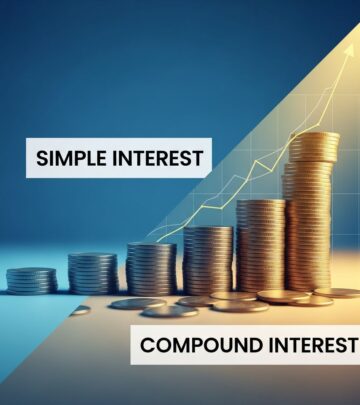
Compound interest is calculated on both the principal amount and the accumulated interest from previous periods. This creates exponential growth over time, making it significantly more advantageous for savers and more costly for borrowers compared to simple interest.
The formula for compound interest is:
A = P(1 + r/n)^(nt)
Where: A = Final amount, P = Principal, r = Annual interest rate, n = Compounding periods per year, t = Time in years
Example: If you invest $1,000 at a 5% annual interest rate compounded annually for 3 years:
- A = $1,000(1 + 0.05/1)^(1×3) = $1,157.63
- Interest earned = $157.63
Notice that compound interest generates $7.63 more than simple interest over the same period. This difference grows substantially over longer time frames and with higher frequencies of compounding.
Compounding Frequency: How Often Interest Accrues
The frequency at which interest is compounded significantly impacts the total amount of interest earned or paid. Common compounding frequencies include:
| Compounding Frequency | Periods Per Year | Common Use |
|---|---|---|
| Annually | 1 | Some bonds and CDs |
| Semi-annually | 2 | Some bonds |
| Quarterly | 4 | Money market accounts |
| Monthly | 12 | Savings accounts, loans |
| Daily | 365 | High-yield savings accounts |
| Continuously | Infinite | Theoretical calculations |
The more frequently interest compounds, the more interest accumulates. Daily compounding typically results in higher returns for savers than annual compounding on the same principal and rate.
Types of Interest Rates
Interest rates come in various forms, each serving different purposes in the financial system:
Fixed Interest Rates
A fixed interest rate remains the same throughout the loan or investment term. This provides predictability and stability, allowing borrowers and lenders to plan their finances with certainty. Fixed rates are common for mortgages, personal loans, and certificates of deposit (CDs).
Variable (Floating) Interest Rates
Variable interest rates fluctuate based on market conditions or a reference rate (such as the prime rate or LIBOR). These rates are often lower initially but carry the risk of increasing over time. Variable rates are common for adjustable-rate mortgages (ARMs), home equity lines of credit (HELOCs), and some credit card offers.
Annual Percentage Rate (APR)
APR represents the total annual cost of borrowing, expressed as a percentage. It includes the interest rate plus other charges or fees involved in the loan process. APR provides a more comprehensive view of the true cost of borrowing compared to the interest rate alone.
Annual Percentage Yield (APY)
APY reflects the total amount earned on an investment account, including the effect of compounding. It’s commonly used for savings accounts and other interest-bearing accounts to show savers the actual return on their deposits.
Interest in Borrowing
When you borrow money, interest is the cost you pay for using someone else’s capital. Key factors affecting borrowing costs include:
- Creditworthiness: Your credit score and history influence the interest rate you qualify for
- Collateral: Secured loans (backed by assets) typically have lower rates
- Loan amount: Larger loans may have different rate structures
- Repayment period: The loan duration affects the interest rate offered
- Economic climate: Overall interest rates in the economy influence personal loan rates
Interest in Saving and Investing
When you save or invest, interest is the return you earn for allowing others to use your money. Savers benefit from interest through:
- Savings accounts: Banks pay interest on deposit balances
- Certificates of Deposit (CDs): Fixed-term investments with guaranteed interest rates
- Bonds: Fixed-income securities that pay regular interest payments
- Money market accounts: Hybrid accounts combining checking features with interest-earning potential
The Federal Reserve and Interest Rates
The Federal Reserve (the central bank of the United States) plays a crucial role in determining the overall interest rate environment. The Fed sets the discount rate and the federal funds rate, which influence the rates that banks charge each other and, by extension, the rates they offer to consumers and businesses. When the Fed raises rates, borrowing becomes more expensive and saving becomes more rewarding. Conversely, when the Fed lowers rates, borrowing becomes cheaper and saving generates lower returns.
Key Considerations for Interest Rates
Understanding these factors can help you make better financial decisions:
- Inflation impact: Real interest rates (adjusted for inflation) determine true purchasing power
- Opportunity cost: Consider alternative uses of your money before borrowing or investing
- Early repayment penalties: Some loans charge penalties for paying off debt early
- Rate locks: For mortgages, consider locking in rates if you expect increases
- Comparison shopping: Different lenders offer varying rates; always compare offers
Frequently Asked Questions (FAQs)
Q: What is the difference between simple and compound interest?
A: Simple interest is calculated only on the principal amount and remains the same each period. Compound interest is calculated on both the principal and accumulated interest, resulting in exponential growth over time. Compound interest typically generates significantly more earnings or costs over extended periods.
Q: How does the Federal Reserve influence interest rates?
A: The Federal Reserve sets the federal funds rate, which is the interest rate at which banks lend reserve balances to each other overnight. This rate influences all other interest rates in the economy, including the rates banks offer on mortgages, savings accounts, and personal loans.
Q: What is APR versus APY?
A: APR (Annual Percentage Rate) is the cost of borrowing, including the interest rate plus other fees. APY (Annual Percentage Yield) is the actual return on savings or investments, including the effect of compounding. APY is typically higher than the stated interest rate due to compounding.
Q: Should I choose a fixed or variable interest rate?
A: Fixed rates provide stability and predictability, making them ideal if you prefer consistent payments. Variable rates start lower but can increase, making them riskier but potentially cheaper if rates decrease or you plan to refinance. Your choice depends on market expectations and your risk tolerance.
Q: How can I maximize interest earnings on my savings?
A: Look for accounts with high APY rates, choose daily or continuous compounding when available, and consider higher-yield options like CDs or money market accounts. Additionally, making regular deposits and keeping money invested for longer periods amplifies compound interest benefits.
Q: What factors determine the interest rate I qualify for?
A: Lenders consider your credit score, income, employment history, debt-to-income ratio, collateral (for secured loans), and the current economic environment. Improving your creditworthiness typically helps you qualify for lower interest rates.
References
- Interest Rates and Economic Activity — Federal Reserve Board of Governors. 2024. https://www.federalreserve.gov/faqs/what-are-the-limitations-on-the-federal-funds-rate.htm
- Annual Percentage Rate (APR) and Annual Percentage Yield (APY) — Consumer Financial Protection Bureau. 2024. https://www.consumerfinance.gov/ask-cfpb/what-is-apr-and-how-does-it-compare-to-interest-rate-en-1611/
- Understanding Compound Interest — U.S. Securities and Exchange Commission. 2024. https://www.investor.gov/introduction-investing/investing-basics/timeline-and-power-compounding
- Credit Risk and Interest Rate Determination — International Monetary Fund (IMF). 2023. https://www.imf.org/
- Monetary Policy and Interest Rate Transmission Mechanisms — Bank for International Settlements. 2024. https://www.bis.org/
Similar Articles








Read full bio of medha deb