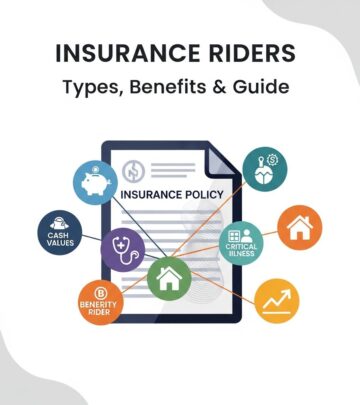
Insurance Riders Explained: Essential Guide For Policyholders
Discover how insurance riders enhance your policy with tailored protection for life's uncertainties and valuable assets.

Insurance riders serve as customizable extensions to standard policies, allowing individuals to address specific risks or needs not fully covered by base plans. These add-ons, often called endorsements or floaters, enable policyholders to tailor protection for scenarios like high-value items, disabilities, or natural disasters.
Defining Insurance Riders and Their Core Functions
At their essence, insurance riders modify an existing policy by either broadening coverage limits, adding protection for excluded perils, or waiving certain premiums under defined conditions. Unlike standalone policies, riders integrate seamlessly into the parent contract, becoming enforceable as part of it once purchased.
Policyholders typically pay an extra fee for these enhancements, which varies based on the rider type, insured amount, and personal risk factors. This modular approach empowers consumers to avoid overpaying for unnecessary broad coverage while filling critical gaps.
Why Policyholders Opt for Riders
- Targeted Protection: Riders cover niche risks, such as sewer backups or earthquake damage, absent from standard homeowners policies.
- Asset Safeguarding: High-value possessions like jewelry or art receive scheduled coverage with higher limits and lower deductibles.
- Financial Relief: In life insurance, riders can accelerate death benefits for illnesses or waive premiums during disabilities.
- Flexibility: Options like term conversion allow seamless policy upgrades without new medical exams.
These benefits make riders essential for those with unique circumstances, ensuring comprehensive safeguards without purchasing entirely new policies.
Prevalent Rider Categories Across Insurance Types
Riders adapt to various insurance domains, from life and health to property and auto. Below, we categorize common examples with their applications.
Life Insurance Riders
Life policies frequently incorporate riders to provide living benefits or future-proof coverage. Key variants include:
| Rider Name | Description | Typical Benefit |
|---|---|---|
| Waiver of Premium | Waives policy premiums if the insured becomes totally disabled and unable to work. | Maintains coverage without payments; available on term or whole life. |
| Accelerated Death Benefit | Allows early access to a portion of the death benefit upon terminal illness diagnosis. | Up to 75% of face value for medical costs; often tax-free. |
| Guaranteed Insurability | Permits buying more coverage later without health questions. | Ideal for young families anticipating life changes. |
| Term Conversion | Enables switching term to permanent life without exams. | Preserves insurability as needs evolve. |
| Critical/Chronic Illness | Provides payouts for specified severe conditions, not just terminal ones. | Funds care; some insurers offer at no extra cost. |
These riders enhance life insurance’s utility beyond death benefits, supporting policyholders during hardships.
Homeowners and Property Riders
Standard homeowners policies exclude events like floods or limit valuables; riders bridge these voids.
- Flood or Earthquake: Standalone-like coverage for water or seismic events, often required in prone areas.
- Scheduled Personal Property: Boosts limits for items like laptops, bikes, or rings, reducing out-of-pocket after deductibles.
- Sewer Backup or Water Damage: Protects against plumbing failures not covered basically.
For instance, a $2,500 laptop under a rider with $100 deductible yields $2,400 payout versus $1,500 from base policy after $1,000 deductible.
Other Policy Riders
Auto riders might cover custom parts; health or disability ones waive premiums or add income protection. Availability depends on the carrier and policy type.
Factors Influencing Rider Costs
Riders incur additional premiums, calculated via age, health, location, and coverage scope. Waiver riders for life insurance might add 5-15% to base premiums, while property floaters scale with item value.
Some carriers bundle riders at low or no cost, but most adjust totals upward. Shop comparisons reveal variances; for example, chronic illness riders may be free from select providers.
Steps to Add Riders Effectively
- Assess Needs: Inventory assets and risks via home inventories or family planning.
- Review Policy: Check current limits and exclusions.
- Consult Carrier: Inquire about options during renewal or qualifying events like marriage.
- Compare Quotes: Evaluate costs and terms across insurers.
- Understand Terms: Confirm activation triggers, durations, and portability.
Adding mid-term is possible but may trigger re-underwriting or premium hikes.
Pros and Cons of Insurance Riders
| Advantages | Disadvantages |
|---|---|
| Custom fit for specific risks | Extra premium costs |
| Seamless policy integration | Limited to carrier offerings |
| Potential savings on deductibles | May not transfer to new policies |
| Living benefits for health events | Strict qualification criteria |
Weighing these helps determine value; essential riders justify costs for at-risk individuals.
Frequently Asked Questions
What exactly constitutes an insurance rider?
An optional amendment expanding, restricting, or adding policy coverage for perils or items.
Are riders permanent once added?
They bind to the policy term; renewals may require reconfirmation.
Can I add riders to any existing policy?
Often yes at renewal or qualifying events, but carriers may reissue with adjustments.
Do all insurers offer the same riders?
No; options vary, so compare providers.
Is a rider the same as a separate policy?
No, riders attach to and modify the base policy, typically cheaper for targeted needs.
Strategic Tips for Rider Selection
Prioritize based on life stage: young parents favor insurability riders; homeowners in flood zones need peril add-ons. Annual reviews ensure alignment with changes like new valuables or health shifts.
Consult independent agents for multi-carrier insights. Document everything to streamline claims, as riders demand proof like appraisals for scheduled items.
Real-World Applications and Case Studies
Consider a family with a term life policy: Adding waiver and conversion riders ensures continuity if the breadwinner disables, convertible later for permanence.
A homeowner with rare art: Scheduling via rider covers full appraised value worldwide, unlike base limits.
These illustrate riders’ role in risk mitigation, providing peace of mind through precision.
References
- Life Insurance Riders Simply Explained — Guardian Life. 2023. https://www.guardianlife.com/life-insurance/riders
- What Is an Insurance Rider? Explained by Hippo — Hippo. 2023. https://www.hippo.com/learn-center/insurance-rider
- Insurance Rider: Definition and How It Works — MetLife. 2023. https://www.metlife.com/stories/benefits/insurance-rider/
- Insurance Riders Info & Types — Matic. 2023. https://matic.com/blog/common-insurance-riders/
- What Is an Insurance Rider and How Does It Work? — Treloar & Heisel. 2023. https://treloaronline.com/resources/insurance-rider/
- Four Life Insurance Riders to Consider – and Two to Avoid — United Policyholders. 2023. https://uphelp.org/four-life-insurance-riders-to-consider-and-two-to-avoid/?print=print
Similar Articles








Read full bio of medha deb