Inflationary Gap: Definition, Causes, and Economic Impact
Understanding inflationary gaps: When actual GDP exceeds potential GDP, creating upward price pressure.
What Is an Inflationary Gap?
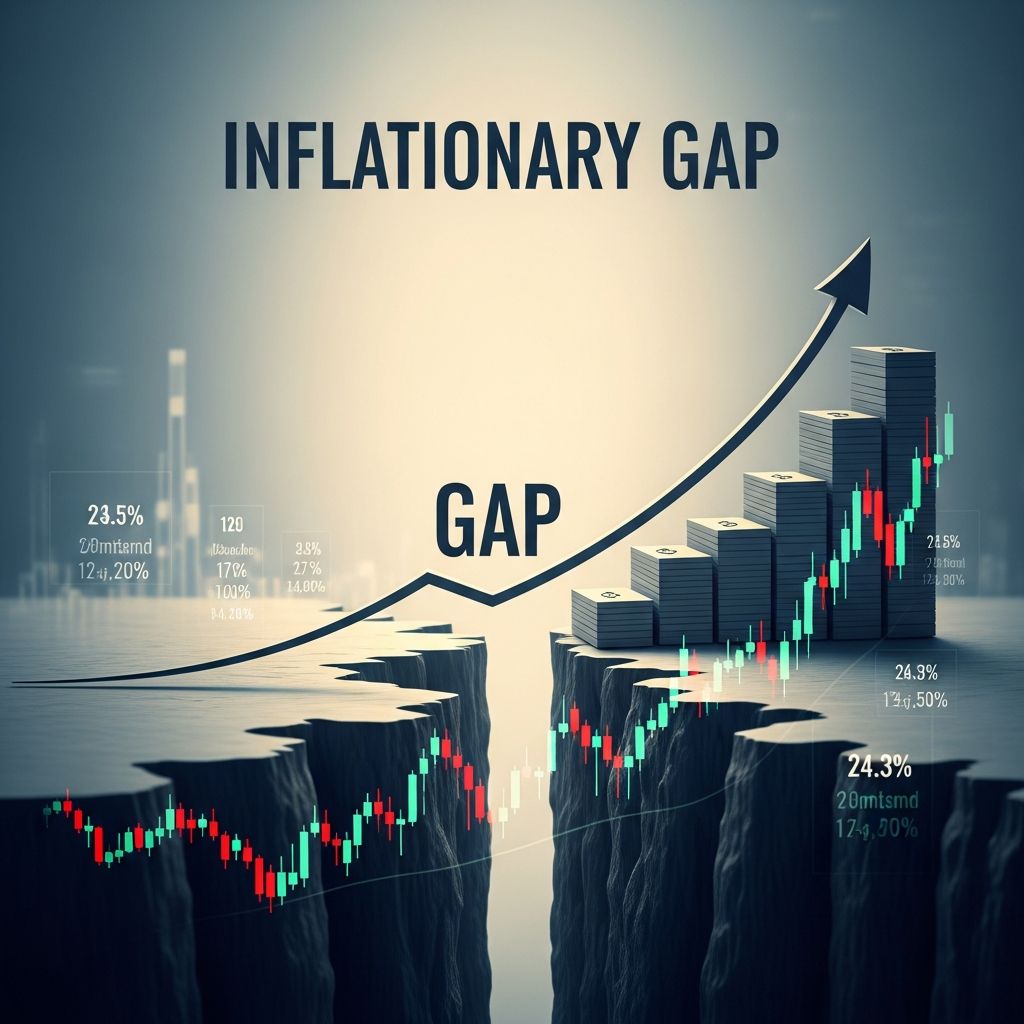
An inflationary gap is a macroeconomic concept that measures the positive difference between an economy’s actual gross domestic product (GDP) and its potential GDP at full employment. This gap represents a situation where an economy is producing more output than it sustainably can, leading to upward pressure on prices and inflation. The term was popularized by economist John Maynard Keynes as a way to identify where an economy stands within the business cycle.
When an inflationary gap exists, it signals that aggregate demand is outpacing aggregate supply, creating an imbalance in the economy. This occurs specifically during expansionary periods of the business cycle when economic activity accelerates beyond the economy’s productive capacity. Understanding the inflationary gap is crucial for policymakers, investors, and economists who seek to maintain economic stability and manage inflationary pressures.
Understanding the Inflationary Gap: Key Concepts
The Difference Between Inflation and Inflationary Gap
It is important to distinguish between inflation and an inflationary gap, as these are related but distinct economic concepts. Inflation refers to a general, sustained increase in the prices of goods and services throughout an economy over time. It reflects the erosion of purchasing power as consumers need more money to buy the same basket of goods.
An inflationary gap, by contrast, is not about price movements themselves but rather about the structural imbalance in the economy that creates conditions favorable to inflation. An inflationary gap can exist without inflation occurring immediately, though it creates the conditions under which inflation is likely to develop. Conversely, inflation can occur even when an inflationary gap does not exist, such as during supply shocks or cost-push inflation scenarios.
Full Employment and Potential GDP
To understand an inflationary gap, one must first grasp the concept of potential GDP at full employment. Potential GDP represents the maximum amount of goods and services an economy can produce when all resources—including labor, capital, and technology—are being utilized at their optimal levels. Full employment does not mean zero unemployment; rather, it refers to a state where the economy is operating at its natural rate of unemployment, typically around 4-5% in developed economies.
When actual GDP exceeds potential GDP, it means the economy is producing beyond what can be sustained without straining resources. This overheating creates the inflationary gap, as businesses attempt to meet excess demand by raising prices rather than increasing production capacity, which cannot expand in the short term.
Causes of an Inflationary Gap
Inflationary gaps arise from specific economic conditions that push aggregate demand beyond the economy’s capacity to supply goods and services. Understanding these causes helps explain why economies experience cyclical booms and inflationary pressures.
Expansionary Monetary Policy
One of the primary causes of inflationary gaps is expansionary monetary policy. When central banks lower interest rates and increase the money supply, they inject liquidity into the economy. This increased money availability encourages consumers and businesses to spend more, raising aggregate demand. While this stimulates economic activity in the short run, excessive expansion can push demand beyond the economy’s productive capacity, creating an inflationary gap.
Increased Government Spending
Government spending represents a direct component of aggregate demand through the GDP equation. When governments increase expenditures on infrastructure, defense, social programs, or other initiatives, they inject money directly into the economy. If this spending exceeds what the economy can produce at full employment, it contributes to an inflationary gap. Stimulus packages and expansionary fiscal policies are common triggers.
Rising Investment and Consumer Spending
Private investment and consumer spending form significant portions of aggregate demand. During periods of optimism and economic confidence, businesses increase capital investments and consumers boost spending on goods and services. When both occur simultaneously and exceed the economy’s productive capacity, an inflationary gap emerges. Low interest rates and positive wealth effects (such as rising stock or real estate prices) typically fuel this increased spending.
Increased Net Exports
Net exports—the difference between exports and imports—also contribute to aggregate demand. When foreign demand for a country’s exports surges, or when exchange rates make exports more competitive, net exports increase. This added demand component can push total aggregate demand beyond potential GDP, contributing to an inflationary gap.
How an Inflationary Gap Affects the Economy
When an economy enters an inflationary gap, several interconnected effects manifest across different sectors and economic participants.
Price Increases and Inflation
The most direct consequence of an inflationary gap is upward pressure on prices. When too much money chases too few goods—the classic definition of demand-pull inflation—businesses respond by raising prices. Consumers and businesses face eroding purchasing power as the prices of goods and services rise faster than incomes. This inflation can become embedded in wage expectations, creating a wage-price spiral where workers demand higher wages to maintain purchasing power, leading businesses to raise prices further.
Impact on Interest Rates
Central banks typically respond to inflationary gaps by raising interest rates to cool demand. Higher interest rates increase borrowing costs for consumers and businesses, discouraging spending and investment. While intended to reduce the inflationary gap, this response can also slow economic growth and employment, creating a trade-off between inflation control and economic activity.
Reduced Consumer and Business Confidence
As inflation accelerates due to an inflationary gap, consumers and businesses may reduce spending due to uncertainty about future price levels and economic stability. Savers benefit from higher interest rates but may postpone large purchases. Businesses delay investments when facing uncertain inflation outlooks, potentially leading to reduced economic dynamism.
Distortion of Economic Decision-Making
Inflationary gaps distort the price signals that guide economic decisions. When inflation is high and unpredictable, businesses cannot accurately assess true profitability versus nominal gains, making long-term investment planning difficult. This uncertainty can reduce entrepreneurship and innovation, ultimately harming long-term economic growth.
Calculating the Inflationary Gap
The inflationary gap is calculated using a straightforward formula that requires two key macroeconomic variables.
Formula and Components
The inflationary gap is calculated by subtracting potential GDP from actual GDP:
Inflationary Gap = Actual GDP − Potential GDP
If the result is positive, an inflationary gap exists. The magnitude of this positive number indicates how far above potential the economy is operating. For example, if an economy’s actual GDP is $700 billion while its potential GDP at full employment is $500 billion, the inflationary gap is $200 billion.
Data Requirements
Calculating an inflationary gap requires accurate measurements of both actual and potential GDP. Actual GDP is determined through national accounting methods and represents what an economy is currently producing. Potential GDP is more challenging to measure as it represents an unobserved theoretical maximum and must be estimated using statistical techniques, historical trends, and assumptions about labor force participation and productivity growth.
Challenges in Measurement
One significant challenge in calculating inflationary gaps is that potential GDP is not directly observable. Economists must estimate it using various methods, and different estimation techniques can yield different results. Additionally, potential GDP changes over time as the economy’s productive capacity expands through investment, technological advancement, and workforce growth, requiring continuous updates to calculations.
Policy Solutions to Close an Inflationary Gap
Policymakers employ two primary approaches to eliminate inflationary gaps and return the economy to equilibrium: monetary policy and fiscal policy.
Monetary Policy Approaches
Central banks use contractionary monetary policy to reduce inflationary gaps by limiting the money supply and raising interest rates. Higher interest rates make borrowing more expensive, discouraging consumer spending on big-ticket items and business investment. Simultaneously, higher savings rates become attractive, reducing aggregate demand. The Federal Reserve, European Central Bank, and other central banks employ these tools to combat inflationary pressures arising from excessive demand.
Fiscal Policy Approaches
Governments can implement contractionary fiscal policy by reducing government spending and increasing taxes. Lower government expenditures directly reduce aggregate demand, while higher taxes reduce disposable income available for consumer spending and business investment. These measures work alongside monetary policy to cool an overheating economy. Policymakers must balance the need to reduce inflation against potential negative effects on employment and economic growth.
Combined Policy Approach
Most effectively, policymakers combine monetary and fiscal policies to address inflationary gaps comprehensively. This coordination ensures that demand-reduction efforts across both the private and public sectors work synergistically, minimizing disruption while achieving the goal of restoring equilibrium between aggregate demand and aggregate supply at the full employment level of output.
Inflationary Gap vs. Recessionary Gap
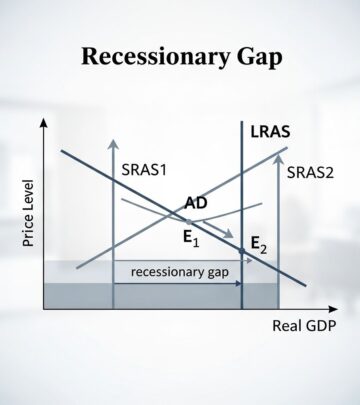
Understanding inflationary gaps becomes clearer when compared to their counterpart: recessionary gaps. A recessionary gap occurs when actual GDP falls below potential GDP, indicating that the economy is operating below full employment. In a recessionary gap, aggregate demand is insufficient to employ all available resources, leading to unemployment and underutilized productive capacity.
While inflationary gaps create upward pressure on prices and require contractionary policies, recessionary gaps create deflationary pressures and require expansionary policies to stimulate demand. The two gaps represent opposite points in the business cycle, with equilibrium—neither gap—representing the optimal economic state.
The Business Cycle Connection
Inflationary gaps emerge during expansionary phases of the business cycle when economic growth accelerates rapidly. These gaps are temporary phenomena that typically trigger policy responses designed to prevent the economy from overheating. If left unchecked, inflationary gaps can lead to destabilizing inflation, followed by contractionary policy responses that may precipitate recessions. Understanding where an economy sits relative to its inflationary or recessionary gaps is essential for anticipating policy shifts and their economic consequences.
Frequently Asked Questions (FAQs)
Q: How does an inflationary gap differ from regular inflation?
A: An inflationary gap is the structural imbalance between actual and potential GDP that creates conditions for inflation, while inflation is the actual rise in price levels. An inflationary gap may exist without current inflation, but it signals that inflationary pressures are building.
Q: Can an economy have inflation without an inflationary gap?
A: Yes. Inflation can occur due to supply shocks (such as rising oil prices), cost-push factors, or import price increases even when actual GDP is below potential GDP, meaning no inflationary gap exists.
Q: What is the natural rate of unemployment at full employment?
A: The natural rate of unemployment, also called the non-accelerating inflation rate of unemployment (NAIRU), typically ranges from 4-5% in developed economies. This represents unemployment that persists even at full employment due to frictional and structural factors.
Q: How long do inflationary gaps typically last?
A: Inflationary gaps are typically temporary phenomena lasting anywhere from several months to a few years. Policy responses and market adjustments gradually bring actual GDP back toward potential GDP, eliminating the gap.
Q: Why don’t policymakers simply eliminate inflationary gaps immediately?
A: Policy responses take time to work through the economy (policy lags), and policymakers must balance inflation control against employment and growth concerns. Overly aggressive responses can trigger recessions, so gradualism is often preferred.
Q: What happens to employment during an inflationary gap?
A: During an inflationary gap, unemployment is typically below the natural rate as businesses scramble to meet excess demand. This tight labor market drives wage increases, further fueling inflation.
References
- Inflationary Gap Definition & Calculations — Study.com. Accessed 2025. https://study.com/academy/lesson/inflationary-gap-definition-lesson-quiz.html
- Inflationary Gap: Definition, Formula, Examples — Corporate Finance Institute. Accessed 2025. https://corporatefinanceinstitute.com/resources/economics/inflationary-gap/
- Inflationary Gap (Positive Output Gap) — Fiveable AP Macroeconomics. Accessed 2025. https://fiveable.me/key-terms/ap-macro/inflationary-gap-positive-output-gap
- Learn About Inflationary Gaps in Macroeconomics — MasterClass. Accessed 2025. https://www.masterclass.com/articles/learn-about-inflationary-gaps-in-macroeconomics
- Introduction to Macroeconomics — U.S. Bureau of Economic Analysis. Accessed 2025. https://www.bea.gov/
Similar Articles








Read full bio of medha deb