Rising Prices and Rising Debt: Inflation’s Effect on Credit Card Balances
Explore how inflation drives both higher prices and mounting credit card interest rates.
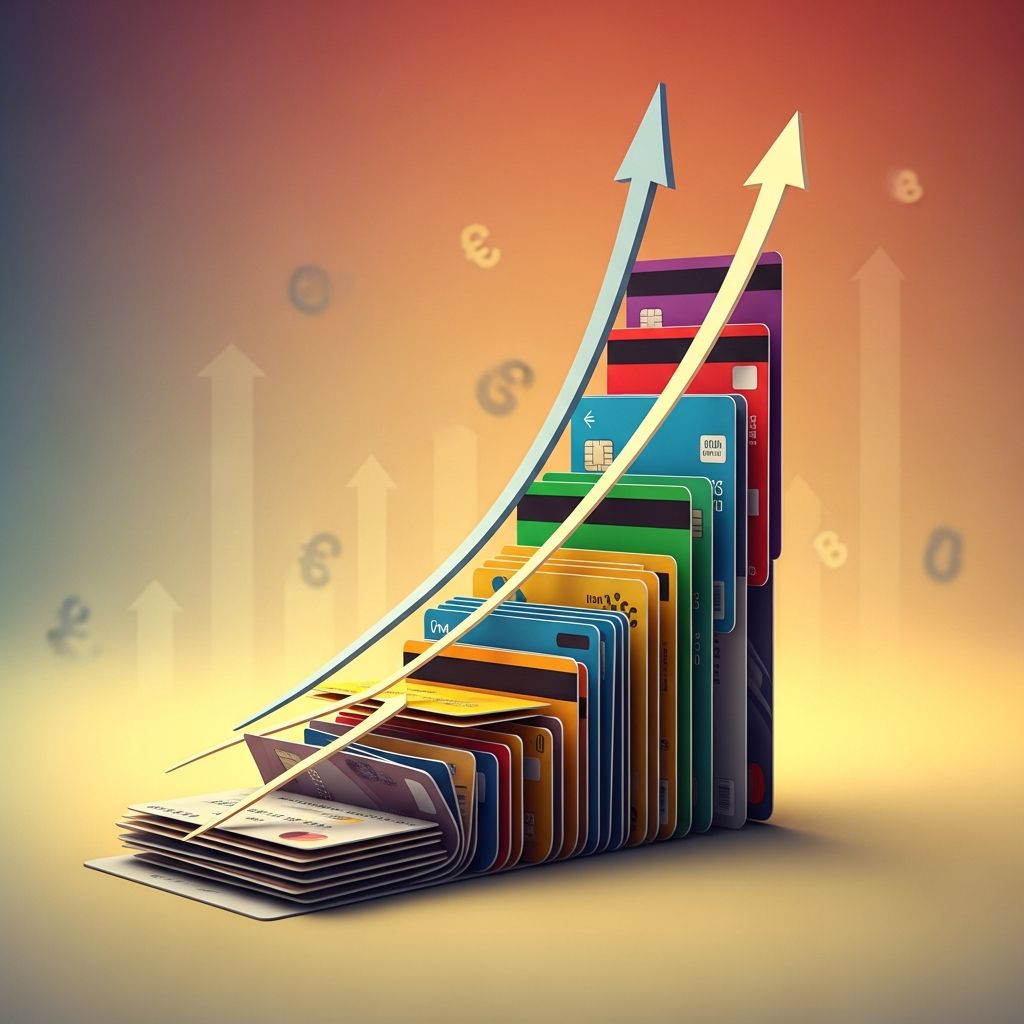
Economic inflation represents one of the most insidious threats to household financial stability, operating through multiple channels to simultaneously increase what consumers must spend while diminishing their ability to manage that spending. The relationship between inflationary pressure and credit card debt creates a compounding crisis that extends far beyond simple price increases at the grocery store or gas pump.
Understanding the Dual Impact of Inflation on Consumer Finances
Inflation functions as a two-pronged attack on household budgets. The immediate effect appears obvious: consumers face higher prices for essential goods and services. However, the secondary consequence proves equally damaging. When inflation rises, credit card companies respond by increasing their interest rates, meaning that borrowers who turn to plastic to bridge the gap between income and expenses face not only elevated purchase prices but also substantially higher costs for the privilege of borrowing.
This dual mechanism creates what economists describe as a magnifying effect on financial distress. A family struggling with elevated grocery bills and energy costs may resort to credit card borrowing to maintain their standard of living. Yet the interest rates applied to those balances compound the original problem, adding an additional financial burden on top of already-stressed household budgets.
How Inflation Drives Credit Card Interest Rates Upward
The connection between inflation and credit card rates operates through fundamental economic principles. Credit card companies, like all lenders, face a critical concern: the purchasing power of repaid money. When inflation accelerates, the dollars returned to credit card companies through borrower payments retain less value than the dollars originally loaned. To compensate for this erosion of purchasing power, lenders systematically raise their interest rates.
The mechanics work as follows: if a lender provides a thousand dollars today but receives repayment in future dollars worth significantly less due to inflation, the lender experiences a loss of real value. Credit card companies price this risk into their rates. During periods of low inflation, rates remain more moderate. When inflation climbs, rates follow in lockstep.
Contemporary data illustrates this relationship vividly. Before inflation surged following 2020, credit card rates hovered around manageable levels. As inflation intensified, particularly during 2022 and beyond, credit card companies raised their average annual percentage rates (APRs) into the 21 to 23 percent range—among the highest levels in modern history. For cardholders carrying balances, this translates into hundreds of dollars annually in additional interest charges on moderate balances.
The Escalating Burden of High-Interest Borrowing
The practical impact of elevated interest rates on household finances deserves careful consideration. Consider a realistic scenario: a family carrying a $6,500 credit card balance at a 22 percent APR. Before considering any principal reduction, this family pays over $1,400 annually in interest alone—roughly $117 monthly devoted entirely to interest charges rather than debt reduction.
This dynamic creates a pernicious trap. Consumers making minimum payments find that the majority of their payments service interest rather than reduce principal. The balance shrinks slowly, if at all, despite consistent monthly payments. Over time, families become trapped in revolving debt, paying thousands in interest while struggling to make meaningful progress toward debt elimination.
The situation intensifies for those carrying premium rewards credit cards, where APRs frequently reach 20 to 24 percent. While rewards programs offer incentives like airline miles or statement credits, a $7,500 balance on such a card can generate over $1,600 in annual interest—often exceeding the value of earned rewards and transforming what appeared to be a favorable financial product into a net liability.
Why Inflation Accelerates Consumer Borrowing
Beyond its direct impact on interest rates, inflation drives consumers to increase their credit card borrowing for a fundamental reason: expenses rise faster than incomes. Wages, for most workers, increase gradually and with a lag behind price increases. This creates a squeeze where household expenses outpace earnings, leaving families with a shortfall they must bridge somehow.
When essential costs—groceries, utilities, housing, healthcare—climb rapidly, families face immediate decisions. They cannot simply stop eating or turn off the heat. Instead, many turn to credit cards to maintain their existing standard of living, borrowing to cover the difference between what they earn and what they must spend.
Recent economic data demonstrates this phenomenon clearly. During the period from 2013 to 2020, when inflation remained unusually low at approximately 2 percent annually, credit card balances grew at a measured pace of 2.37 percent per year. Following the higher inflation period that began in 2021, credit card balances surged at 10.27 percent annually—more than four times faster. This acceleration directly correlates with families using credit cards as a financial buffer against rising living costs.
The Current State of American Credit Card Debt
The aggregate impact of these forces has produced historical levels of consumer credit card debt. As of the fourth quarter of 2025, Americans collectively carried $1.277 trillion in credit card balances—a sum that represents a 66 percent increase since Q1 2021 and exceeds the previous pandemic-era record by $350 billion. Individual consumers now carry an average balance exceeding $6,500, according to recent surveys.
The distribution of this debt reveals important patterns. High balances concentrated among working-age adults demonstrate particular vulnerability. Millennials report the highest incidence of five-figure credit card debt, with 35 percent carrying $10,000 or more. Generation X follows at 31 percent, while 26 percent of Generation Z report balances exceeding $10,000.
Perhaps most troublingly, more than half of active credit cardholders now carry balances month to month, unable to pay their statements in full. This represents a fundamental shift in how Americans utilize credit cards—no longer primarily for convenience or rewards, but as necessity-driven borrowing to afford basic living expenses.
The Interest Rate Crisis and Its Financial Consequences
The explosion of credit card interest rates has fundamentally altered the economics of consumer debt. According to the Consumer Financial Protection Bureau, average credit card APRs now hover around 21 percent, up substantially from the 15 percent levels that prevailed before recent inflation surges. For perspective, this represents a 40 percent increase in rates over a relatively brief period.
The cumulative financial impact staggers the imagination. Americans have paid a record-setting $2.1 trillion in credit card interest since 2010—a sum exceeding total outstanding student debt and auto loan debt combined. For every day that current interest rate levels persist, American families accrue approximately $368 million in additional credit card interest charges beyond what would occur under a 10 percent rate cap.
Monthly credit card payments have similarly soared. From early 2018 through the end of 2025, average monthly credit card payments rose by $553, representing a 38 percent increase from $1,441 to $1,994. This places additional strain on household budgets already squeezed by inflation across essential categories.
Who Bears the Heaviest Burden?
The inflation-driven credit card crisis does not affect all Americans equally. Survey data reveals that 55 percent of respondents report using credit cards simply to make ends meet, suggesting that higher prices force routine expenses onto revolving credit. Additionally, 46 percent of survey respondents report having maxed out at least one credit card due to inflationary pressure.
Working families, those without substantial emergency savings, and younger generations face the most acute pressure. These households lack sufficient financial buffers to absorb price increases without borrowing. As inflation persists, their credit card balances expand, trapped in a cycle of necessity-driven borrowing at historically elevated interest rates.
Breaking the Cycle: Strategies for Managing Inflation’s Impact
While macroeconomic forces remain beyond individual control, households can implement specific strategies to reduce their vulnerability to inflation-driven credit card debt accumulation:
- Build emergency reserves: Even modest savings buffers provide alternatives to credit card borrowing when unexpected expenses arise or income temporarily declines.
- Prioritize high-interest debt elimination: Focusing extra payments on credit card balances with the highest interest rates accelerates the path to debt freedom.
- Explore balance transfer opportunities: In certain circumstances, transferring balances to lower-rate cards or consolidation loans can reduce interest burdens.
- Negotiate with creditors: Many credit card companies remain willing to discuss rate reductions for established customers with positive payment histories.
- Consider additional income streams: Supplementing primary employment through part-time work or side income directly addresses the earnings-expense gap that drives borrowing.
- Reassess spending patterns: While inflation drives up absolute prices, reducing discretionary expenses provides additional resources for debt repayment.
Frequently Asked Questions
How much does inflation typically increase credit card interest rates?
Credit card rate increases track closely with inflation. During recent inflationary periods, credit card APRs increased from approximately 15-16 percent to 21-23 percent, a rise directly correlated with inflation acceleration.
Does inflation affect all types of debt equally?
While inflation influences various interest rates, credit cards are particularly sensitive due to their variable-rate structure and the shorter repricing intervals credit card companies employ compared to mortgage or auto loan lenders.
Why don’t wages increase at the same rate as inflation?
Labor market dynamics typically result in wages lagging behind price increases. Workers negotiate or receive raises annually or less frequently, while prices adjust continuously, creating persistent gaps between earning growth and expense growth.
What percentage of Americans currently carry credit card debt?
Approximately half of active credit cardholders now carry balances from month to month, representing roughly 40 percent of all U.S. adults.
Are there alternatives to credit card borrowing during inflationary periods?
Personal loans, home equity lines of credit (for homeowners), and family borrowing represent alternatives, though each carries distinct advantages and disadvantages. Building emergency savings remains the most effective long-term strategy.
Looking Forward: The Persistent Challenge
The relationship between inflation and credit card debt appears likely to persist as a significant consumer finance challenge. High interest rates, sticky inflation expectations, and elevated living costs continue to pressure household budgets. Without substantial macroeconomic shifts or policy interventions, the trend toward increased credit card reliance and accumulating balances seems positioned to continue.
Individual financial planning must account for these structural realities. Households should approach credit cards with clear awareness that in an inflationary environment, every balance carried represents not merely the purchase price but an additional layer of interest charges that compounds over time. Minimizing reliance on credit card borrowing and maintaining disciplined repayment of any balances assumed represents prudent financial management in the current economic environment.
References
- What the return of inflation may mean for credit card debt — CardRatings. https://www.cardratings.com/research/what-the-return-of-inflation-may-mean-for-credit-card-debt.html
- The Average Credit Card Debt in America Hits a Record High of $6,580 Per Individual in 2026 — Business Insider Markets. March 17, 2026. https://markets.businessinsider.com/news/stocks/the-average-credit-card-debt-in-america-hits-a-record-high-of-6-580-per-individual-in-2026-a-latest-report-launched-by-elitepersonalfinance-1035936260
- Credit Card Survey: Many Americans Say a 10% Rate — Debt.com. https://www.debt.com/research/credit-card-survey/
- More Than Half of Credit Cardholders Are Carrying Debt Month-to-Month at Crushing Interest Rates — The Century Foundation and Protect Borrowers. March 17, 2026. https://protectborrowers.org/report-more-than-half-of-credit-cardholders-are-carrying-debt-month-to-month-at-crushing-interest-rates-as-trumps-affordability-crisis-worsens/
- 2026 Credit Card Debt Statistics — LendingTree. https://www.lendingtree.com/credit-cards/study/credit-card-debt-statistics/
- Interest Nation: The State of America’s Credit Card Debt Crisis — The Century Foundation. https://tcf.org/content/report/interest-nation-the-state-of-americas-credit-card-debt-crisis/
Similar Articles








Read full bio of medha deb