Industry: Definition, Types, and Economic Impact
Understanding industries: Classification, sectors, and their role in economic growth.
What Is an Industry?
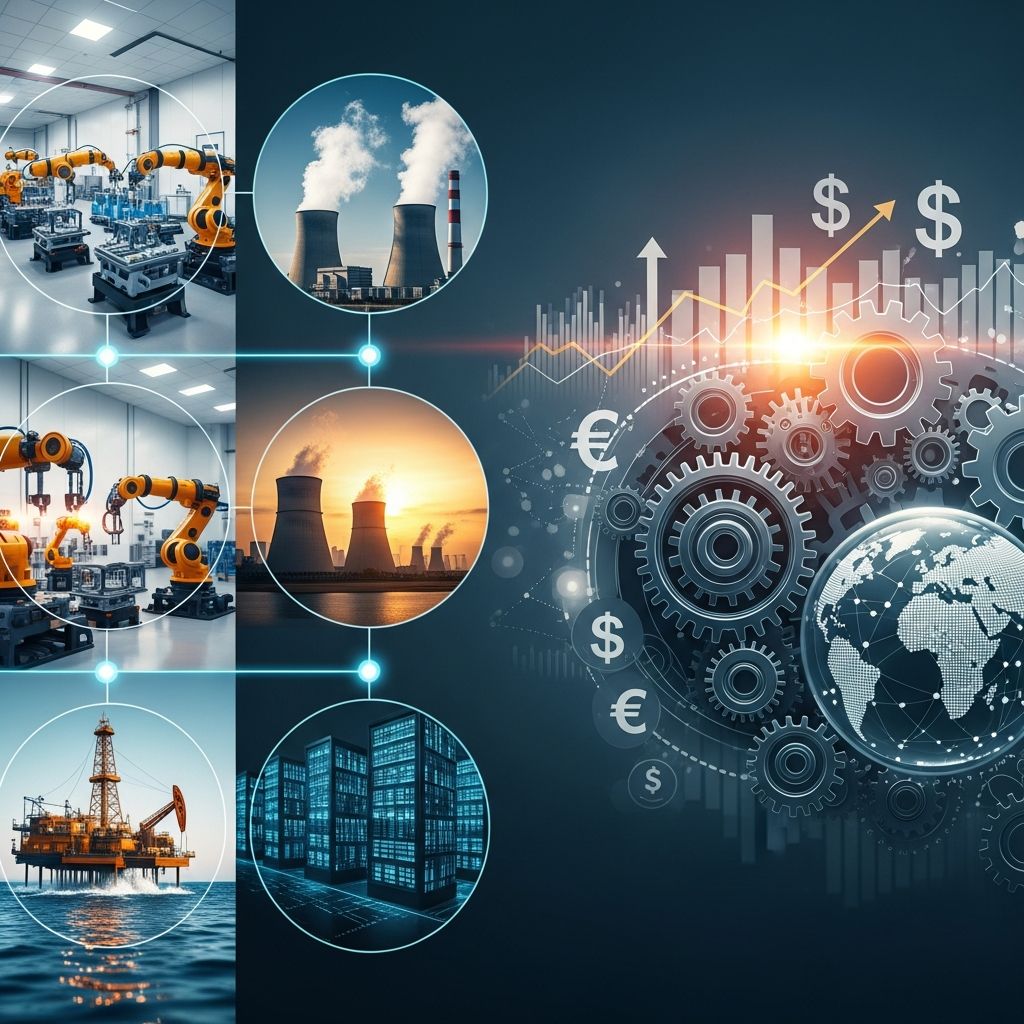
An industry represents a group of companies or organizations that engage in similar or related business activities. Industries are fundamental to modern economies, serving as the backbone of commerce, employment, and economic growth. The term “industry” typically refers to a specific sector within the broader economy where businesses produce goods or services, compete within a defined market, and share common characteristics in their operations, production methods, or target markets.
The concept of an industry has evolved significantly over time, beginning with the agricultural sector in ancient civilizations, progressing through the Industrial Revolution with manufacturing, and extending into today’s digital and service-based economies. Understanding industries is essential for investors, policymakers, entrepreneurs, and economists who seek to comprehend economic structures and identify growth opportunities.
Understanding Industry Basics
At its core, an industry comprises all businesses that produce similar products or provide comparable services. Companies within an industry often face similar competitive pressures, regulatory requirements, technological challenges, and market dynamics. This shared environment creates distinct industry characteristics that influence how businesses operate and compete.
Industries can be distinguished by several key factors:
- Production Methods: The techniques and technologies used to create products or deliver services
- Raw Materials: The inputs required for production and service delivery
- Labor Requirements: Specific skills and workforce needs within the industry
- Market Characteristics: Customer base, geographic reach, and competitive intensity
- Regulatory Environment: Government rules and compliance requirements specific to the industry
- Technological Innovation: The pace and nature of technological advancement affecting the sector
Classification of Industries
Industries are typically classified into distinct sectors based on their primary function and the stage of production. The most common classification system divides the economy into three or four sectors, each serving different economic functions and playing unique roles in overall economic development.
Primary Industries (Extractive)
Primary industries focus on extracting raw materials directly from nature. These include agriculture, mining, fishing, forestry, and oil and gas extraction. Primary industries provide the foundational materials upon which other sectors depend. Farmers, miners, and fishers work in these industries to supply commodities that feed into secondary industries for further processing and value addition.
Primary industries are typically characterized by:
- Direct dependence on natural resources and environmental conditions
- Labor-intensive operations in many cases
- Vulnerability to weather, climate, and commodity price fluctuations
- Strategic importance to national economies and food security
- Often lower profit margins but essential market role
Secondary Industries (Manufacturing)
Secondary industries transform raw materials from primary industries into finished or semi-finished products through manufacturing and processing. This sector includes automotive production, textile manufacturing, food processing, chemical production, construction, and consumer goods manufacturing. Secondary industries add significant value to raw materials through labor, technology, and innovation.
Manufacturing industries typically feature:
- Conversion of raw materials into usable products
- Capital-intensive operations requiring substantial infrastructure
- Technological advancement and process improvement focus
- Significant employment opportunities across skill levels
- Geographic concentration in regions with adequate resources and infrastructure
Tertiary Industries (Services)
Tertiary industries provide services to consumers and other businesses rather than producing physical goods. This vast sector encompasses healthcare, education, retail, hospitality, financial services, transportation, telecommunications, entertainment, and professional services. The service sector has become increasingly dominant in developed economies, representing the majority of economic activity and employment in most developed nations.
Service industries are characterized by:
- Intangible output that cannot be stored or inventoried
- Direct interaction with customers and clients
- Variability in service quality and delivery
- Often less capital-intensive than manufacturing
- Growing importance in post-industrial economies
Quaternary Industries (Knowledge-Based)
Quaternary industries, recognized in modern economic classifications, focus on information and knowledge creation, analysis, and dissemination. This emerging sector includes research and development, information technology, consulting, higher education, media, and digital services. Quaternary industries drive innovation and are increasingly central to competitive advantage in global markets.
Industry Classification Systems
Different classification systems help organize industries for statistical, regulatory, and analytical purposes. Understanding these systems aids investors, researchers, and policymakers in analyzing economic trends and business performance.
Standard Industrial Classification (SIC)
The Standard Industrial Classification system, established by the U.S. government, categorizes industries using a hierarchical four-digit code system. Although largely superseded by NAICS, SIC codes remain in use for historical data and certain regulatory purposes, providing a foundational framework for industry organization.
North American Industry Classification System (NAICS)
NAICS, developed jointly by the United States, Canada, and Mexico, provides a standardized system for classifying industries across North America using six-digit codes. This system offers greater detail and flexibility than SIC codes and is updated every five years to reflect economic changes and emerging industries.
Global Industry Classification Standard (GICS)
GICS, created by Morgan Stanley Capital International and Standard & Poor’s, classifies companies into 11 sectors, 24 industry groups, 68 industries, and 154 sub-industries. This hierarchical system is widely used by financial analysts, investors, and index providers for portfolio analysis and market research.
Major Economic Sectors
Modern economies typically organize industries into several major sectors, each encompassing related industries with similar characteristics and challenges:
| Sector | Description | Key Industries | Economic Characteristics |
|---|---|---|---|
| Technology | Information technology, software, telecommunications, and digital services | Software, hardware, semiconductors, IT services, cloud computing | High growth, rapid innovation, knowledge-intensive |
| Healthcare | Medical services, pharmaceuticals, medical devices, and biotechnology | Hospitals, clinics, drug manufacturers, medical device makers | Defensive, aging populations drive growth, regulatory-intensive |
| Finance | Banking, insurance, investment services, and real estate | Banks, insurance companies, investment firms, real estate agencies | Cyclical, highly regulated, system-critical importance |
| Consumer Discretionary | Retail, entertainment, restaurants, and consumer goods | Retailers, restaurants, apparel makers, entertainment venues | Cyclical, sensitive to consumer confidence and economic cycles |
| Energy | Oil, gas, renewable energy, and utilities | Oil companies, utilities, renewable energy producers | Capital-intensive, commodity-dependent, essential to economies |
| Industrials | Manufacturing, aerospace, defense, and heavy equipment | Machinery makers, aircraft manufacturers, industrial equipment | Cyclical, capital-intensive, global trade dependent |
| Materials | Chemicals, mining, metals, and forestry | Chemical producers, mining companies, metal manufacturers | Commodity-dependent, cyclical, essential to production |
Industry Analysis and Economic Impact
Industries shape economies through employment generation, innovation, trade patterns, and technological advancement. Understanding industry dynamics helps explain economic performance, identify investment opportunities, and inform policy decisions.
Employment and Economic Growth
Industries are the primary source of employment across economies. Different industries create varying types of jobs—from entry-level positions to highly skilled technical roles. The composition of industries within an economy determines employment patterns, wage levels, and workforce skill requirements. Developed economies have shifted toward service and knowledge-based industries, while developing nations often maintain stronger manufacturing and primary sectors.
Innovation and Technological Change
Industries drive technological innovation, pushing boundaries in research and development. Technology-intensive industries like semiconductors, biotechnology, and software development generate innovations that transform entire economies. Technological disruption within industries creates both opportunities and challenges for established businesses.
Global Trade and Competition
Industries participate in global supply chains and international trade. Comparative advantages in specific industries determine export patterns and trade balances. Industrial competitiveness influences national economic performance and living standards, making industrial policy an important consideration for governments worldwide.
Industry Life Cycle
Industries follow predictable patterns of development, typically progressing through distinct life cycle stages:
Introduction Stage
New industries emerge when technological innovation or market opportunities create demand for novel products or services. Few competitors exist, growth is rapid but uncertain, and companies focus on establishing market presence rather than profitability.
Growth Stage
Market acceptance expands, competitors increase, and profitability improves. Industry expansion attracts investment and new participants. Production scales up, costs decline through economies of scale, and market share battles intensify.
Maturity Stage
Market growth slows, competition intensifies, and profitability stabilizes or declines. Industry consolidation often occurs as weaker competitors exit the market. Companies focus on efficiency, differentiation, and market share maintenance.
Decline Stage
Demand decreases due to technological obsolescence, changing consumer preferences, or market saturation. Fewer competitors remain, and profitability erodes. Resources shift toward more promising industries.
Frequently Asked Questions
Q: What is the difference between an industry and a sector?
A: While often used interchangeably, sectors are broader categories encompassing multiple related industries. For example, the technology sector includes software, hardware, telecommunications, and IT services industries.
Q: How do industries contribute to economic development?
A: Industries generate employment, create goods and services, drive innovation, contribute tax revenue, facilitate international trade, and generate wealth. Economic development depends significantly on a diverse, competitive industrial base.
Q: Why is industry classification important?
A: Classification systems enable statistical analysis, facilitate investment research, support policy development, allow meaningful economic comparisons, and help identify industry trends and opportunities.
Q: How do disruptive technologies affect industries?
A: Disruptive technologies can fundamentally transform industries by creating new markets, obsoleting existing business models, enabling new competitors, and forcing established companies to adapt or decline.
Q: What factors determine industry competitiveness?
A: Industry competitiveness depends on factors including access to resources, labor availability and skills, technological capabilities, regulatory environment, infrastructure quality, capital availability, and competitive intensity.
Q: How do economic cycles affect different industries?
A: Cyclical industries like construction and automotive are heavily affected by economic booms and recessions, while defensive industries like healthcare and utilities experience more stable demand across economic cycles.
References
- North American Industry Classification System (NAICS) — Overview and Structure — U.S. Census Bureau. 2024. https://www.census.gov/naics/
- Global Industry Classification Standard (GICS) — S&P Global Market Intelligence. 2024. https://www.spglobal.com/marketintelligence/en/client-solutions/market-data/gics
- Understanding Industry Classification and Economic Sectors — International Monetary Fund (IMF). 2023. https://www.imf.org/
- The Structure of Modern Economies: A Review of Sectoral Classification — Organisation for Economic Co-operation and Development (OECD). 2024. https://www.oecd.org/
- Industry Life Cycles and Economic Development — World Bank Economics Research. 2023. https://www.worldbank.org/
Similar Articles








Read full bio of Sneha Tete