Indifference Curve: Definition, Graph & Example
Understanding indifference curves and their role in consumer choice theory and economic analysis.
What Is an Indifference Curve?
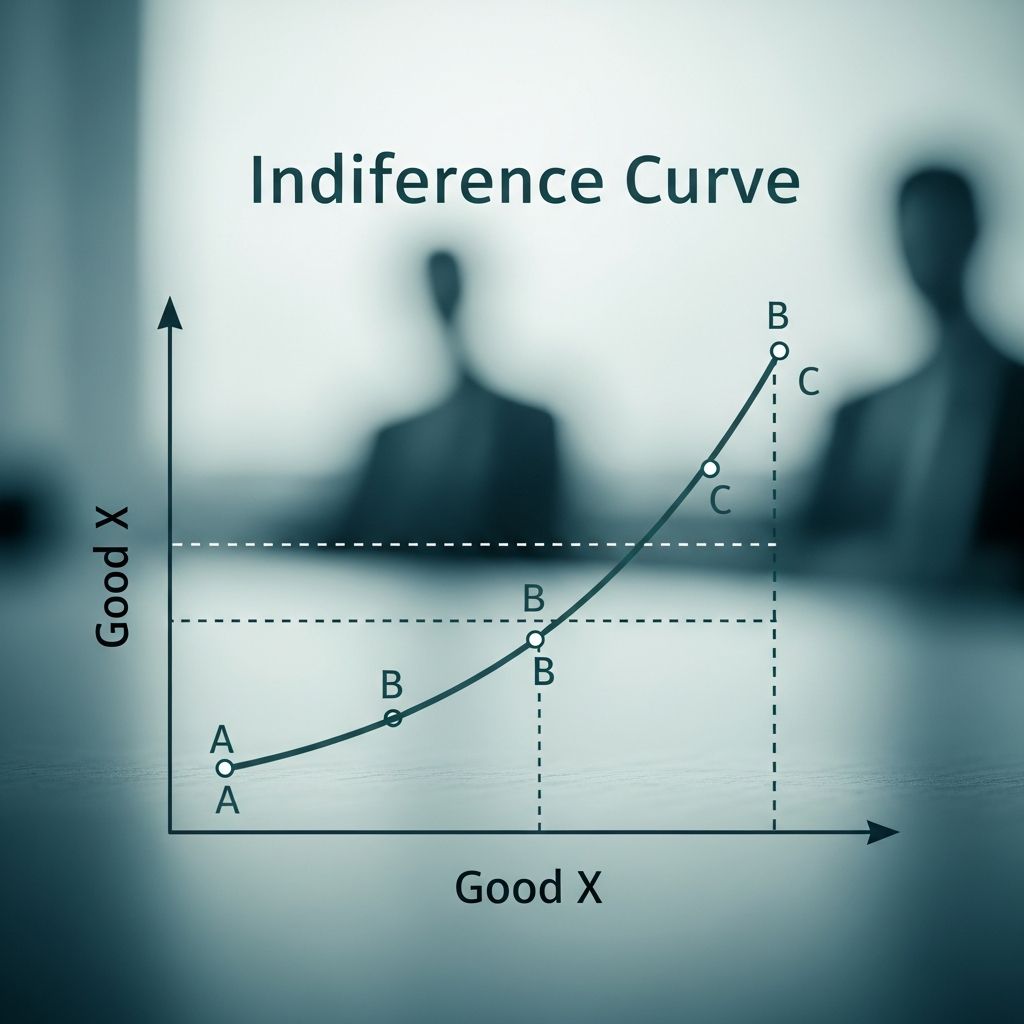
An indifference curve is a fundamental concept in microeconomic theory that represents the preferences of a consumer across different combinations of goods and services. In essence, an indifference curve is a graphical representation showing all the possible combinations of two goods that provide a consumer with the same level of satisfaction or utility. The consumer is said to be “indifferent” among all the bundles of goods that lie on this curve because each combination yields identical total utility.
The term “indifference” refers to the consumer’s complete lack of preference among the various consumption bundles represented on the curve. Whether a consumer chooses one combination or another on the same indifference curve, their overall satisfaction remains constant. This concept is crucial for understanding how consumers make purchasing decisions and allocate their limited resources among competing alternatives.
In practical terms, if a consumer has a choice between Bundle A (containing 10 apples and 5 oranges) and Bundle B (containing 8 apples and 7 oranges), and both bundles lie on the same indifference curve, the consumer would be equally satisfied with either option. This equality of satisfaction across different combinations is what defines an indifference curve.
Understanding the Basics of Indifference Curves
To fully comprehend indifference curves, it is essential to understand several key characteristics and principles that govern their behavior. These curves are typically drawn on a two-dimensional graph, with one good represented on the horizontal axis (X-axis) and another good on the vertical axis (Y-axis). Each point on the curve represents a specific combination of the two goods that yields the same total utility.
Key Characteristics of Indifference Curves
Indifference curves possess several important properties that define their shape and behavior:
Downward Sloping: Indifference curves typically slope downward from left to right. This negative slope reflects the fundamental economic principle that to maintain the same level of satisfaction, if a consumer gets more of one good, they must be willing to accept less of another. This assumption is based on the principle of non-satiation, which posits that consumers always prefer more goods to fewer goods.
Convex to the Origin: Most indifference curves are convex to the origin, meaning they curve inward toward the origin point of the graph. This shape reflects the assumption of diminishing marginal utility and diminishing marginal rate of substitution. As a consumer consumes more of one good relative to another, they become less willing to substitute additional units of that good for the other.
Never Intersect: Two indifference curves from the same preference system can never cross each other. If they did, it would create a logical contradiction in consumer preferences and violate the basic axioms of consumer theory. This property ensures that preferences remain consistent and transitive.
Higher Curves Represent Greater Utility: In an indifference curve map, curves positioned farther from the origin represent higher levels of utility. A consumer would always prefer to be on a higher indifference curve rather than a lower one because any point on a higher curve represents a consumption bundle with more overall satisfaction.
The Marginal Rate of Substitution
A critical concept associated with indifference curves is the marginal rate of substitution (MRS). The MRS represents the rate at which a consumer is willing to substitute one good for another while maintaining the same level of total utility. In other words, it quantifies how much of one good a consumer will give up to obtain one additional unit of another good.
Mathematically, the MRS is represented by the slope of the indifference curve at any given point. The slope of an indifference curve equals the negative ratio of the marginal utility of good X to the marginal utility of good Y. This relationship can be expressed as follows: the MRS of X for Y equals negative MU(X) divided by MU(Y).
The principle of diminishing marginal rate of substitution states that as a consumer obtains more of one good, they become progressively less willing to substitute additional units of that good for another. This principle is why indifference curves are convex to the origin. For example, if you already have ten bananas and only one apple, you might be willing to give up eight bananas to get another apple. However, if you have one banana and ten apples, you would only be willing to sacrifice one banana to get an additional apple.
Indifference Curve Maps
An indifference curve map is a collection of multiple indifference curves displayed on the same graph, each representing different levels of utility. This map provides a comprehensive picture of a consumer’s preferences across a wide range of consumption possibilities. Each curve in the map corresponds to a specific level of total utility.
In an indifference curve map, the curves are arranged in a hierarchy based on their distance from the origin. Curves closer to the origin represent lower levels of utility, while curves farther from the origin represent progressively higher levels of utility. For instance, if we label three indifference curves as I1, I2, and I3, with I3 positioned farthest from the origin, then any consumption bundle on I3 provides more satisfaction than any bundle on I2, which in turn provides more satisfaction than any bundle on I1.
This hierarchical arrangement allows economists and consumers to quickly compare the relative satisfaction levels of different consumption bundles. It also demonstrates how a consumer’s optimal choice of goods changes as their income or the prices of goods change.
Budget Constraint and Optimal Consumption
While indifference curves represent consumer preferences, they do not account for the practical limitation of a consumer’s income. This is where the budget constraint comes into play. A budget line, also known as a budget constraint, represents all the possible combinations of two goods that a consumer can afford given their income and the prices of those goods.
The optimal consumption bundle occurs at the point where an indifference curve is tangent to the budget line. At this point of tangency, the consumer achieves the highest level of utility given their financial constraints. The condition for this optimal choice is that the marginal rate of substitution equals the price ratio of the two goods.
In mathematical terms, the optimization condition can be expressed as: MRS = P(X)/P(Y), where P(X) and P(Y) are the prices of goods X and Y respectively. At this optimal point, the slope of the indifference curve (negative MRS) exactly matches the slope of the budget line (negative price ratio).
Types of Indifference Curves
While most indifference curves follow the standard pattern of being downward sloping and convex to the origin, certain types of goods produce indifference curves with different shapes:
Perfect Substitutes
When two goods are perfect substitutes for each other, their indifference curves are straight lines with a constant negative slope. In this case, the consumer is willing to substitute one good for another at a constant rate. For example, if a consumer views a one-dollar bill and four quarters as perfect substitutes, they would be willing to trade one for the other at a constant rate regardless of how much of each they currently possess.
Perfect Complements
When two goods are perfect complements, meaning consumers want to consume them in fixed proportions, their indifference curves have an L-shape. A classic example is left shoes and right shoes—a consumer wants to consume them in a 1:1 ratio. Having more left shoes than right shoes provides no additional utility. The indifference curves in this case are L-shaped, with the corner of the L representing the optimal consumption ratio.
Ordinary Goods
Most real-world goods are ordinary goods, which means they satisfy the four standard properties of indifference curves: downward slope, convexity, non-intersection, and consistent preferences. For ordinary goods, consumers require more of one good to compensate for less consumption of another, and they experience diminishing marginal rates of substitution.
Practical Applications and Importance
Indifference curve analysis has numerous practical applications in economics and business decision-making. Economists use indifference curves to model consumer behavior and predict how changes in income and prices affect consumption patterns. Businesses utilize these concepts to understand consumer preferences and optimize pricing strategies.
Understanding indifference curves helps explain phenomena such as the substitution effect and income effect. The substitution effect describes how consumers shift to cheaper alternatives when prices rise. The income effect describes how a change in real purchasing power affects consumption choices. Together, these effects explain the total impact of a price change on the quantity demanded of a good.
Additionally, indifference curve analysis provides insights into consumer welfare. By comparing consumption bundles across different indifference curves, economists can assess how policy changes or economic events affect overall consumer satisfaction.
Limitations of Indifference Curve Analysis
While indifference curves are powerful analytical tools, they do have certain limitations. The analysis assumes rational behavior and consistent preferences, which may not always reflect real-world consumer decisions. Consumers sometimes make impulsive purchases or are influenced by factors not accounted for in basic indifference curve theory, such as advertising, social pressure, or psychological factors.
Additionally, indifference curve analysis becomes more complex when dealing with more than two goods, as graphical representation becomes impossible. Although the theory can be extended mathematically to multiple goods, the intuitive visual representation that makes indifference curves so useful is lost.
Frequently Asked Questions
Q: What does it mean to be “indifferent” on an indifference curve?
A: Being indifferent means that a consumer experiences equal satisfaction from all consumption bundles that lie on the same indifference curve. The consumer has no preference for one bundle over another because they all provide identical utility levels.
Q: Why do indifference curves never intersect?
A: Indifference curves cannot intersect because doing so would violate the transitivity assumption of consumer preferences and create logical inconsistencies. If two curves intersected, it would imply that the same consumption bundle could provide two different levels of utility, which is impossible.
Q: How does the budget line relate to indifference curves?
A: The budget line shows all affordable combinations of two goods given a consumer’s income and the prices of those goods. The optimal consumption choice occurs where the budget line is tangent to the highest achievable indifference curve.
Q: What is the relationship between marginal rate of substitution and price ratio?
A: At the optimal consumption bundle, the marginal rate of substitution equals the price ratio of the two goods. This condition ensures that the consumer has no incentive to alter their consumption bundle given their budget constraint.
Q: How do indifference curves change when consumer income increases?
A: When income increases, the budget line shifts outward, allowing the consumer to reach higher indifference curves and achieve greater overall utility. The optimal consumption bundle typically shifts to include more of both goods (assuming both are normal goods).
References
- Indifference Curves – Overview, Diminishing Marginal Utility, Graphs — Corporate Finance Institute. 2024. https://corporatefinanceinstitute.com/resources/economics/indifference-curve/
- Indifference Curve — Economics Help. 2024. https://www.economicshelp.org/blog/glossary/indifference-curves/
- Consumer Theory and Utility Maximization — OpenStax. 2024. https://openstax.org/books/principles-economics-3e/pages/6-1-choices-constrained-by-income
- Microeconomic Theory — International Monetary Fund Economic Review. 2024. https://www.imf.org/external/pubs/ft/wp/wp.aspx
Similar Articles








Read full bio of medha deb