Index Funds: Benefits and Drawbacks
Discover the advantages of low-cost diversification in index funds alongside key limitations for smarter portfolio decisions.
Index funds provide a straightforward way for investors to gain broad market exposure through passive strategies that mirror established benchmarks. These vehicles prioritize matching index performance over beating it, appealing to those seeking simplicity and efficiency in their portfolios.
Understanding Index Funds Fundamentals
An
index fund
holds a portfolio designed to replicate the composition and returns of a specific market index, such as the S&P 500 or Dow Jones Industrial Average. Rather than relying on stock pickers to select winners, these funds invest in all or a representative sample of the index’s components, ensuring close alignment with benchmark movements.This passive approach contrasts with active management, where fund managers frequently trade to outperform the market. By minimizing trading, index funds reduce operational costs and maintain transparency in their holdings. Available as mutual funds or exchange-traded funds (ETFs), they cater to various investor needs, with ETFs offering intraday trading flexibility.
Historically, indices like the S&P 500 represent large-cap U.S. equities, but options span bonds, international markets, and sectors. This variety allows tailored exposure without the need for individual security selection.
Key Advantages of Investing in Index Funds
Index funds stand out for several compelling reasons that make them a cornerstone of many portfolios.
Cost Efficiency and Low Expense Ratios
Passive management translates to significantly lower fees compared to actively managed funds. Without the need for extensive research or frequent trading, expense ratios often fall below 0.1%, preserving more returns for investors. Over decades, this compounding advantage can substantially boost net performance.
Broad Diversification with Minimal Effort
One share grants ownership in hundreds or thousands of securities, spreading risk across companies, sectors, and sometimes geographies. For instance, an S&P 500 fund covers 500 leading U.S. firms, cushioning against any single stock’s downturn. This built-in diversification simplifies risk management for novice and seasoned investors alike.
Tax Advantages from Low Turnover
Infrequent trading minimizes capital gains distributions, enhancing tax efficiency. ETFs, in particular, use in-kind redemption processes that avoid taxable events, making them suitable for taxable accounts.
Proven Long-Term Track Record
Studies show most active funds fail to beat their benchmarks over extended periods, positioning index funds for reliable, market-average returns. Their consistency suits retirement planning, forming the core of many 401(k) and IRA allocations.
Simplicity and Accessibility
With low or no minimum investments and availability through most brokerages, index funds lower barriers to entry. Their transparent strategy requires little ongoing oversight, ideal for hands-off investors.
Potential Disadvantages to Consider
While attractive, index funds have limitations that warrant careful evaluation.
Exposure to Full Market Volatility
Tracking the market means sharing its downturns fully. During recessions or corrections, index funds decline alongside benchmarks, offering no downside protection.
No Opportunity to Outperform
Capped at index returns, they miss potential alpha from skilled active management. In bull markets favoring specific sectors, active strategies might surpass indices.
Limited Customization Options
Investors cannot exclude underperforming holdings or tilt toward preferences, as the fund strictly mirrors the index. Concentrated indices amplify risks from dominant components, like tech-heavy benchmarks.
Structural Differences in Mutual Funds vs. ETFs
Traditional index mutual funds may impose minimums and end-of-day pricing, while ETFs provide flexibility but could incur brokerage commissions.
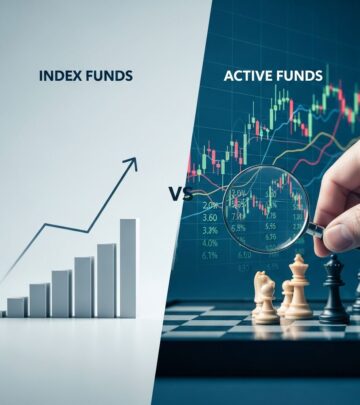
| Feature | Index Funds | Actively Managed Funds |
|---|---|---|
| Management Style | Passive | Active |
| Fees | Low (e.g., <0.1%) | Higher (often 0.5-1.5%) |
| Diversification | High, index-based | Varies by manager |
| Performance Goal | Match index | Beat index |
| Tax Efficiency | High | Lower due to turnover |
This table highlights structural differences based on common industry observations.
Who Benefits Most from Index Funds?
Beginners appreciate the low entry barriers and reduced decision-making. Long-term investors, especially those saving for retirement, value steady compounding without timing the market. Risk-averse individuals gain from diversification, though aggressive growth seekers might look elsewhere.
Core-satellite strategies often use index funds as the stable foundation, supplemented by targeted active bets.
Strategies for Effective Index Fund Allocation
- Asset Allocation: Combine equity, bond, and international index funds for balanced exposure.
- Rebalancing: Annually adjust to maintain target weights, capturing gains and buying low.
- Dollar-Cost Averaging: Invest fixed amounts regularly to mitigate volatility.
- Low-Cost Providers: Select funds from Vanguard, Fidelity, or Schwab for minimal fees.
Common Myths About Index Funds Debunked
- Myth: They’re risk-free. Reality: Market risk persists; diversification reduces, but doesn’t eliminate, losses.
- Myth: Only for novices. Reality: Institutional investors allocate trillions to indices for efficiency.
- Myth: No growth potential. Reality: They capture full market upside over time.
Index Funds in Retirement Planning
Target-date funds, often index-based, automate lifecycle adjustments, gliding toward conservatism near retirement. Data from the U.S. Department of Labor emphasizes low-cost index options in 401(k) plans to maximize participant outcomes.
Frequently Asked Questions (FAQs)
What is the best index fund for beginners?
Total stock market or S&P 500 funds offer broad U.S. exposure with ultra-low costs.
Are index funds better than individual stocks?
For most, yes—due to diversification and lower risk, though stocks suit high-conviction picks.
Can index funds lose money?
Yes, during market declines, but historically recover over long horizons.
How do index ETFs differ from mutual funds?
ETFs trade like stocks intraday; mutual funds at end-of-day NAV, with potential minimums.
Should I invest all my money in one index fund?
No—diversify across asset classes to manage risk effectively.
Index funds democratize investing, but success hinges on patience and discipline. Align choices with goals, risk tolerance, and time horizon for optimal results.
References
- What is an index fund? – Vanguard — Vanguard. 2023. https://investor.vanguard.com/investor-resources-education/understanding-investment-types/what-is-an-index-fund
- What Are Index Funds and How Can They Be Used In Your Portfolio? — Chase. 2024. https://www.chase.com/personal/investments/learning-and-insights/article/what-is-an-index-fund
- Index Funds vs. Mutual Funds – New York Life Insurance — New York Life. 2023. https://www.newyorklife.com/articles/index-fund-vs-mutual-fund
Similar Articles








Read full bio of medha deb