Indemnity: Definition, Types, and Business Applications
Understanding indemnity agreements and their role in protecting businesses from financial liability.
What Is Indemnity?
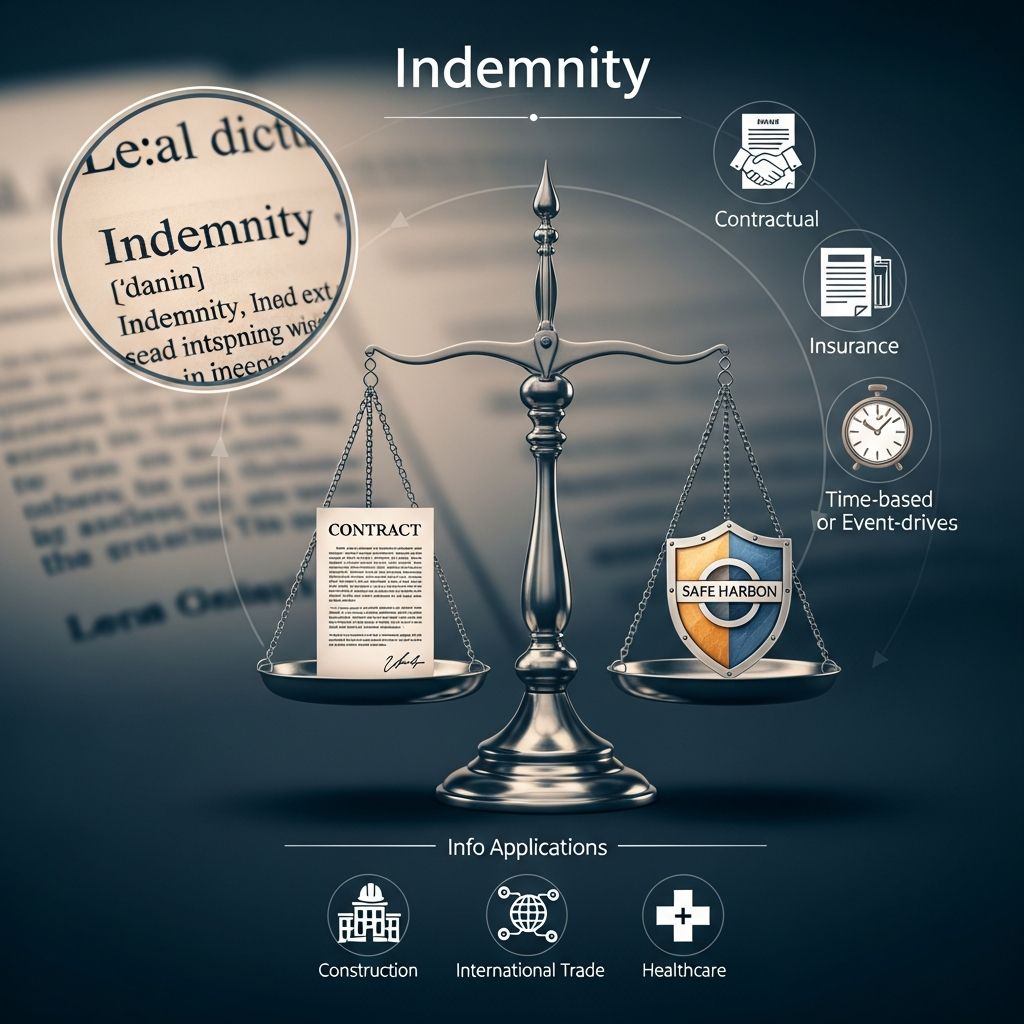
Indemnity refers to security or protection against a financial liability. It typically occurs in the form of a contractual agreement made between parties in which one party agrees to pay for losses or damages suffered by the other party. In essence, indemnity is a legal obligation where one party (the indemnitor) commits to compensate another party (the indemnitee) for any losses or damages they may incur.
The term indemnity comes from Latin and literally means “to make whole” or “to restore.” In modern business and legal contexts, indemnity serves as a fundamental risk management tool that protects individuals and organizations from bearing the full financial burden of unexpected losses, negligence, accidents, or unforeseen circumstances.
Indemnification may be compensated in various forms including cash payments, repairs, replacement of damaged property, or other means which the parties have agreed upon in their contract. The specific method of compensation depends entirely on the nature of the agreement and the preferences of the involved parties.
How Indemnity Works
Indemnity functions through a contractual relationship where one party assumes responsibility for potential losses of another party. When a loss or damage occurs that falls within the scope of the indemnity agreement, the responsible party must compensate the affected party to restore them to their original financial position.
For example, in an insurance context, the insurer (indemnitor) agrees to compensate the insured (indemnitee) for any covered losses during the policy period. The insured makes premium payments to bind the agreement, allowing the insurer to collect funds that will be used to compensate for damages or losses when they occur.
The process typically involves the indemnitee proving the amount and nature of their loss, submitting documentation, and the indemnitor then providing compensation up to the limits specified in the agreement. This system ensures that individuals and businesses can transfer risk to those better positioned to bear it, whether that’s insurance companies or other contractual partners.
Types of Indemnity
Indemnity agreements come in different forms, each serving specific purposes in various business and legal contexts.
Express Indemnity
Express indemnity is a written agreement where the terms and conditions are explicitly outlined. This is the most common type of indemnity found in business relationships. Examples include insurance contracts, construction contracts, agency agreements, and service agreements. In express indemnity agreements, the scope of coverage, financial limits, exclusions, and obligations of both parties are clearly defined in writing.
Implied Indemnity
Implied indemnity arises not from a written agreement but from circumstances or the conduct of the parties involved. This type of indemnity obligation emerges naturally from the relationship between parties, even without explicit contractual language. A practical example is an agent-principal business relationship. When a principal refuses to accept goods that an agent supplies, the agent may sell them to others. However, if the agent sustains a loss while selling, the principal is legally obligated to pay for it, even though this obligation may not be explicitly written in their agreement.
Professional Indemnity
Professional indemnity insurance protects licensed professionals such as architects, accountants, lawyers, engineers, and healthcare providers against claims arising from errors, negligence, or omissions in their professional work. This type of indemnity is often mandatory or highly recommended in regulated professions and serves to protect both the professional and their clients.
Key Elements of Indemnity Clauses
Indemnity clauses form the foundation of indemnity agreements and contain several critical elements that define the scope and limitations of protection.
Scope of Coverage
The scope of coverage defines which specific events, losses, or circumstances are covered under the indemnity agreement. Typically, indemnity provisions start with a broad scope of coverage that is then narrowed through a list of specific exclusions. Understanding what is covered is essential for both parties to manage expectations and ensure adequate protection.
Exclusions
Exclusions specify which risks or types of damages are not covered by the indemnity agreement. Common exclusions might include intentional misconduct, violations of law, or losses resulting from gross negligence. It is crucial for businesses to carefully review and understand these exclusions to ensure they are not left vulnerable to uncovered losses. Reading exclusions carefully is often overlooked but critically important.
Financial Limits
Indemnity clauses establish maximum financial limits on the amount the indemnitor must pay. These limits may include per-occurrence limits (maximum for a single incident) and aggregate limits (maximum total payout over the policy period). Businesses must carefully review these limits to ensure their coverage aligns with potential liability exposure. When standard coverage limits appear insufficient, businesses may purchase excess policies or umbrella policies to increase protection.
Notification Requirements
Most indemnity agreements require the indemnitee to notify the indemnitor within a specific timeframe when a claim is filed or anticipated. Policyholders typically must provide proof of loss within 30 to 60 days of the incident. Failure to meet notification requirements can jeopardize coverage, making prompt reporting essential when a claim or potential claim arises.
Indemnity vs. Hold Harmless Clauses
While often used interchangeably, indemnity and hold harmless clauses serve different purposes and should not be confused.
Indemnity is a contractual obligation to compensate another party for losses or damages they have suffered. It involves direct financial compensation to restore the indemnitee to their original position.
A hold harmless clause, by contrast, is a waiver that prevents one party from holding another party responsible for certain actions or outcomes. Rather than providing compensation, it releases one party from liability entirely. A hold harmless clause might protect a general contractor from being sued by subcontractors for workplace injuries, whereas indemnity would specifically cover financial compensation for damages actually sustained.
Many agreements contain both provisions, with hold harmless clauses providing initial liability protection and indemnity clauses providing financial compensation when losses do occur.
Importance of Indemnity in Business
Indemnity plays a crucial role in modern business operations across virtually every industry and organizational size.
Director and Executive Protection
In corporate governance, indemnity agreements are commonplace to protect Board Directors and company executives from personal liability. These agreements hold directors harmless from liabilities, losses, and lawsuits that may result from serving on the board. This protection is essential for attracting high-quality professionals to serve in leadership positions, as it shields them from personal financial responsibility for corporate actions.
Risk Management and Financial Stability
Indemnity provides critical risk management by transferring potential financial burdens to parties better positioned to bear them. For businesses operating in industries with inherent risks, indemnity is vital to manage liability, cover potential losses, and maintain operational stability. Without adequate indemnity protection, a single significant loss could devastate a business’s finances.
Professional Practice Protection
For professionals such as architects, accountants, consultants, lawyers, engineers, and healthcare providers, indemnity is essential. These professionals face significant liability risks due to alleged errors, negligence, or omissions in their work. Indemnity coverage allows these professionals to manage risks effectively and protect both their practice and personal finances when claims arise.
Cost and Litigation Management
Indemnity insurance protects the holder from paying the full amount of a settlement or judgment, even when it is the insured’s fault. Coverage typically includes court costs, attorney fees, and settlement amounts, significantly reducing the financial burden of litigation.
Real-World Applications of Indemnity
Indemnity appears across numerous industries and business contexts.
Insurance Industry
The most straightforward application of indemnity occurs in insurance. An insurance company agrees to compensate the insured for covered losses up to policy limits. For example, a property owner paying homeowners insurance premiums receives indemnity protection. If the building sustains significant structural damage from fire, the insurance company indemnifies the owner by reimbursing repair costs or reconstructing damaged areas using authorized contractors.
Business Interruption Insurance
Most business interruption insurance policies contain an Extended Period of Indemnity Endorsement, which extends coverage beyond the time required to physically restore damaged property. This provision covers additional expenses that allow the business to return to normal operations and restore revenues to pre-loss levels.
Construction and Contracts
Construction contracts frequently include indemnity provisions protecting various parties. General contractors may require subcontractors to indemnify them against workplace injuries and property damage claims. Similarly, property owners may require contractors to carry indemnity insurance protecting the owner from liability arising from the contractor’s work.
Healthcare and Medical Practice
Healthcare professionals face significant malpractice exposure. Indemnity coverage protects medical professionals when facing malpractice lawsuits. Through indemnity, the insurer covers associated claim costs and resolutions as long as the claim falls within the scope of coverage. Many healthcare facilities require physicians and other medical professionals to maintain indemnity coverage as a condition of employment.
Legal and Financial Services
Lawyers, accountants, and financial advisors carry professional indemnity insurance protecting against claims related to professional errors, omissions, or negligence. These claims can be costly and potentially business-threatening, making indemnity coverage essential.
Indemnity Insurance Coverage
Indemnity insurance compensates beneficiaries for actual economic losses up to the policy’s limiting amount. Recovery is generally limited to the amount of provable loss, even if the face amount of the policy is higher. This differs from life insurance, where the beneficiary’s economic loss is irrelevant—the full policy amount is paid upon the insured’s death from covered causes.
Typical examples of indemnity insurance include professional liability insurance, errors and omissions insurance, general liability insurance, directors and officers insurance, and specialty coverage for specific industries. Each type addresses particular risks inherent to specific professions or business operations.
Frequently Asked Questions
Q: What is the difference between indemnity and insurance?
A: Indemnity is a contractual obligation to compensate for losses, while insurance is a specific type of indemnity agreement where an insurance company agrees to cover specified risks in exchange for premiums. All indemnity insurance involves indemnity, but not all indemnity agreements are insurance contracts.
Q: Can indemnity agreements be one-sided?
A: Yes, indemnity agreements can be one-sided, with only one party obligated to indemnify the other. However, many agreements include mutual indemnification, where both parties agree to indemnify each other for specific losses or circumstances.
Q: What happens if an indemnity agreement excludes coverage for a loss I experience?
A: If a loss falls within an exclusion in your indemnity agreement, the indemnitor is typically not obligated to compensate you. This is why carefully reviewing exclusions before entering into an indemnity agreement is critically important. You may need to seek additional coverage through supplemental policies.
Q: How important is indemnity insurance for small businesses?
A: Indemnity insurance is highly important for small businesses. A single significant liability claim or loss can bankrupt a small business, making indemnity insurance essential for protecting the business, its assets, and its owners from catastrophic financial loss.
Q: Can indemnity agreements include indemnification for intentional misconduct?
A: Most jurisdictions do not enforce indemnity agreements that attempt to indemnify a party for their own intentional misconduct or gross negligence. Public policy typically prevents parties from avoiding liability for intentional wrongdoing through contractual indemnification.
References
- Indemnity – Definition, Example, Types, Importance — Corporate Finance Institute. 2024. https://corporatefinanceinstitute.com/resources/accounting/indemnity-definition/
- The Role of Indemnity in Insurance Law — August Law. 2024. https://www.august-law.com/the-role-of-indemnity-in-insurance-law/
- Indemnity — Wikimedia Foundation. 2024. https://en.wikipedia.org/wiki/Indemnity
Similar Articles








Read full bio of Sneha Tete