Income Thresholds for US Social Classes
Discover the income levels defining lower, middle, upper-middle, and upper classes across America, with state variations and key factors influencing your status.
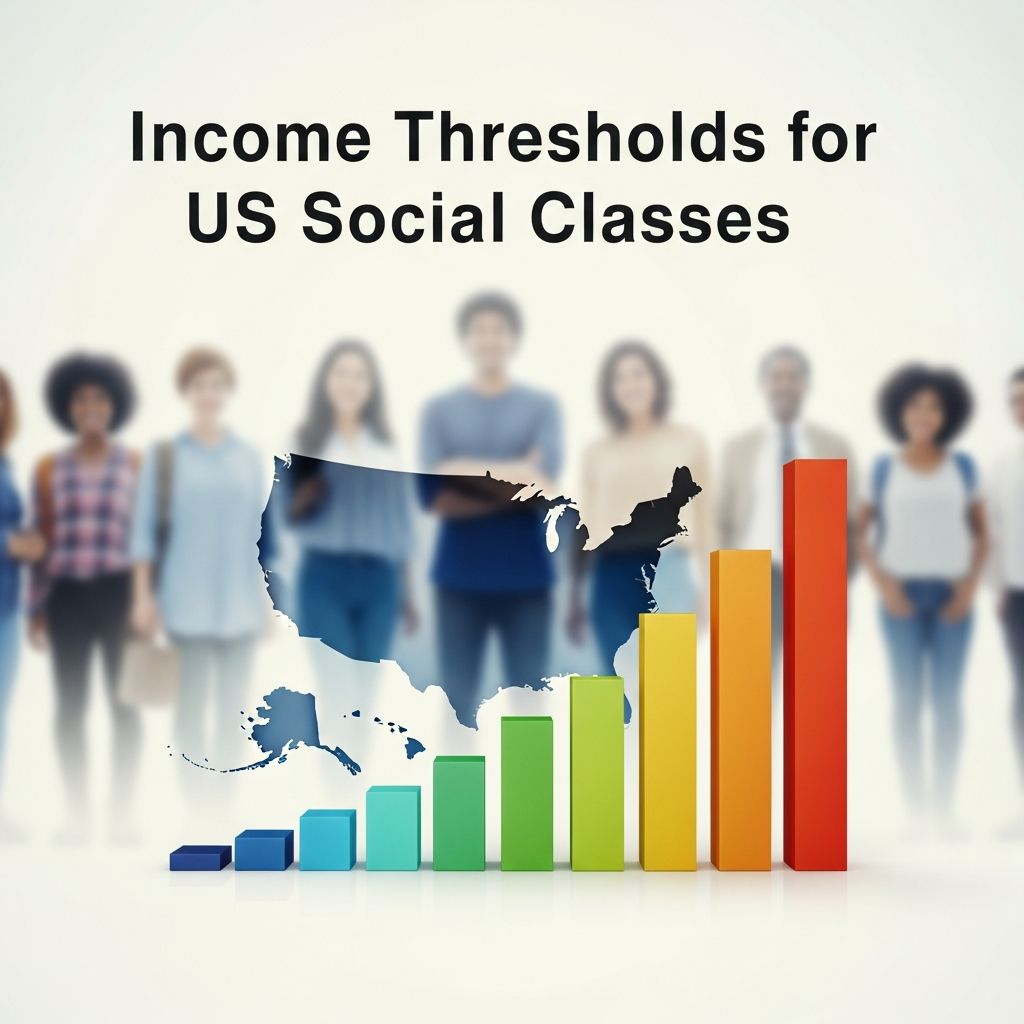
Household income levels in the United States serve as key indicators for classifying individuals and families into socioeconomic groups, ranging from lower to upper class. National median household income stands at approximately $80,734 for the 2020-2024 period, but thresholds vary significantly by location, family size, and demographics.
Defining Social Classes by Income
Social class categories are often delineated using multiples of the median income. Lower class typically falls below 67% of the median, middle class between 67% and 200%, upper-middle from 200% to 500%, and upper class above 500%. For a median of $80,734, this translates to roughly: lower class under $54,000, middle class $54,000-$161,000, upper-middle $161,000-$403,000, and upper over $403,000 annually.
National Benchmarks
- Lower Class: Households earning less than two-thirds of the median, often facing financial strain.
- Middle Class: The broadest group, encompassing working families with stable but modest lifestyles.
- Upper-Middle Class: Professionals with higher education and dual incomes, affording comforts like homeownership.
- Upper Class: Top earners with significant wealth accumulation and luxury spending power.
Regional Variations in Income Levels
Income thresholds shift dramatically by state due to cost of living, job markets, and economic hubs. Washington, D.C., boasts a median household income of $88,311, second only to top states, while disparities persist within regions.
| State | Median Household Income (2023) | Upper-Middle Threshold (200% Median) |
|---|---|---|
| District of Columbia | $88,311 | $176,622 |
| Maryland | $98,461 (est.) | $196,922 |
| Massachusetts | $96,505 (est.) | $193,010 |
| California | $91,905 (est.) | $183,810 |
| Texas | $76,292 (est.) | $152,584 |
High-cost areas like D.C. and Maryland require higher incomes for middle-class status compared to lower-cost states like Texas.
Impact of Household Size on Class Status
Median incomes adjust by family size, affecting class perceptions. A four-person household in D.C. has a median of $215,972, pushing middle-class ranges higher.
- One-person: Often lower medians, e.g., $75,814 in D.C.
- Two-person: Dual earners boost to $147,683 in D.C.
- Three-person: $183,198 median in D.C.
- Four-person: Highest at $215,972, reflecting child-related costs.
Racial and Ethnic Disparities in Earnings
Income varies widely by race and ethnicity. Asian households lead at $116,503 median (2020-2024), while Black households average $55,157 nationally. In D.C., non-Hispanic White households earn $170,201 versus $60,764 for Black households, highlighting stark gaps.
Over 15 years, most groups saw income rises in majority of states, but non-Hispanic Whites declined in five states like Alaska and Nevada.
Top Income Tiers: Entering Elite Status
The upper class aligns with top percentiles. Top 10% households earn $251,000+, top 5% $335,000+, top 1% $659,060+ pre-tax. Single earners need $450,100 for top 1%.
| Percentile | Household Income Threshold | Individual Income Threshold |
|---|---|---|
| Top 10% | $251,036 | $155,042 |
| Top 5% | $335,000+ | N/A |
| Top 1% | $659,060 | $450,100 |
Factors Beyond Income Defining Class
While income sets baselines, net worth, debt, home equity, and education influence true class mobility. Wealth concentration grows, with top 1% holding disproportionate shares. Rising inequality, per Gini coefficient trends, widens gaps.
Cost of Living Adjustments
In high-cost states like California, a $128,813 median for four-person households still yields middle-class status only up to $257,000, but housing costs erode purchasing power. Lower-cost areas like North Carolina offer middle-class life at $108,511 median.
Trends in Income Growth
From 2005-2009 to 2020-2024, median incomes rose for nearly all groups in most states post-inflation adjustment. D.C. reached $109,870 median, underscoring urban economic strength.
Strategies to Climb Income Brackets
- Pursue high-demand careers in tech, healthcare, finance.
- Leverage dual incomes and education for upper-middle entry.
- Invest in assets to build net worth beyond salary.
- Relocate to high-income states like Maryland or Massachusetts.
FAQs
What income defines middle class nationally?
Approximately $54,000 to $161,000 for households, based on 67%-200% of $80,734 median.
How does family size affect thresholds?
Larger families have higher medians; e.g., D.C. four-person at $215,972 vs. one-person $75,814.
What is top 1% income?
$659,060 household, $450,100 individual in 2025 data.
Why do racial income gaps exist?
Historical, educational, and employment disparities contribute, e.g., Asian $116,503 vs. Black $55,157 medians.
Does location matter for class?
Yes, D.C. median $88,311 vs. national $80,734 requires higher earnings for equivalent lifestyle.
References
- Median Household Income by State 2026 — World Population Review. 2026. https://worldpopulationreview.com/state-rankings/median-household-income-by-state
- Income and Net Worth of The TOP 1% 5% 10% 25% 50% in the U.S. — YouTube (Erin Talks Money). 2026. https://www.youtube.com/watch?v=YxNdF9gAYVU
- How Income Varies by Race and Geography — U.S. Census Bureau. 2026-01. https://www.census.gov/library/stories/2026/01/household-income-by-race-and-state.html
- Who Are the Top One Percent by Income or Net Worth in 2026? — DQYDJ. 2026. https://dqydj.com/top-one-percent-united-states/
Similar Articles








Read full bio of medha deb