Income Statement Formulas, Calculations & Ratios
Master income statement analysis with essential formulas, calculations, and financial ratios for business evaluation.
Understanding Income Statement Formulas, Calculations, and Ratios
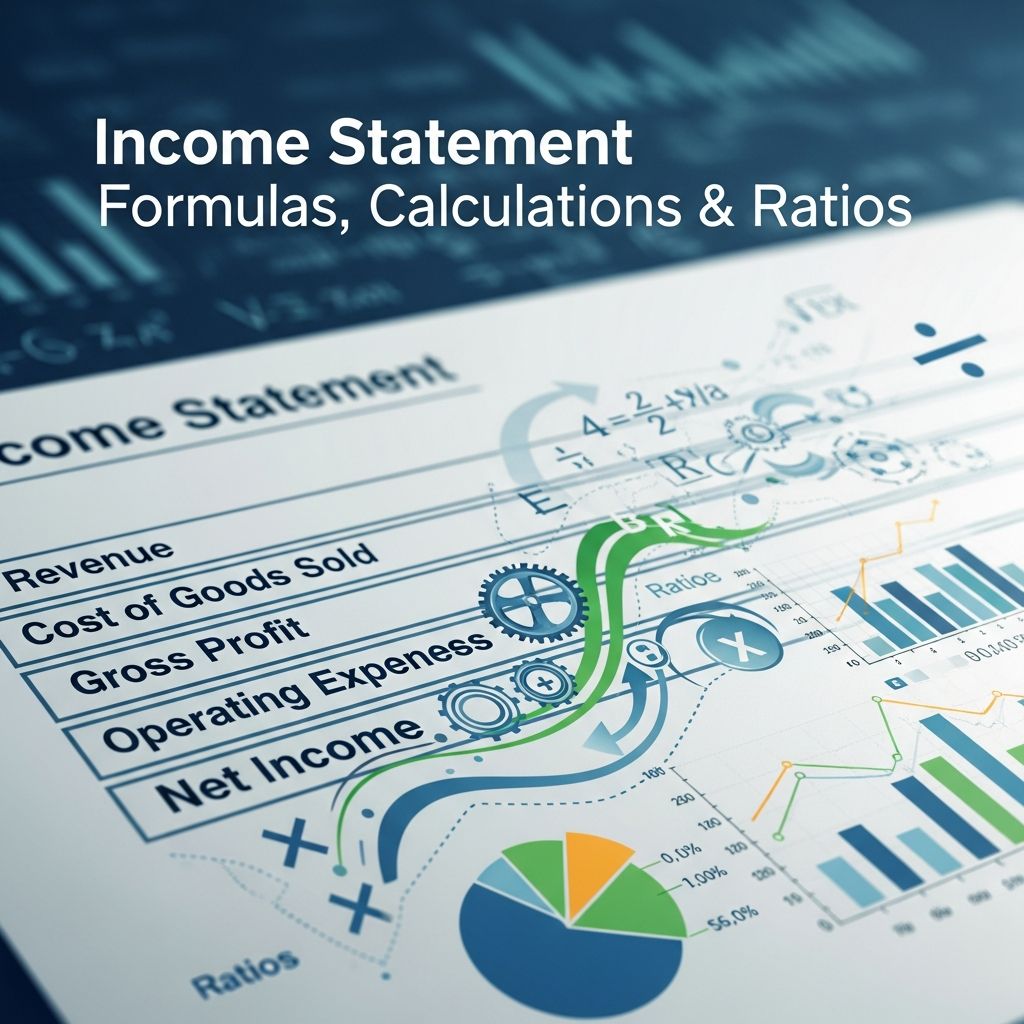
The income statement, also known as a profit and loss statement, is one of the most critical financial documents a business can produce. It provides a comprehensive overview of a company’s revenues, expenses, and profitability over a specific period. To extract meaningful insights from an income statement, professionals must understand how to calculate and interpret various financial ratios and formulas. These calculations serve as analytical tools that help investors, creditors, managers, and analysts evaluate a company’s financial health, operational efficiency, and earning potential.
Financial ratios derived from income statements enable stakeholders to make informed decisions about investment opportunities, credit extension, and strategic business planning. Rather than looking at raw numbers, financial ratios standardize information, making it possible to compare companies of different sizes and across various industries. Understanding these formulas and calculations is essential for anyone involved in financial analysis or business management.
The Basic Income Statement Formula
At its foundation, the income statement follows a straightforward formula:
Revenue – Expenses = Net Income
However, most comprehensive income statements use a multi-step approach that provides greater detail and insight into how a company generates its profits. The multi-step formula breaks down the calculation process:
Revenue – Cost of Goods Sold = Gross Profit
Gross Profit – Operating Expenses = Operating Income
Operating Income – Non-operating Expenses = Net Income
This structured approach allows analysts to identify profitability at different stages of operations, making it easier to pinpoint where a company excels or struggles financially.
Profitability Ratios and Margins
Profitability ratios are among the most widely used financial metrics derived from income statements. These ratios measure a company’s ability to generate profit relative to its sales, assets, and equity. They reveal how efficiently a company converts revenue into actual profit and how effectively management uses resources to create shareholder value.
Gross Profit Margin
The gross profit margin is one of the most fundamental profitability ratios and measures how much money a business makes per dollar earned after accounting for the cost of goods sold. This ratio is calculated using the formula:
Gross Profit Margin = (Sales Revenue – COGS) / Sales Revenue
For example, if a company has sales revenue of $9,000 and cost of goods sold of $4,000, the calculation would be: ($9,000 – $4,000) / $9,000 = 0.55, or 55%. This means the company retains 55 cents of every dollar earned as gross profit before operating expenses. A higher gross profit margin indicates better pricing strategies or lower production costs, while a lower margin may suggest pricing pressures or rising input costs.
Businesses can improve their gross profit margin by lowering cost of goods sold through negotiating better wholesale prices or by raising selling prices. However, price increases must be carefully considered to avoid losing customer demand.
Operating Profit Margin
The operating profit margin measures what percentage of revenue remains as profit after accounting for both cost of goods sold and operating expenses. The formula is:
Operating Margin = Operating Income / Net Sales × 100
For instance, if a company has net sales of $50 billion and operating income of $7.5 billion, the operating margin would be: ($7.5 billion / $50 billion) × 100 = 15%. This indicates the company earns 15 cents of operating profit for every dollar of sales. The operating margin is particularly useful because it isolates the profitability from core business operations, excluding the effects of financing and tax decisions.
Net Profit Margin
The net profit margin is the most comprehensive profitability measure, as it accounts for all expenses, including cost of goods sold, operating expenses, interest, and taxes. This ratio shows what percentage of total revenue becomes actual profit available to shareholders. The formula is:
Net Profit Margin = Net Income / Net Sales
A net profit margin of 10% means the company retains 10 cents of profit for every dollar of sales after all expenses have been paid. This ratio provides the most complete picture of profitability but can be influenced by financial decisions and tax strategies.
Efficiency and Turnover Ratios
Efficiency ratios measure how effectively a company uses its assets and resources to generate revenue and profit. These ratios are calculated using a combination of income statement and balance sheet figures.
Receivables Turnover Ratio
The receivables turnover ratio measures how many times a company collects its average accounts receivable during a period. The formula is:
Receivables Turnover Ratio = Net Sales / Average Accounts Receivable
A higher receivables turnover ratio indicates the company collects payment from customers more quickly, which improves cash flow. Conversely, a low ratio suggests customers are taking longer to pay, which could indicate collection problems or lenient credit policies.
Inventory Turnover Ratio
The inventory turnover ratio reveals how many times a company sells and replaces its inventory during a period. The formula is:
Inventory Turnover Ratio = Cost of Goods Sold / Average Inventory
A high inventory turnover ratio suggests efficient inventory management and strong sales, while a low ratio may indicate slow-moving inventory or potential obsolescence issues. However, the appropriate inventory turnover varies significantly by industry.
Days’ Sales in Inventory
This ratio, also known as days to sell, estimates how many days inventory sits before being sold:
Days’ Sales in Inventory = 365 / Inventory Turnover Ratio
If the inventory turnover ratio is 4, then days’ sales in inventory would be 365 / 4 = 91.25 days, meaning on average the company holds inventory for approximately three months before selling it.
Interest Coverage and Leverage Metrics
These ratios help assess a company’s ability to meet debt obligations and understand its financial leverage structure.
Times Interest Earned Ratio
The times interest earned ratio, also called the interest coverage ratio, measures how many times a company can cover its interest payments with operating income:
Times Interest Earned = Operating Income / Interest Expense
A ratio of 5, for example, means the company generates enough operating income to pay its interest expenses five times over. Lenders and creditors closely monitor this ratio because it indicates whether a company generates sufficient earnings to service its debt obligations.
Per-Share Metrics
Earnings per share is a crucial metric for investors evaluating stock value and company profitability on a per-share basis.
Earnings Per Share
Earnings per share measures how much net income is attributable to each outstanding share of common stock:
Earnings Per Share = Net Income / Number of Outstanding Shares
If a company has net income of $10 million and 5 million outstanding shares, the EPS would be $2 per share. EPS is widely used by investors to evaluate investment opportunities and compare companies within the same industry.
Cash Flow Ratios from the Income Statement
Understanding cash flow is critical because profits don’t always equal cash availability. Several ratios help analyze the relationship between reported income and actual cash flow.
Current Average Liability Ratio
This ratio measures a company’s ability to pay current liabilities with cash generated from operations:
Current Average Liability Ratio = Net Cash from Operating Activities / Average Current Liabilities
For example, if operating cash flow is $700 and average current liabilities are $950, the ratio would be approximately 0.74. This indicates the company generates enough operating cash to cover its current liabilities within a reasonable timeframe.
Cash Flow Margin
The cash flow margin ratio shows what percentage of net sales is converted into actual cash:
Cash Flow Margin = Net Cash from Operating Activities / Net Sales
If a company has operating cash flow of $700 and net sales of $1,200, the cash flow margin would be 700 / 1,200 = 0.58, or 58%. A higher cash flow margin indicates the company converts its sales into cash more efficiently, reducing reliance on credit sales.
How to Calculate and Interpret Income Statement Ratios
Calculating income statement ratios involves five essential steps. First, identify the specific formula for the ratio you want to calculate. Second, locate the necessary figures on the company’s income statement and any relevant balance sheet data. Third, perform the calculation using the formula. Fourth, interpret the results in context—understanding what the number means for the business. Fifth, benchmark the results against industry standards, competitors, or the company’s historical performance.
For instance, if you calculate a 15% operating margin, you should compare this to competitors in the same industry and review whether this margin has been consistent or changing over several years. This comparative analysis reveals whether the company is performing well relative to peers and whether performance is improving or deteriorating.
The Importance of Ratio Analysis
Financial ratio analysis is the process of evaluating a company’s performance by examining key ratios across multiple dimensions. Rather than relying on a single ratio, analysts typically evaluate a set of ratios across liquidity, profitability, leverage, and efficiency before drawing conclusions. This comprehensive approach helps identify a company’s strengths and weaknesses, track performance trends over time, and make meaningful comparisons with competitors or industry benchmarks.
Analysts rarely make investment or credit decisions based on a single metric. Instead, they use combinations of ratios to track a company’s performance trends and identify potential risks or strengths. This multi-dimensional analysis provides a more complete and reliable picture of financial health.
Comparing Balance Sheet Data with Income Statement Data
Many important financial ratios combine figures from both the income statement and the balance sheet. When calculating such ratios, it’s important to use balance sheet averages because the income statement covers activities over a period while the balance sheet provides only a snapshot of one specific day. To calculate an average, add the balance sheet figure from two consecutive years and divide by two. This approach ensures a fair comparison between period-based income statement data and point-in-time balance sheet figures.
Identifying Trends and Performance Changes
Beyond calculating individual ratios, businesses should track how ratios change over multiple periods. By comparing income statements from different periods, companies can identify key trends in financial performance, including revenue growth, expense patterns, and margin changes. These trend analyses reveal whether a company’s profitability is improving or declining and whether specific expense categories are growing faster than revenue.
Using Ratios for Strategic Decision-Making
Different stakeholders use income statement ratios for different purposes. Investors focus on profitability and earnings per share to evaluate investment potential. Creditors examine interest coverage and cash flow ratios to assess repayment ability. Management uses efficiency ratios to identify operational improvements. Competitors benchmark their performance against peers using industry-standard ratios. This versatility makes income statement analysis essential for various stakeholders.
Frequently Asked Questions
Q: What is the difference between gross profit margin and net profit margin?
A: Gross profit margin only considers cost of goods sold, while net profit margin accounts for all expenses including operating costs, interest, and taxes. Net profit margin provides a more complete picture of overall profitability.
Q: Why should I use balance sheet averages when calculating ratios?
A: The income statement covers a period of time while the balance sheet is a snapshot of one day. Using averages from two consecutive years ensures fair comparison between period-based and point-in-time figures.
Q: What does a high times interest earned ratio indicate?
A: A high times interest earned ratio indicates the company generates substantial operating income relative to its interest obligations, suggesting lower credit risk and strong ability to service debt.
Q: Can I rely on a single ratio to evaluate a company?
A: No, analysts recommend evaluating multiple ratios across profitability, liquidity, efficiency, and leverage categories. A single ratio provides limited insight; comprehensive analysis requires examining several metrics together.
Q: How often should I calculate and review income statement ratios?
A: Most companies calculate financial ratios quarterly and annually to track performance trends. Regular review helps identify emerging problems or opportunities earlier than annual analysis alone.
References
- Financial Ratios: Definition, Types, and Examples — Corporate Finance Institute. 2024. https://corporatefinanceinstitute.com/resources/accounting/financial-ratios/
- How to Read and Analyze Financial Statements — Bench Accounting. 2024. https://www.bench.co/blog/accounting/how-to-read-and-analyze-financial-statements
- Financial Ratios: In-Depth Explanation with Examples — Accounting Coach. 2024. https://www.accountingcoach.com/financial-ratios/explanation
- Profitability Ratios – Definitions, Types, Formulas — 365 Financial Analyst. 2024. https://365financialanalyst.com/knowledge-hub/financial-analysis/profitability-ratios/
- Income Statement Definition, Formula & Importance — Tipalti. 2024. https://tipalti.com/resources/learn/income-statement/
Similar Articles








Read full bio of Sneha Tete