Income Elasticity of Demand: Definition & Formula
Understand how consumer income changes affect demand for goods and services.
Income Elasticity of Demand: Understanding Consumer Behavior and Income Changes
Income elasticity of demand (YED) is a fundamental economic concept that measures the responsiveness of quantity demanded for a good or service to changes in consumer income. It quantifies the relationship between how much consumers earn and how much they purchase of a particular product. Understanding this relationship is crucial for businesses, investors, and policymakers who need to forecast demand patterns and make informed decisions about resource allocation and pricing strategies.
The income elasticity of demand reveals whether demand for a product will increase, decrease, or remain stable when consumer incomes rise or fall. This metric helps explain why certain products experience surge in sales during economic booms while others thrive during recessions. By analyzing income elasticity, economists and business professionals can predict future consumption patterns and identify investment opportunities in growing sectors.
Understanding the Definition and Core Concept
Income elasticity of demand represents the percentage change in quantity demanded divided by the percentage change in consumer income. It captures the elasticity—or sensitivity—of consumer demand relative to income fluctuations. Rather than assuming all goods behave similarly when incomes change, income elasticity recognizes that different products have different income sensitivities.
The relationship between consumer income and product demand is direct and measurable. When consumer wages increase, demand for certain goods typically rises as well, assuming all other factors remain constant. Conversely, when incomes decline, consumers tend to reduce their consumption of these same goods. However, this relationship is not uniform across all products, which is precisely why income elasticity of demand is so valuable for economic analysis.
The Income Elasticity of Demand Formula
The formula for calculating income elasticity of demand is straightforward and widely used in economic analysis:
Income Elasticity of Demand = % Change in Quantity Demanded / % Change in Income
For example, if consumer income increases by 10% and the quantity demanded for a specific good increases by 20%, the income elasticity of demand would be calculated as 20% ÷ 10% = 2.0. This coefficient of 2.0 indicates that for every 1% increase in income, consumers demand 2% more of that product. This formula applies uniformly across different product categories and economic contexts, making it a universal tool for economic analysis.
Classification of Income Elasticity: Three Primary Types
Based on the numerical value calculated from the formula, income elasticity of demand falls into three distinct categories, each with different implications for consumer behavior and business strategy:
Positive Income Elasticity of Demand
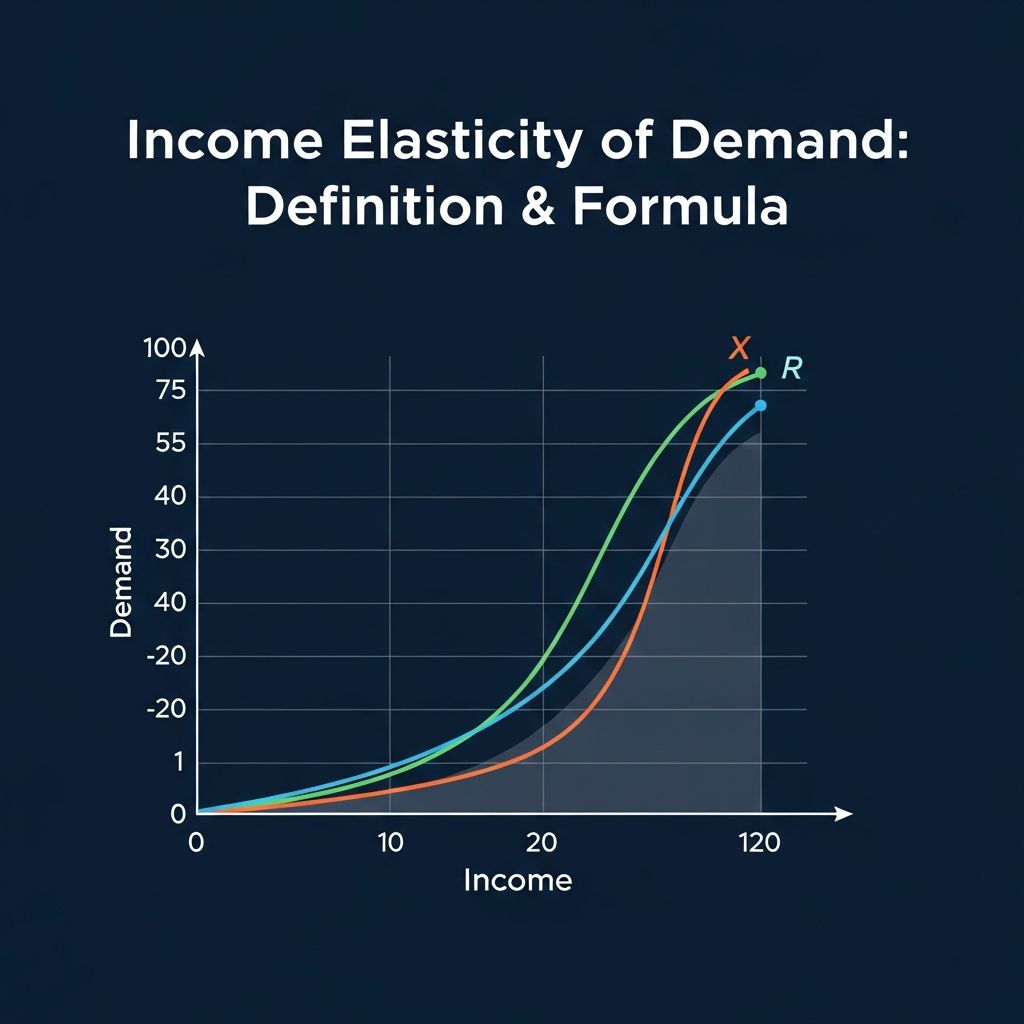
Positive income elasticity occurs when demand for a commodity rises with an increase in consumer income and declines when income falls. Products exhibiting positive income elasticity are classified as normal goods—commodities that consumers demand more of as their purchasing power increases. The upward slope of the demand curve in this case indicates that rising income contributes to rising demand and vice versa.
Positive income elasticity encompasses three subcategories:
- Unitary Elasticity (YED = 1): The percentage change in product demand corresponds exactly to the percentage change in consumer income. A 15% increase in income results in precisely a 15% increase in demand.
- Greater than Unitary (YED > 1): The percentage change in demand exceeds the percentage change in income, indicating luxury goods or superior goods. Examples include luxury automobiles, fine dining experiences, and designer clothing. These products experience disproportionately larger increases in demand when incomes rise.
- Less than Unitary (0 < YED < 1): The percentage change in demand is less than the percentage change in income. These are necessity goods like milk, bread, and basic clothing. Even when incomes rise significantly, consumers don’t proportionally increase their consumption of these essential items.
Negative Income Elasticity of Demand
Negative income elasticity refers to a condition in which demand for a commodity decreases with a rise in consumer income and increases with a fall in consumer income. Products displaying negative income elasticity are called inferior goods—commodities that consumers demand less of as their incomes increase because they can afford better alternatives. The downward slope implies that an increase in income contributes to a fall in demand, while a decrease in income causes a rise in demand.
A practical example illustrates this concept clearly: as consumer income increases, demand for millet (a basic grain) decreases because consumers can now afford to purchase wheat, which they perceive as a superior alternative. Therefore, millet is classified as an inferior good relative to wheat for consumers with rising incomes. Other examples of inferior goods include generic brand products, used clothing, and public transportation among affluent consumers who can afford private vehicles.
Zero Income Elasticity of Demand
Zero income elasticity corresponds to situations when there is no impact of rising household income on commodity demand. Such goods are termed essential goods or perfectly inelastic goods with respect to income. Both high-income and low-income consumers require the same quantity of these products regardless of income changes. Salt exemplifies this category perfectly—consumers need approximately the same amount of salt whether they earn €30,000 or €300,000 annually.
Other examples of goods with zero or near-zero income elasticity include basic medications, water, and fundamental utilities. These products meet essential human needs that don’t increase proportionally with income levels.
Engel’s Law and Food Consumption Patterns
An important economic principle related to income elasticity is Engel’s Law, which states that as income rises, the proportion of income spent on food decreases. In aggregate, food has an income elasticity of demand between zero and one, meaning expenditure increases with income, but not as rapidly as income itself increases. This pattern has been observed consistently across different economies and time periods, demonstrating fundamental changes in consumer behavior as prosperity increases.
This principle helps explain why wealthy nations typically spend a smaller percentage of their total income on food compared to developing nations, where food consumption can represent 50-70% of household expenditures.
Practical Applications of Income Elasticity of Demand
Demand Forecasting and Future Planning
Income elasticity of demand serves as a valuable tool to anticipate future demand for goods and services. When businesses and economists understand the income elasticity of their products, they can predict how demand will change in response to projected economic growth or decline. If there is a substantial change in wages or overall consumer income levels, the change in demand for products will also be significant. This is because when buyers become aware of a shift in income, they will change their preferences and expectations for such products.
For example, if an economy experiences 5% income growth and a particular luxury good has an income elasticity of 2.5, businesses can forecast approximately 12.5% growth in demand for that product, enabling them to plan production, inventory, and marketing strategies accordingly.
Guiding Investment Choices
Understanding the relationship between national income and product demand is crucial for businesses and investors making allocation decisions. A region or sector exhibiting strong correlation between demand and income growth becomes an attractive investment prospect. Areas where income elasticity of demand is significantly positive are often deemed lucrative for investment, particularly during periods of economic expansion.
Investors can identify growth opportunities by selecting sectors with high positive income elasticity during economic upswings, while defensive investments in essential goods with low elasticity provide stability during economic downturns.
Economic Indicators and Consumption Patterns
Income elasticity of demand can be used as an indicator of future consumption patterns and economic development. The selected income elasticities of various products suggest that as incomes increase over time, an increasing portion of consumers’ budgets will be devoted to purchasing automobiles, restaurant meals, and entertainment services, while a smaller share goes to tobacco, margarine, and basic staples.
Factors Influencing Income Elasticity of Demand
Several factors beyond the basic nature of a good influence its income elasticity:
- Nature of the Good: Whether a product is classified as a luxury or necessity fundamentally determines its income elasticity. Luxury goods typically exhibit higher positive elasticity, while necessities show lower elasticity.
- Availability of Substitutes: If a product has readily available substitutes, its income elasticity might be higher. When consumers’ incomes decline, they may quickly switch to more affordable alternatives.
- Cultural and Societal Perceptions: Social status and cultural values significantly influence demand. Owning an iPhone in many Western cultures carries status symbol implications, making its demand more income-elastic than a basic phone would be.
- Economic Environment: During bullish economic periods, even luxury goods might experience stable or increased demand. The real estate surge in major U.S. cities following the 2008 financial crisis recovery demonstrates how economic confidence affects income elasticity.
Income-Varying Elasticities Across Income Levels
Income elasticities are not static; they vary as household income changes, particularly for goods and commodities such as food and energy. At low levels of per capita income, elasticities of demand for food, energy, and other products can be quite high. As per capita income increases, however, income elasticities typically decline. At high levels of income, marginal elasticities may approach zero or even turn negative.
This decline in elasticities as income increases represents a form of Kuznets’ curve, reflecting how consumption patterns fundamentally shift as economies industrialize and become wealthier. At low income levels, demand for energy or other goods increases very rapidly in response to income changes. However, as income rises further, basic consumption requirements for food and energy become increasingly satisfied. Consumption patterns subsequently shift toward services rather than goods, which require fewer commodities to produce.
Comparative Analysis: Normal Goods vs. Inferior Goods
| Characteristic | Normal Goods | Inferior Goods | Essential Goods |
|---|---|---|---|
| Income Elasticity | Positive (> 0) | Negative (< 0) | Zero (≈ 0) |
| Income Increase Effect | Demand rises | Demand falls | Demand unchanged |
| Examples | Luxury cars, restaurants, designer clothing | Generic brands, millet, used clothing | Salt, water, basic medications |
| Consumer Behavior | Upgrade to better alternatives | Switch to superior alternatives | No behavioral change |
Frequently Asked Questions About Income Elasticity of Demand
What does a coefficient of 2.0 mean for income elasticity of demand?
An income elasticity coefficient of 2.0 means that for every 1% increase in consumer income, the quantity demanded for that product increases by 2%. This indicates a luxury good with high responsiveness to income changes, such as premium automobiles or fine dining experiences.
Why is income elasticity of demand important for businesses?
Income elasticity of demand helps businesses forecast future sales, plan production capacity, determine pricing strategies, and identify investment opportunities. By understanding how their products respond to income changes, companies can adapt to economic cycles and consumer behavior shifts more effectively.
Can income elasticity of demand change over time?
Yes, income elasticity can change over time due to evolving consumer preferences, cultural shifts, technological innovation, availability of substitutes, and changing economic conditions. A product considered a luxury good in one era may become a necessity in another.
How does income elasticity differ from price elasticity of demand?
Income elasticity measures the responsiveness of demand to changes in consumer income, while price elasticity measures responsiveness to changes in product price. Both are important for understanding consumer behavior, but they measure different economic relationships.
What products typically have the highest income elasticity?
Luxury goods such as premium automobiles, high-end restaurants, vacation travel, jewelry, and designer clothing typically exhibit the highest income elasticity. These products experience the greatest proportional increases in demand when consumer incomes rise.
References
- Income Elasticity of Demand – Overview, Measurement, Types — Corporate Finance Institute. 2024. https://corporatefinanceinstitute.com/resources/economics/income-elasticity-of-demand/
- Income elasticity of demand — Wikimedia Foundation. 2024. https://en.wikipedia.org/wiki/Income_elasticity_of_demand
- What Is the Income Elasticity of Demand? Definition and Examples — Peak Frameworks. 2024. https://www.peakframeworks.com/post/income-elasticity-of-demand
Similar Articles








Read full bio of Sneha Tete