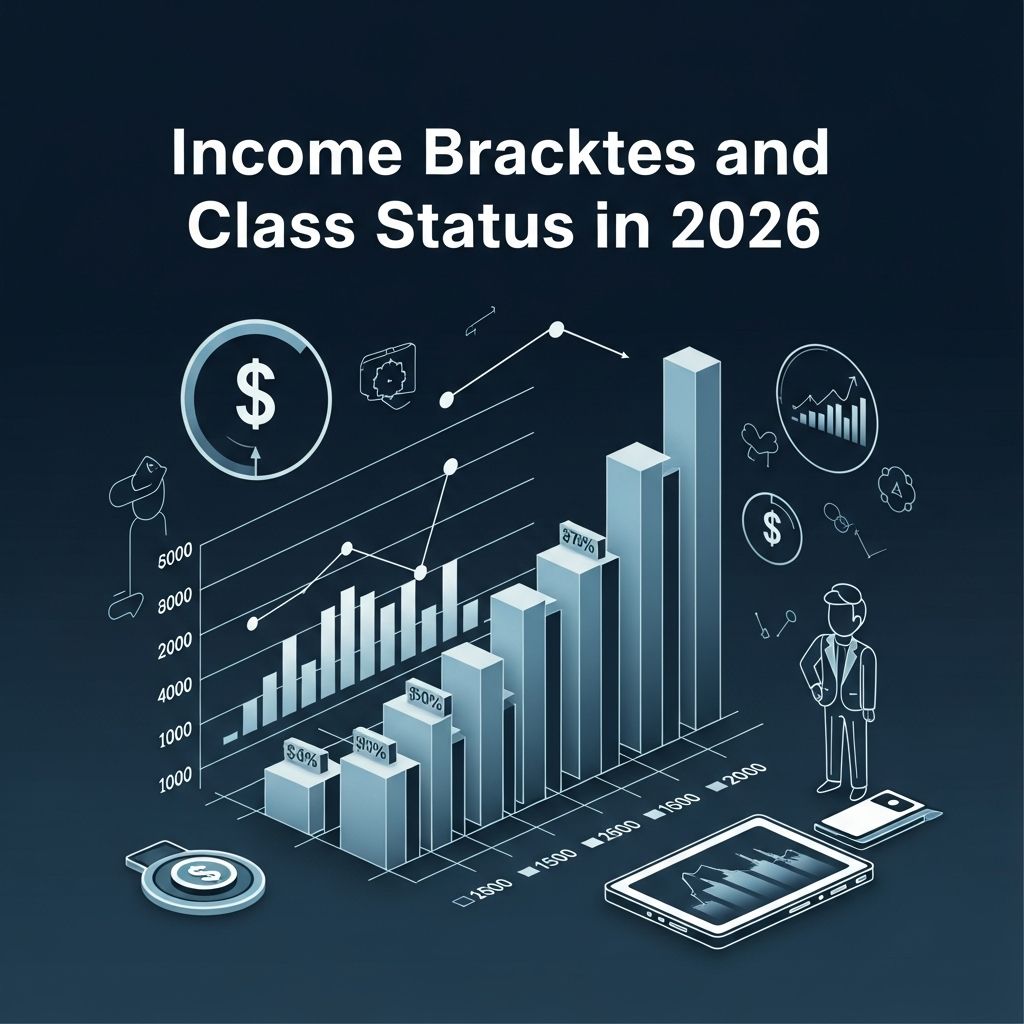
Income Brackets and Class Status in 2026
Discover where your income places you in America's economic landscape
Economic classification has become an increasingly important topic as Americans seek to understand their financial standing within the broader economy. The question of whether you belong to the lower, middle, or upper class is not merely academic—it reflects your purchasing power, financial security, and access to opportunities. In 2026, these classifications depend on specific income thresholds that vary significantly across the United States, influenced by regional cost of living, local economic conditions, and overall household earnings.
The Foundation of Class Designation: How Income Thresholds Work
Economic class designation relies on mathematical formulas applied to household income data. The most widely used methodology involves calculating income ranges based on the median household income within a specific geographic area. Rather than using fixed dollar amounts that apply uniformly across all states, researchers and economists recognize that $100,000 means something very different in rural Mississippi than it does in suburban Massachusetts.
The approach used by major financial research organizations applies a variation of established methodologies that define middle-class households as those earning between two-thirds and double the median household income in their respective regions. This flexible framework acknowledges that cost of living, housing prices, taxes, and other economic factors create dramatically different financial realities across America. By using this proportional method, analysts can identify true middle-class status regardless of geographic location.
The Lower-Income Classification: Breaking Down the Threshold
Households earning below two-thirds of their region’s median income typically fall into the lower-income category. This classification encompasses a wide spectrum of Americans, from those facing genuine economic hardship to families that might be considered solidly working-class in their communities.
The geographic variation in lower-income thresholds is particularly pronounced. Mississippi, with the lowest statewide middle-class income range, establishes lower-income status at approximately $39,000 annually for a household. Neighboring states show similarly modest entry points: West Virginia sets the threshold near $40,532, Louisiana at $40,532, Arkansas at $41,404, and Kentucky at $43,017. These thresholds reflect the lower cost of living and different wage structures in these regions.
Even within individual states, significant variations exist at the city level. Certain metropolitan areas have dramatically lower thresholds than their state averages. Cleveland, Ohio represents an extreme case where middle-class entry begins at just $28,922 annually, while Toledo’s threshold stands at $33,708. Buffalo, New York requires approximately $35,000 to reach middle-class status. These variations demonstrate how local economic conditions create distinct financial realities.
The Middle-Class Range: Where Most Americans Cluster
The middle class represents the largest and perhaps most economically significant segment of American society. This group encompasses families with moderate incomes, reasonable job security, and the ability to meet basic needs while maintaining some discretionary spending capacity.
Middle-class income ranges demonstrate remarkable variation across the country. Mississippi establishes the floor at $39,000 and the ceiling at $118,000. These boundaries reflect the state’s overall economic conditions and wage levels. As income requirements increase in more expensive states, the ranges expand substantially.
The highest middle-class thresholds appear in America’s most prosperous regions. Massachusetts leads the nation with an upper-middle-class boundary reaching $209,656 annually—more than five times Mississippi’s threshold. This extraordinary difference reflects Boston’s status as a major financial and technology hub, combined with exceptionally high housing costs and a concentration of well-compensated professionals.
New Jersey follows closely behind Massachusetts with an upper bound of $208,588 on middle-class income. Maryland reaches $205,810, Hawaii $201,490, and California $200,298. These five states represent America’s most expensive housing markets and regions with concentrations of high-paying industries.
The lower boundaries for middle-class status also reflect regional variation. Massachusetts establishes the entrance to middle class at $69,885, New Jersey at $69,529, and Maryland at $68,603. Even the lower threshold in Massachusetts exceeds the upper boundary in Mississippi by nearly $52,000—a disparity that underscores how geography determines financial classification.
The Upper-Income Threshold: Entry into Economic Privilege
Households earning above approximately $169,800 annually are generally classified as upper-income in contemporary analysis. This threshold represents a significant economic milestone, typically placing households in roughly the top 25 percent of earners nationally. Upper-income status confers advantages in borrowing capacity, investment opportunities, and long-term wealth accumulation.
The highest earners—those exceeding $251,040 annually—enter the top 10 percent of American income distribution. This elite group enjoys substantially different economic experiences than the broader middle class, including access to specialized financial services, greater portfolio diversification options, and enhanced ability to weather economic downturns.
It is important to note that upper-income classification, like middle-class status, should ideally account for regional cost-of-living variations. A $200,000 household income provides far greater purchasing power in rural areas than in expensive metropolitan centers. However, most national analyses use relatively fixed upper-income thresholds that do not adjust for regional differences as thoroughly as middle-class calculations do.
State-by-State Comparison: Understanding Regional Variation
The following states represent the highest and lowest income classification thresholds:
Highest Thresholds (Upper Bound for Middle Class):
- Massachusetts: $209,656
- New Jersey: $208,588
- Maryland: $205,810
- Hawaii: $201,490
- California: $200,298
Lowest Thresholds (Upper Bound for Middle Class):
- Mississippi: $118,000
- West Virginia: $121,596
- Louisiana: $121,972
- Arkansas: $124,212
- Kentucky: $129,052
This comparison reveals that the highest-threshold states have middle-class ceilings approximately 75 percent higher than the lowest-threshold states. Someone earning $150,000 would be considered upper-income in Mississippi but solidly middle-class in Massachusetts—an illustration of how context determines classification.
Factors Driving Income Classification Variation
Understanding why these thresholds vary so dramatically requires examining the economic engines driving different regions. Several factors influence regional income patterns and consequently reshape class boundaries.
Industry Concentration and Wage Levels: States with significant financial services, technology, healthcare, and professional services sectors generate higher median incomes. Massachusetts benefits from its concentration of financial firms, biotechnology companies, and prestigious universities. California’s technology sector similarly inflates median household incomes. Conversely, states with economies based on agriculture, manufacturing, or tourism typically have lower median incomes and correspondingly lower class thresholds.
Housing and Cost-of-Living Expenses: Real estate prices represent the most visible cost-of-living differential across America. Massachusetts’ median household income of $104,828 seems modest until one recognizes that median home prices exceed $600,000. The same household income in Mississippi, where median home prices hover around $200,000, provides substantially greater purchasing power. Economists debate whether income thresholds should account for these differences or remain standardized nationally.
Educational Attainment: States with higher average educational levels tend to have higher income thresholds. Massachusetts and New Jersey both rank among the nation’s most educated states, with corresponding high household incomes. Educational investment correlates strongly with earnings potential, creating self-reinforcing patterns where educated workforces attract high-paying employers.
Population Demographics: Age distribution, family structure, and immigration patterns influence regional income levels. States with younger populations might have lower median incomes simply because workers have less experience. States with higher proportions of dual-income households naturally show higher median family incomes.
Interpreting Your Personal Income Classification
Determining whether you occupy lower, middle, or upper-income status requires comparing your household income to your region’s specific thresholds rather than national figures. A household earning $80,000 would be solidly middle-class in most of America but would not reach middle-class status in expensive northeastern states.
This calculation should account for your state of residence and, ideally, your specific metropolitan area if one exists nearby. The SmartAsset methodology provides detailed thresholds for individual cities and counties, allowing more precise classification. However, basic state-level data offers sufficient guidance for most Americans seeking to understand their general economic position.
It is worth noting that household income classification differs from personal net worth or long-term wealth accumulation. A household earning $150,000 annually might carry substantial debt and accumulate minimal assets, while a retired couple living on $50,000 in Social Security might own a home free and clear and maintain significant savings. Income represents current earning power, while wealth reflects accumulated financial assets—distinct but related concepts.
The Broader Economic Context: Class Status in 2026
Income classifications must be understood within the larger economic landscape. The wealth distribution in America has become increasingly unequal, with the top 1 percent holding approximately 30.5 percent of all wealth while the bottom 50 percent holds just 2.5 percent. Middle-income families, which historically held roughly 32 percent of aggregate wealth, have experienced declining wealth shares over recent decades.
This broader context suggests that reaching middle-class income status does not guarantee the financial security and stability that previous generations experienced. Rising costs for healthcare, education, and housing consume increasingly large portions of middle-class household budgets. Understanding your income classification provides one metric of financial standing but should be combined with analysis of debt levels, savings rates, and long-term financial trajectory.
Frequently Asked Questions About Income Classification
Q: Does my income classification change if I move to a different state?
A: Yes. Your absolute income remains the same, but your classification relative to your new region’s median income will likely change. Someone earning $100,000 might be upper-middle-class in a lower-cost state but only solidly middle-class in an expensive state.
Q: Should I consider household income or individual income for classification purposes?
A: Income classifications typically reference household income rather than individual earnings. Dual-income households can reach higher classification thresholds than single earners with identical individual salaries.
Q: How often do these income thresholds change?
A: Thresholds are recalculated annually based on updated median income data. Significant shifts occur when regional economies change dramatically or when major industries relocate.
Q: Is income classification relevant for financial planning?
A: Income classification provides useful context but should not drive financial planning decisions. Your personal goals, expenses, debt levels, and long-term aspirations matter more than your relative position within income brackets.
References
- World Bank Group Income Classifications for FY26 — World Bank. 2025-07-01. https://blogs.worldbank.org/en/opendata/understanding-country-income
- What It Takes to Be Middle Class in America – 2026 Study — SmartAsset. 2026. https://smartasset.com/data-studies/middle-class-2026
- 2026 Income Classifications: Lower, Middle, Upper Brackets Based on Regional Data — IndexBox. 2026. https://www.indexbox.io/blog/us-household-income-brackets-lower-middle-and-upper-class-defined-for-2026/
Similar Articles








Read full bio of Sneha Tete