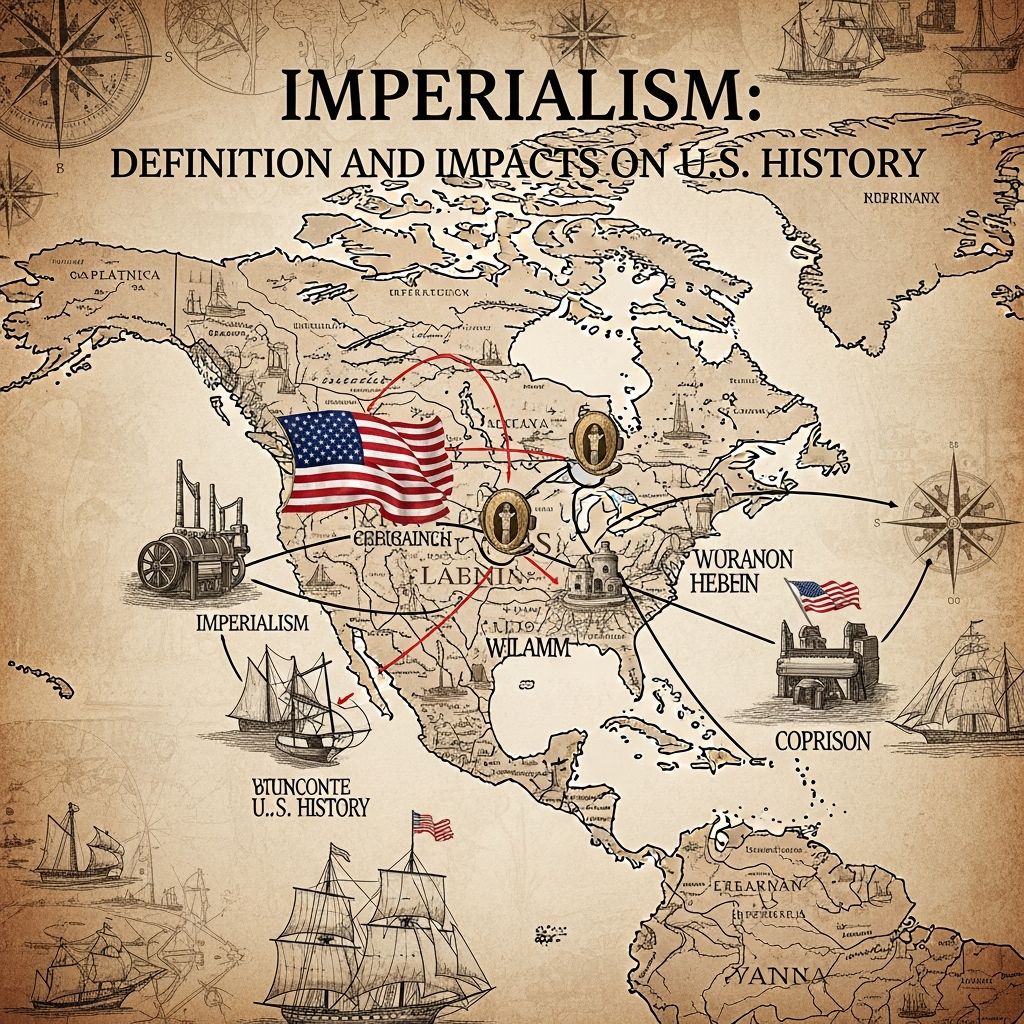
Imperialism: Definition and Impacts on U.S. History
Explore how American imperialism shaped global politics and defined the nation's foreign policy.
Understanding Imperialism and Its Definition
Imperialism represents one of the most significant forces that shaped modern history, and the United States stands as a prime example of this phenomenon. Imperialism is the state policy, practice, or advocacy of extending power and dominion, especially by direct territorial acquisition or by gaining political and economic control of other territories and peoples. In the American context, imperialism refers to the policy and practice of the United States extending its influence, power, and control over other nations, often through military force, economic dominance, or diplomatic pressure. This phenomenon became particularly prominent in the late 19th and early 20th centuries, as the U.S. sought to expand its territorial holdings and global influence, which led to complex interactions with indigenous populations and sparked various responses to foreign control.
American imperialism or U.S. imperialism is the exercise of power or control by the U.S. outside its borders. It operates through multiple mechanisms including military conquest, military protection, gunboat diplomacy, unequal treaties, support for preferred factions, regime change, economic or diplomatic support, economic interference via private companies, or influence on local culture and media. The distinction between traditional imperialism and American practice lies in the methods employed; while the U.S. has never officially identified itself and its territorial possessions as an empire, numerous commentators, including Max Boot, Arthur M. Schlesinger Jr., and Niall Ferguson, have described American actions as fundamentally imperialistic.
Historical Foundations: From Expansion to Empire
The roots of American imperialism extend much deeper than the late 19th century, tracing back to the nation’s founding principles and early territorial ambitions. Yale historian Paul Kennedy asserted that “From the time the first settlers arrived in Virginia from England and started moving westward, this was an imperial nation, a conquering nation.” George Washington himself described the early United States as an “infant empire,” a characterization that Thomas Jefferson expanded upon in 1786 when he stated that the U.S. “must be viewed as the nest from which all America, North & South is to be peopled,” emphasizing that American expansion was a foundational goal from the nation’s inception.
The concept of Manifest Destiny became the prevailing ideology of the 19th century, providing moral justification for American westward expansion. This belief held that American expansion across the continent was not only inevitable but also righteous and divinely ordained. Discontent with British rule came partly from the Royal Proclamation of 1763, which barred settlement west of the Appalachian Mountains, creating frustration among colonists eager to expand into western territories. Once independence was achieved, this expansion proceeded with vigor, driven by economic necessity, political ambition, and cultural ideology.
The Louisiana Purchase and Early Imperial Acquisitions
One of the earliest and most consequential imperial acquisitions was the Louisiana Purchase of 1803, which transferred 828,000 square miles of territory claimed by France to the United States. Historian Donald W. Meinig describes this as an “imperial acquisition—imperial in the sense of the aggressive encroachment of one people upon the territory of another, resulting in the subjugation of that people to alien rule.” This massive territorial expansion doubled the size of the United States and set a precedent for future acquisitions.
President James Monroe promulgated his Monroe Doctrine in 1823, establishing a policy aimed at ending European interventions in Latin America. This doctrine represented a pivotal moment in American imperial thinking, as it asserted American dominance over the Western Hemisphere and signaled the nation’s intention to be the primary power in the region. The doctrine effectively claimed the Americas as an American sphere of influence, establishing principles that would guide U.S. foreign policy for centuries to come.
Impact on Native American Populations
The expansion of American imperial power came at tremendous cost to Native American populations. Following Columbus, the European and then American presence steadily expanded across what became the U.S., driving Native Americans out by treaty or by force, including multiple wars. Many Native American settlements were depopulated by unknowingly imported diseases, such as smallpox, which decimated indigenous populations before formal conquest even occurred. The U.S. policies towards Native Americans, as described by historian Donald W. Meinig, were “designed to remold them into a people more appropriately conformed to imperial desires.”
Native Americans eventually became citizens in 1924, though this came only after centuries of displacement and subjugation. The relationship between imperial expansion and Native American sovereignty remains a critical aspect of understanding American history, as the nation’s founding principles of expansion directly conflicted with indigenous rights and self-determination. The process of westward expansion involved countless treaties, many of which were broken, wars, and forced relocations that remain contentious issues in contemporary American discourse.
The Age of New Imperialism: Late 19th Century Expansion
While American expansionism had characterized the nation since its founding, the late 19th century marked a dramatic shift toward what scholars term “New Imperialism.” This period, roughly from the 1870s onward, saw the United States aggressively pursuing overseas territorial acquisitions beyond the North American continent. The economic and strategic motivations behind this expansion were clearly articulated by contemporary thinkers. In 1902, Brooks Adams predicted in his book The New Empire that the U.S. would soon “outweigh any single empire, if not all empires combined.” Indeed, within 20 years America would become the world’s dominant economic and military power.
This period of New Imperialism was driven fundamentally by economic necessity. The United States had developed significant industrial capacity and sought new markets for its goods, new sources of raw materials, and strategic military bases to support its growing maritime and commercial interests. The nation’s rapid industrialization created pressure to expand economic influence abroad, making imperialism not merely an ideological pursuit but an economic imperative.
The Spanish-American War and Territorial Acquisitions
The Spanish-American War of 1898 represented a pivotal moment in American imperial expansion. The U.S. recognized that Spain’s hold on its empire was weakening, and like an expansionist power recognizing opportunity, it intervened in the Cuban War for Independence, transforming it into the Spanish-Cuban-Philippine-American War, commonly known as the Spanish-American War. This conflict proved transformative for American imperial ambitions and resulted in substantial territorial gains.
As a result of the war, the United States obtained a territorial empire with notably the Philippines, Puerto Rico, and Guam. The war also provided an opportunity for the U.S. to annex Hawaii in 1898 to protect American ships that would be steaming toward the Philippines. Hawaii eventually became a state in 1959, becoming the first non-contiguous territory to achieve statehood. These acquisitions represented a fundamental shift in American foreign policy, as the nation now possessed overseas colonies and imperial territories in multiple oceans.
Managing Imperial Territories: Legal and Constitutional Challenges
The acquisition of these new territories created significant legal and constitutional challenges for the United States. The Constitution contains no provision for colonies, only territory that would eventually be incorporated as states. Congress attempted to address this constitutional dilemma by passing the Foraker Act in 1900, which declared that Puerto Rico would be an insular territory; its inhabitants would be citizens of Puerto Rico, rather than U.S. citizens, creating a unique status that differed from traditional territorial governance. This legislation represented an attempt to manage imperial possessions while maintaining constitutional principles, though it created a complex legal framework that persists in modified forms today.
The question of how to govern territories that might never become states prompted significant constitutional and political debate. The concept of “insular territories” created a class of American possessions whose inhabitants occupied an ambiguous position between foreign nationals and full American citizens. This framework allowed the United States to maintain imperial control over distant territories without necessarily granting full political and civil rights to their populations.
Cuban Relations and the Platt Amendment
While the U.S. initially pursued direct annexation of Cuba, circumstances led to a different arrangement. The Platt Amendment was utilized to prevent Cuba from entering into any agreement with foreign nations and also granted the Americans the right to build naval stations on Cuban soil. This represented a form of indirect imperial control, wherein the U.S. exercised dominance without formal annexation. Executive officials in the American government began to determine themselves the supreme authority in matters regarding the recognition or restriction of independence, effectively controlling Cuban foreign policy decisions. This arrangement demonstrated American willingness to employ informal mechanisms of imperial control when direct territorial annexation was not feasible.
Pacific Expansion and Strategic Interests
American imperial expansion in the Pacific reflected strategic military and commercial calculations. The annexation of Hawaii protected crucial shipping routes and provided a strategic military base in the central Pacific. The acquisition of Guam, the Philippines, and other Pacific territories extended American power across the Pacific Ocean, establishing military and commercial outposts that served American strategic interests throughout the 20th century. These territories provided coaling stations for American ships, military bases for the Navy, and footholds for commercial penetration of Asian markets.
Economic Motivations Behind American Imperialism
Underlying all American imperial ventures were fundamental economic considerations. The nation’s rapidly growing industrial capacity required expanding markets for American manufactured goods. Imperialism provided access to new markets, sources of raw materials, and opportunities for American capital investment. Colonial territories offered protected markets where American goods faced no competition from other industrial powers, giving American manufacturers significant advantages. Additionally, imperial possessions provided strategic locations for American naval forces and commercial shipping, reducing transportation costs and transit times for American trade.
Neocolonialism and Indirect Control
As American imperialism evolved, it increasingly employed indirect methods of control through what commentators have termed neocolonialism—dominating territory via indirect means—which leverages economic power rather than military force. This approach often proved more effective and less costly than direct military occupation. Through economic investment, control of key industries, and influence over local governance structures, the United States could exercise substantial control over other nations without formal political annexation. This method became particularly prevalent in the 20th century and contributed to the evolution of American global dominance.
Imperial Legacy: Modern Territorial Possessions
The territorial acquisitions resulting from American imperialism remain evident today. U.S. acquisitions on the North American continent became states, and the residents of them became citizens. Hawaii voted for statehood in 1959. Other island jurisdictions remain territories, namely Guam, Puerto Rico, the U.S. Virgin Islands, American Samoa, and the Northern Mariana Islands, but the residents of them are also citizens. The remainder of U.S. territories eventually became independent, ranging from three freely associated states that participate in U.S. government programs in exchange for military basing rights, to Cuba, which severed diplomatic relations during the Cold War. This patchwork of territorial arrangements reflects the complex legacy of American imperialism.
Global Power and Imperial Alliances
American imperial expansion was facilitated by the eagerness with which other nations sought alliance with the United States. Some observers described the process as “pactomania,” reflecting the enthusiasm with which nations competed for American favor and alliance. Most of the world were interested in allying with the U.S., a phenomenon that became increasingly pronounced as American power grew. By the early 1940s, observers including Isaiah Bowman, Henry Luce, and Wendell Willkie stressed the allying potential of the U.S., recognizing that American power and influence had become unprecedented in scale and reach. The “imperium” of this unprecedented scale was partly made possible by the eagerness with which America’s alliance was sought and welcomed.
Imperialism’s Lasting Impact on U.S. Foreign Policy
The imperial tradition established in the late 19th century profoundly shaped American foreign policy throughout the 20th and into the 21st centuries. American interventionism, military bases abroad, economic dominance, and cultural influence can all be traced to the imperial precedents established during this formative period. The nation’s self-conception as a global power with legitimate interests across the globe reflects the imperial mentality developed during the age of New Imperialism. Contemporary debates about American military interventions, overseas military bases, and economic policies frequently echo the justifications and methods employed during the classical imperial age.
Frequently Asked Questions
Q: What is the difference between imperialism and colonialism?
A: While often used interchangeably, imperialism refers to the policy or practice of extending a nation’s power and influence, while colonialism specifically refers to the establishment of settlements and direct political control over territories. Imperialism is the broader concept, and colonialism is one method through which imperialism is practiced. The United States employed both traditional colonialism and later forms of indirect imperialism through economic and diplomatic means.
Q: Did American imperialism end after the early 20th century?
A: While the age of formal territorial acquisition ended in the early 20th century, many scholars argue that American imperialism continues through indirect means. The concept of neocolonialism describes how nations can exercise control through economic power, military presence, and cultural influence rather than formal political annexation. American military bases worldwide, economic dominance, and cultural influence represent ongoing expressions of American imperial power.
Q: How did the Constitution address the question of American colonies?
A: The U.S. Constitution made no provision for colonies or overseas territories. Congress addressed this through legislation like the Foraker Act of 1900, which created the status of “insular territories” for possessions like Puerto Rico. This legal framework allowed the U.S. to maintain imperial territories while technically adhering to constitutional principles, though it created complex questions about citizenship and political rights that remain relevant today.
Q: What role did economic motivations play in American imperialism?
A: Economic necessity was fundamental to American imperialism. The nation’s rapid industrialization created pressure to expand markets for American goods and secure sources of raw materials. Imperialist ventures provided protected markets, strategic military bases, and opportunities for American capital investment. Contemporary observers like Brooks Adams explicitly connected imperial expansion to American economic dominance and predicted American hegemony based on these economic foundations.
Q: Which territories remain under American control today?
A: Several territories resulting from American imperialism remain under U.S. control, including Puerto Rico, Guam, the U.S. Virgin Islands, American Samoa, and the Northern Mariana Islands. While some former territories like the Philippines achieved independence, others evolved into freely associated states, and a few like Hawaii eventually became states. These territories represent the enduring legacy of 19th-century American imperial expansion.
References
- Imperialism — Britannica Editors. 2024. https://www.britannica.com/topic/imperialism
- American Imperialism — Wikipedia. 2025. https://en.wikipedia.org/wiki/American_imperialism
- American Imperialism: Definition and History — Fiveable. 2024. https://fiveable.me/key-terms/ap-world/american-imperialism
- American Imperialism: Crash Course US History #28 — Crash Course. 2012. https://www.youtube.com/watch?v=QfsfoFqsFk4
Similar Articles








Read full bio of Sneha Tete