Stock Market Cycles: 4 Stages To Identify And Trade Better
Master the art of spotting stock market cycles to time your investments and boost long-term returns effectively.

Stock market cycles are recurring patterns of upward and downward movements in stock prices, driven by economic conditions, investor sentiment, and trading activity. Recognizing these cycles helps investors time entries and exits, manage risk, and capitalize on opportunities. The standard model features four phases: accumulation, markup, distribution, and markdown.
What Are Stock Market Cycles?
Stock market cycles reflect the natural ebb and flow of prices, mirroring broader business cycles but with distinct characteristics. Unlike linear growth, markets move in waves, influenced by factors like GDP growth, interest rates, corporate earnings, and psychological sentiment. A full cycle typically spans several years, though durations vary.
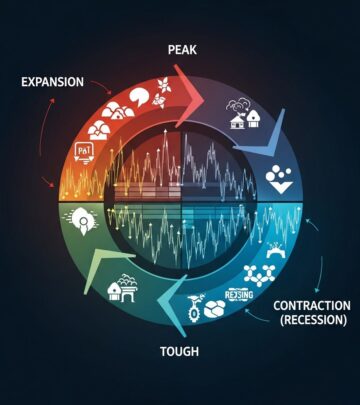
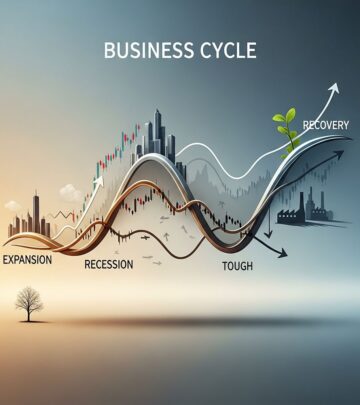
Business cycles, as defined by economic expansions and contractions, underpin market cycles. The National Bureau of Economic Research (NBER) identifies phases based on GDP, employment, and production metrics. Early expansion phases see rapid growth averaging one year, mid-cycle slower growth at 3.5 years, late cycle at 1.5 years, and recessions around nine months.
The Four Stages of Stock Market Cycles
Markets progress through four primary stages, each marked by specific price action, volume, and sentiment shifts. Understanding these enables precise positioning.
Stage 1: Accumulation Phase
This initial stage follows a market bottom, where prices stabilize in a sideways range after a downturn. Smart money—institutional investors—begins buying undervalued assets quietly, absorbing shares from panicked sellers. Prices meander with low volatility, often forming a base pattern like a flat bottom or cup-and-handle.
- Key characteristics: Sideways price action, increasing volume without price rise, capitulation highs in selling volume.
- Investor sentiment: Pessimistic; fear dominates as recent losses linger.
- Duration: Can last months to years, testing patience.
Identification tip: Watch for higher lows and volume spikes on up days, signaling emerging strength. A break above resistance confirms transition to markup.
Stage 2: Markup (Advancing) Phase
The bull market ignites as breakout occurs, driving prices higher in a sustained uptrend. Broader participation joins institutions, fueled by improving economic data and positive news. This phase delivers the bulk of gains, with higher highs and lows.
- Key characteristics: Strong upward momentum, rising volume on advances, optimistic media coverage.
- Investor sentiment: Greed builds; FOMO (fear of missing out) draws retail investors.
- Duration: Longest phase, often 35% of the cycle, with momentum sub-phases.
Chart signals include moving average crossovers (e.g., 50-day above 200-day) and relative strength index (RSI) between 50-70. Economic alignment: mid-cycle growth with moderate GDP increases.
Stage 3: Distribution Phase
At peaks, institutions offload holdings to euphoric retail buyers. Prices flatten or form double tops, with high volume but no new highs. Divergences appear: prices stall while indicators weaken.
- Key characteristics: Choppy action, volume peaks without price gain, head-and-shoulders patterns.
- Investor sentiment: Extreme optimism; ‘this time it’s different’ narratives prevail.
- Duration: Short, around 25% of cycle, as excesses build.
Warning signs: Bear traps (false breakdowns recovered) give way to bull traps (failed rallies). Break below 200-day moving average confirms end.
Stage 4: Markdown (Declining) Phase
The downtrend accelerates as reality hits, with panic selling and capitulation. Prices plunge, volume surges on declines, forming lower highs and lows. Bubbles burst here.
- Key characteristics: Sharp drops, high volume on down days, panic indicators like VIX spikes.
- Investor sentiment: Fear and despair; capitulation bottoms the cycle.
- Duration: Variable, roughly 25%, but recessions shorten to months.
Recognition: Trendline breaks, death crosses (50-day below 200-day MA), and economic late-cycle slowdowns like rising unemployment.
How to Identify Stock Market Cycles
Tools and techniques blend technical analysis, volume study, and fundamentals for accuracy.
Technical Indicators
Use moving averages, MACD, and RSI to spot phase transitions. Volume-price relationships are crucial: confirming volume supports trends; divergence warns reversals.
| Phase | Price Action | Volume Pattern | Key Indicator |
|---|---|---|---|
| Accumulation | Sideways range | Increasing on lows | RSI >30 |
| Markup | Higher highs/lows | Rising on ups | MA crossover |
| Distribution | Flat top, divergences | High, non-confirming | RSI divergence |
| Markdown | Lower highs/lows | High on downs | Death cross |
Volume Analysis
Volume precedes price. Accumulation shows dry-up then spikes; markup confirms advances; distribution peaks erratically; markdown surges downward.
Sentiment Gauges
AAII surveys, put/call ratios, and VIX measure crowd psychology. Extremes signal tops/bottoms.
Investment Strategies for Each Cycle Phase
- Accumulation: Buy quality value stocks/ETFs; dollar-cost average. Focus defensives.
- Markup: Ride momentum with growth stocks, cyclicals. Increase equity exposure.
- Distribution: Trim winners, raise cash, add hedges like puts.
- Markdown: Defensive shift to bonds, gold, cash. Avoid margin.
Sector rotation aligns with business cycles: early-cycle financials/tech, mid consumer discretionary, late utilities/healthcare.
Business Cycles vs. Stock Market Cycles
Business cycles (early/mid/late/recession) drive markets but asynchronously. Stocks often peak pre-recession due to forward-looking nature. NBER data shows average cycle 5.5 years.
Common Mistakes in Cycle Identification
- Ignoring volume, leading to false breakouts.
- Chasing tops in euphoria.
- Panic-selling bottoms.
- Over-relying on one indicator.
Avoid recency bias; use multi-timeframe analysis.
Historical Examples of Market Cycles
Dot-com bubble (2000): Markup to distribution in tech. GFC (2008): Markdown capitulation. Post-COVID (2020): Rapid accumulation to markup.
Frequently Asked Questions (FAQs)
What is the average length of a stock market cycle?
Cycles vary, but full loops average 4-7 years, with bull phases longer than bears.
How reliable are market cycle indicators?
Highly useful when combined; no single tool is foolproof. Backtesting improves accuracy.
Can individuals time the market using cycles?
Yes, with discipline. Most succeed via phase-aware allocation over perfect timing.
Do all stocks follow the same cycle?
No; sectors lead/lag. Diversify across cycles.
What role does volume play in cycles?
Critical confirmer; divergences signal phase shifts.
References
- Business and market cycles: What investors should know — Lee Lyn Smith. 2023-05-15. https://www.leelynsmith.com/insights/article/business-and-market-cycles-what-investors-should-know-qa-with-our-cio-brian-dorn/
- The Four Stages of the Stock Market Cycle — Charles Schwab. 2024-08-20. https://www.schwab.com/learn/story/four-stages-stock-market-cycles
- Market cycles: phases, stages, and common characteristics — IG International. 2022-09-30. https://www.ig.com/sg/trading-strategies/market-cycles–phases–stages–and-common-characteristics-220930
- The 4 Stages of the Stock Market Cycle — Motley Fool Wealth Management. 2023-11-10. https://foolwealth.com/insights/four-stages-of-the-stock-market-cycle
- The business cycle: Equity sector investing — Fidelity Investments. 2024-02-14. https://www.fidelity.com/viewpoints/investing-ideas/sector-investing-business-cycle
Similar Articles








Read full bio of medha deb