VA Home Loan: How It Works And Key Benefits For Veterans
Understand how VA loans work, who qualifies, and how to use this powerful mortgage benefit to buy, refinance, or improve a home.

A VA home loan is a mortgage backed by the U.S. Department of Veterans Affairs that helps eligible veterans, service members, and some surviving spouses buy, build, improve, or refinance a home with favorable terms. These loans are issued by private lenders, but the VA guarantees a portion of the loan, reducing risk for the lender and often lowering costs for the borrower.
Because VA loans are supported by a federal agency, they can offer unique features such as no required down payment, no private mortgage insurance (PMI), and limits on closing costs when compared with many conventional mortgages.
What Is a VA Loan?
A VA loan is a mortgage option available to qualifying current and former members of the U.S. military and certain surviving spouses. The VA does not lend the money directly (except under limited direct loan programs), but instead guarantees part of the loan made by approved private lenders such as banks, credit unions, and mortgage companies.
This guarantee means that if the borrower defaults, the VA will cover a portion of the lender’s loss up to a set amount, which allows lenders to extend more flexible terms to eligible borrowers.
- Issuer: Private lenders (banks, credit unions, mortgage companies)
- Guarantor: U.S. Department of Veterans Affairs
- Purpose: Buy, build, repair, retain, or refinance a primary residence
- Audience: Qualified veterans, service members, and eligible surviving spouses
How a VA Loan Works
VA loans operate differently from conventional mortgages because of the federal guaranty and program rules. Understanding the mechanics helps you decide whether this benefit fits your needs.
VA Guarantee and Lender Role
The VA sets broad program rules, defines who is eligible, and guarantees a portion of each qualifying loan. Lenders still set their own underwriting standards for credit scores, income, and other risk factors, as long as they also comply with VA regulations.
- The VA guarantee reduces lender risk, which often translates into lower interest rates and more flexible approval criteria.
- Lenders must ensure that the loan is used for an eligible purpose and that the property meets VA minimum property requirements.
- The borrower must certify that they will occupy the property as a primary residence, except for certain refinancing situations.
Entitlement and Loan Limits (Conceptual)
Every eligible borrower has a certain level of VA entitlement, which is the amount the VA will guarantee on their behalf. In practice, entitlement determines how much you can borrow with VA backing and whether a down payment is required.
Many borrowers with full entitlement can obtain loans above standard conforming limits without a VA-imposed cap, though lenders may apply their own limits and underwriting standards. For larger loans or when some entitlement is already used, a down payment may be needed.
Occupancy Requirements
VA loans are designed for primary residences rather than investment or vacation properties.
- You generally must move into the home within a reasonable period after closing, typically within 60 days, although certain exceptions exist for deployments or spouse occupancy.
- Refinance transactions may have slightly different occupancy certifications, but they still focus on owner-occupied housing.
Key Benefits of VA Loans
VA loans are widely considered one of the most valuable benefits available to qualifying military borrowers due to their cost savings and protections.
No Down Payment in Many Cases
The VA home loan program often allows no down payment as long as the purchase price does not exceed the appraised value and sufficient entitlement is available. Unlike most other low-down-payment loans, borrowers can commonly finance up to 100% of the purchase price.
- Conventional loans typically require at least 3–5% down.
- VA loans can reduce the upfront cash needed to close, which is especially helpful in higher-cost markets.
No Private Mortgage Insurance (PMI)
Unlike many mortgages with less than 20% down, VA loans do not require monthly private mortgage insurance premiums. This can significantly lower the ongoing monthly payment compared to conventional loans with similar down payments.
Competitive Interest Rates
Because VA loans are backed by a federal guaranty and carry lower risk for lenders and investors, they generally offer competitive, often lower, interest rates than similar conventional mortgages, especially for borrowers with moderate credit profiles.
Limited Closing Costs and No Prepayment Penalty
The VA restricts the types and amounts of closing costs that veterans can be charged on VA-backed loans. In addition, borrowers have the right to pay off their mortgage early without a prepayment penalty.
- Certain fees (often called “non-allowable” fees) cannot be charged directly to the borrower under VA rules.
- You may still negotiate seller concessions to help with costs, subject to VA limits.
Assistance if You Run into Trouble
If you face temporary financial hardship, the VA can sometimes provide loan servicing assistance or work with your lender to explore options such as repayment plans or loan modifications to help you avoid foreclosure.
Types of VA Loans
The VA program supports multiple loan types to address different homeowner needs, from buying a first home to refinancing or renovating an existing property.
| VA Loan Type | Primary Use |
|---|---|
| VA Purchase Loan | Buy a primary residence with little or no down payment. |
| VA Cash-Out Refinance | Refinance and take cash out of home equity for other needs. |
| VA Interest Rate Reduction Refinance Loan (IRRRL) | Refinance an existing VA loan to lower the rate or payment with simplified documentation. |
| VA Renovation Loan | Combine the cost of buying a home with funds for repairs or improvements. |
| Native American Direct Loan (NADL) | Direct VA loan for eligible Native American veterans to buy, build, or improve a home on federal trust land. |
Who Qualifies for a VA Loan?
To qualify for a VA-backed home loan, you must meet service-related eligibility requirements, along with lender standards for credit, income, and property occupancy.
Service Requirements
The VA determines eligibility based on your length and character of service and issues a Certificate of Eligibility (COE) if you qualify. General service benchmarks often include:
- At least 90 consecutive days of active service during wartime, or
- At least 181 days of active service during peacetime, or
- More than six years of service in the National Guard or Reserves (with certain active duty periods also qualifying), or
- Being an eligible surviving spouse of a service member who died in the line of duty or from a service-connected cause.
The exact rules vary by service era, and some veterans with less service time may qualify if discharged for a service-connected disability or other qualifying reasons.
Credit, Income, and Occupancy
Beyond military service, you must also meet lender and VA standards related to your finances and intended use of the property.
- Credit: The VA does not set a universal minimum credit score, but lenders usually apply their own requirements. Many lenders look for scores in the 580–620 range or higher, while still considering the overall profile.
- Income and Debt-to-Income (DTI): Lenders review your income, debts, and residual income to ensure you can reasonably afford the mortgage payments.
- Occupancy: The home must be your primary residence, and you must generally intend to occupy it within a reasonable time.
The VA Funding Fee
Most VA loans require a one-time VA funding fee, which helps fund the program and enable the no-down-payment benefit without requiring ongoing taxpayer subsidies.
How the Funding Fee Works
The funding fee is calculated as a percentage of the total loan amount and varies based on factors such as whether it is your first or subsequent use of the VA benefit, your down payment amount, and the loan type.
- First-time users with no down payment typically pay a lower percentage than repeat users with no down payment.
- Putting money down can reduce the funding fee percentage.
- The fee can usually be financed into the loan amount, lowering upfront cash but slightly increasing the monthly payment.
Exemptions and Reductions
Certain borrowers, such as eligible veterans receiving compensation for service-connected disabilities, may be exempt from the funding fee under VA rules. Surviving spouses eligible for VA loans may also qualify for exemptions in some cases.
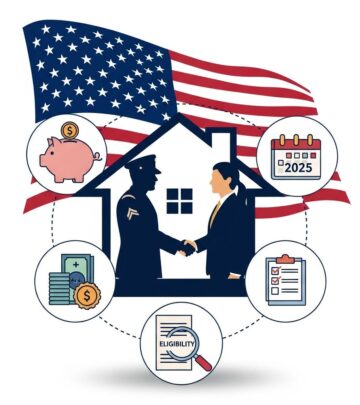
Steps to Get a VA Loan
The VA loan process is similar to other mortgages but includes several steps specific to verifying eligibility and complying with VA guidelines.
- Confirm Eligibility and Request a COE
Verify that your service history likely qualifies for a VA loan and obtain your Certificate of Eligibility (COE) through the VA or with help from your lender. - Check Your Credit and Finances
Review your credit report, gather documentation of income, assets, and debts, and estimate what monthly payment you can comfortably afford. - Choose a VA-Approved Lender
Work with a lender that regularly originates VA loans and understands the program’s specific rules and documentation requirements. - Get Prequalified or Preapproved
Provide basic financial information so the lender can estimate how much you may be able to borrow and issue a preapproval letter to strengthen purchase offers. - Shop for a Home and Make an Offer
Look for properties that meet VA minimum property requirements and your budget, then submit offers with VA loan financing noted. - Complete Appraisal and Underwriting
The lender orders a VA appraisal to verify value and basic property condition, while underwriters assess your credit, income, and overall risk profile. - Close on Your VA Loan
Review final loan terms, sign closing documents, pay any required closing costs and funding fee (if not financed), and receive the keys to your new home.
Pros and Cons of VA Loans
VA loans offer substantial advantages, but they also have trade-offs compared with other mortgage options.[10]
| Pros | Cons |
|---|---|
|
|
Is a VA Loan Right for You?
If you qualify, a VA loan can dramatically lower the upfront and ongoing cost of owning a home compared with many other mortgage options, especially if you plan to make a small down payment. However, you should compare the full cost, including the funding fee and interest rate, against alternatives such as conventional or FHA loans.
- Borrowers planning to own the home long term often benefit from the combination of lower interest rates, no PMI, and strong homeowner protections.
- Those making a large down payment may also want to compare a conventional loan to see which yields the lower lifetime cost.
Frequently Asked Questions (FAQs)
Q: What can I use a VA loan for?
A VA loan can be used to buy, build, improve, or refinance a primary residence, including certain condominiums and manufactured homes that meet VA requirements.
Q: Can I use my VA loan benefit more than once?
Yes. The VA home loan benefit is generally a lifetime benefit, and you can use it multiple times as long as your entitlement is restored or sufficient entitlement remains available.
Q: Do VA loans have a minimum credit score?
The VA does not set a mandatory minimum credit score, but lenders apply their own standards and often look for scores in at least the mid-500s to 600+ range, depending on their risk policies.
Q: Can I buy an investment or vacation property with a VA loan?
No. VA loans are intended for owner-occupied primary residences. You must generally certify that you will live in the home as your main residence, subject to limited exceptions.
Q: What happens if I have trouble making my VA loan payments?
If you face financial difficulties, you should contact your loan servicer immediately. The VA may also be able to work with you and your lender by offering counseling or exploring options to avoid foreclosure when possible.
References
- VA Home Loans — U.S. Department of Veterans Affairs. 2024-01-10. https://www.benefits.va.gov/homeloans/
- VA loans: Benefits, eligibility requirements and more — Rocket Mortgage. 2024-03-15. https://www.rocketmortgage.com/learn/va-loans
- VA Loan Benefits: Incredible Advantages for Veterans — NFM Lending. 2023-11-02. https://nfmlending.com/financing-your-home/education/blog/va-loan-benefits-incredible-advantages-for-veterans/
- What is a VA loan? — Consumer Financial Protection Bureau. 2023-06-15. https://www.consumerfinance.gov/ask-cfpb/what-is-a-va-loan-en-113/
- Eligibility for VA home loan programs — U.S. Department of Veterans Affairs. 2024-02-05. https://www.va.gov/housing-assistance/home-loans/eligibility/
- VA Home Loan Guaranty Buyer’s Guide — U.S. Department of Veterans Affairs. 2022-09-30. https://www.benefits.va.gov/homeloans/documents/docs/VA_Buyers_Guide.pdf
- Eligible Loan Purposes and Loan Types (VA 101) — U.S. Department of Veterans Affairs. 2022-08-12. https://www.benefits.va.gov/homeloans/documents/docs/va101_handout.pdf
Similar Articles








Read full bio of medha deb