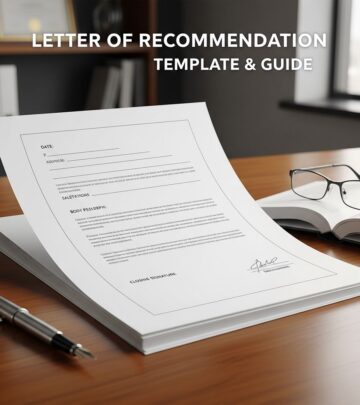
How to Write a Positive Recommendation Letter
Master the art of crafting compelling recommendation letters that highlight strengths and open doors for candidates.

A positive recommendation letter is one of the most valuable tools in a candidate’s job search or academic application arsenal. Whether you’re an employer, manager, professor, or colleague, being asked to write a recommendation letter is both an honor and a responsibility. The letter you write can significantly influence a hiring manager’s or admissions officer’s decision, making it crucial to craft a compelling and thoughtful document that genuinely reflects the candidate’s abilities and character.
Writing an effective recommendation letter goes beyond simply stating that someone is a good worker or student. It requires specific examples, detailed descriptions of their skills, and concrete evidence of their achievements. A well-written recommendation letter serves as a powerful endorsement that can open doors and accelerate career advancement or academic opportunities.
Understanding the Purpose of a Recommendation Letter
Before you begin writing, it’s essential to understand what makes a recommendation letter effective. The primary purpose of a recommendation letter is to provide an objective, credible assessment of a candidate’s qualifications, character, and potential. Unlike a resume, which is written by the candidate themselves, a recommendation letter carries the weight of third-party verification.
Recipients of recommendation letters—whether hiring managers, admissions committees, or program directors—use these letters to gain insight into how candidates perform in real-world settings. They want to understand not just what someone can do, but how they work with others, how they handle challenges, and what makes them stand out from other candidates. This is where your detailed observations and specific examples become invaluable.
Key Elements of a Strong Recommendation Letter
Every effective recommendation letter should contain several essential components that work together to create a compelling narrative about the candidate’s strengths and qualifications.
1. Clear Introduction and Statement of Recommendation
Begin your letter with a polite greeting, such as “Dear Hiring Manager” or “Dear Program Director.” Your opening sentence should immediately convey the purpose of your letter and your enthusiasm for recommending the candidate. Use a clear statement like, “It is my pleasure to strongly recommend [Candidate Name] for [position or program].” This direct approach ensures the recipient understands your intention from the outset and establishes a positive tone for the entire letter.
2. Your Relationship and Credibility
Clearly explain who you are, your position or title, and your relationship to the candidate. Include how long you’ve known them and in what capacity. For example: “I am [Your Name], a [Your Position] at [Institution or Company]. I have [number] years of experience in [your field], and I have worked with [Candidate Name] for [duration].” This context helps establish your credibility and demonstrates that you have sufficient knowledge of the candidate to provide a meaningful assessment.
3. Specific Examples and Evidence of Skills
This is the heart of your recommendation letter. Rather than making general statements like “John is hardworking” or “Maria is a team player,” provide concrete examples that demonstrate these qualities. Include specific projects they worked on, measurable outcomes they achieved, and situations where they displayed exceptional skills. For instance, instead of saying someone is detail-oriented, describe how they caught a critical error that prevented a costly mistake, or how they implemented a system that reduced errors by a specific percentage.
4. Personal Story or Anecdote
Incorporate a brief personal story that illustrates one to two key traits or skills the candidate possesses. This narrative should show rather than tell. For example, you might describe a challenging situation the candidate faced, how they responded, and what the outcome was. This storytelling approach makes your letter more memorable and authentic, helping the reader connect emotionally with the candidate’s strengths.
5. Soft Skills and Professional Qualities
While technical skills are important, don’t overlook soft skills such as communication, collaboration, adaptability, and leadership. Explain how these qualities have benefited their team or organization. For instance, you might note how the candidate’s positive attitude kept the team motivated during a difficult project, or how their excellent communication skills facilitated smooth collaboration across departments.
6. Closing Statement and Contact Information
End your letter with a strong closing statement that reinforces your confidence in the candidate and your willingness to provide further information. Include a statement such as, “I am confident that [Candidate Name] would be an excellent fit for your [organization/program],” or “Please feel free to contact me if you would like to discuss [Candidate’s Name] qualifications further.” Provide your contact information, including email and phone number, to encourage follow-up communication.
Recommendation Letter Format and Structure
A well-organized recommendation letter follows a logical structure that flows naturally and persuasively. Here’s the recommended format:
Header Information: Include your name, title, institution or company, address, and contact information at the top of the letter. Use official letterhead if available.
Date and Recipient Information: Include the date the letter is written and the recipient’s name and address if available. If the recipient is unknown, use a generic salutation such as “To Whom It May Concern.”
Body of the Letter: Structure your letter in three to four well-developed paragraphs. The first paragraph should introduce the candidate and state your recommendation. The second and third paragraphs should provide specific examples and details about the candidate’s qualifications. The final paragraph should serve as your closing, reinforcing your recommendation and offering availability for further discussion.
Signature: Sign the letter above your typed name, title, and institution or company affiliation. For electronic submissions, you may use a digital signature or simply type your name if that’s acceptable to the recipient.
Practical Recommendation Letter Template
Here’s a professional template you can customize for your specific situation:
Subject: Recommendation for [Candidate's Name]Dear [Recipient's Name or Hiring Manager],It is my pleasure to strongly recommend [Candidate Name] for [position, program, or opportunity] at [Organization or Institution Name].I am [Your Name], a [Your Position] at [Your Institution or Company]. I have [number] years of experience in [your field], and I have had the opportunity to work closely with [Candidate Name] for [duration]. During our time together, [Candidate Name] has consistently demonstrated exceptional [key qualities such as reliability, expertise, leadership, problem-solving].One standout example was when [describe a specific project or situation]. [Candidate Name]'s ability to [mention specific skill] resulted in [positive outcome with measurable impact]. This demonstrated their commitment to excellence and their capacity to deliver results even in challenging circumstances.Beyond their technical skills, what truly sets [Candidate Name] apart is their [soft skill—collaboration, adaptability, initiative, positive attitude]. When faced with [describe a situation], they responded with [mention positive approach], which [describe the positive impact]. Their colleagues often rely on them for [mention what they're known for].I am confident that [Candidate Name] would be a valuable addition to your [organization/program] and would excel in the [position/program]. Should you wish to discuss [Candidate Name]'s qualifications further, please don't hesitate to contact me.Best regards,[Your Name][Your Title][Your Institution or Company][Your Email][Your Phone Number]Real-World Examples of Effective Recommendation Letters
To better understand how to apply these principles, let’s examine a concrete example of a strong recommendation letter:
To Whom It May Concern:It is my pleasure to strongly recommend Robert Chen for a position as a Senior Project Manager with Technology Solutions Inc.I am Patricia Martinez, Regional Director of Operations at Innovation Corp. I have 12 years of experience in project management and business operations, and Robert has reported directly to me for the past three years. During our time together, Robert has consistently demonstrated exceptional leadership, strategic thinking, and commitment to delivering projects on time and within budget.A prime example of Robert's capabilities occurred when he led our company's digital transformation initiative. This was a complex, company-wide project with multiple departments and stakeholders. Robert's ability to manage competing priorities, communicate effectively with diverse teams, and maintain focus on our core objectives resulted in the project being completed two weeks ahead of schedule and 8% under budget. His strategic approach to resource allocation and risk management was particularly impressive and directly contributed to this success.What makes Robert stand out beyond his technical project management skills is his exceptional ability to build consensus and inspire teams. During a particularly challenging phase of the project, a key team member was resistant to new processes. Rather than circumvent this challenge, Robert took the time to understand the team member's concerns, involved them in solution development, and ultimately gained their buy-in. This approach not only resolved the immediate issue but strengthened team cohesion and morale.I am confident that Robert would be an outstanding Senior Project Manager for your organization. His combination of technical expertise, leadership ability, and interpersonal skills make him an ideal candidate for this role. Please feel free to contact me at your convenience if you would like to discuss Robert's qualifications in more detail.Sincerely,Patricia MartinezRegional Director of OperationsInnovation Corppatrica.martinez@innovationcorp.com(555) 123-4567Tips for Writing a Compelling Recommendation Letter
Beyond the basic structure and format, several strategies can help you write a recommendation letter that truly stands out:
Be Specific and Avoid Clichés: Generic phrases like “excellent communicator” or “team player” appear in countless recommendation letters. Instead, demonstrate these qualities through specific examples. Show rather than tell. Instead of saying someone is a problem-solver, describe the specific problem they solved and the innovative approach they used.
Use Measurable Outcomes: When possible, include metrics or quantifiable results. For example, rather than saying a candidate improved efficiency, state that they improved efficiency by 25% or reduced processing time from two weeks to three days. These concrete numbers make your claims more credible and memorable.
Align with the Position or Program: Tailor your letter to highlight the qualities most relevant to the specific position or program the candidate is pursuing. If they’re applying for a leadership role, emphasize leadership examples. If they’re applying for a creative position, highlight their innovative thinking and creative problem-solving.
Maintain a Professional Tone: While your letter should convey genuine enthusiasm and support, maintain a professional and objective tone. Avoid excessive emotional language or hyperbole. Let specific examples and results speak for themselves.
Keep It Concise: Aim for one full page, single-spaced, or no more than three to four substantial paragraphs. Busy hiring managers and admissions officers appreciate letters that are comprehensive yet concise. Include all essential information without unnecessary filler.
Proofread Carefully: Errors in spelling, grammar, or punctuation can undermine your credibility and reflect poorly on both you and the candidate. Proofread your letter multiple times and consider asking a colleague to review it before submission.
Different Types of Recommendation Letters
Different contexts may require slightly different approaches to recommendation letters.
Employment Recommendation Letter
For job applications, focus on work-related skills, achievements, and professional qualities. Emphasize how the candidate’s skills match the job requirements and provide examples of their workplace contributions. Mention their reliability, productivity, and ability to work effectively in your organizational culture.
Academic Recommendation Letter
For graduate school or academic program applications, highlight the candidate’s intellectual abilities, academic achievements, research potential, and scholarly interests. Provide examples of their academic performance, projects, or research they conducted. Discuss their potential for success in advanced academic work.
Professional Reference Letter
For freelancers, consultants, or contractors, emphasize their expertise, professionalism, quality of work, and ability to meet deadlines and project requirements. Highlight specific projects you worked on together and the value they delivered.
Personal Character Reference Letter
For volunteer positions, housing applications, or other situations, focus on character, integrity, reliability, and interpersonal qualities. Describe how the person conducts themselves in your community or in personal interactions.
When to Decline a Recommendation Letter Request
Sometimes you may receive a request for a recommendation letter from someone you cannot genuinely recommend. In these cases, it’s better to respectfully decline than to write a lukewarm or negative letter. If you don’t have sufficient positive experiences with the candidate or don’t feel you can provide an authentic strong recommendation, politely explain this and suggest they find someone else who can provide a more enthusiastic endorsement. This approach protects your professional integrity and gives the candidate time to identify an alternative recommender.
Frequently Asked Questions
Q: How long should a recommendation letter be?
A: A recommendation letter should typically be one full page, single-spaced, or three to four substantial paragraphs. This length allows you to provide specific examples and details while respecting the recipient’s time constraints.
Q: Can I write a recommendation letter for someone I just met?
A: Ideally, you should have worked with or known the candidate for a sufficient period to provide meaningful observations. Most recommenders need at least several months of working relationship to write a credible letter. If asked to recommend someone you just met, you may politely decline.
Q: Should I mention any weaknesses in a recommendation letter?
A: A positive recommendation letter should focus on strengths and achievements. However, if addressing a potential concern, you can acknowledge it while emphasizing how the candidate overcame it or how it doesn’t undermine their overall qualifications.
Q: How should I submit a recommendation letter?
A: Follow the recipient’s specific instructions. Many applications have dedicated portals for recommendation letters. Some may request email submission, while others may ask for mailed hard copies. Always follow the application’s guidelines precisely.
Q: What if I’m unsure about the candidate’s qualifications for a specific position?
A: Ask the candidate to provide information about the position and what qualifications they believe are most relevant. This helps you tailor your letter to highlight the most pertinent skills and experiences, making your recommendation more compelling and relevant.
References
- How To Write a Letter of Recommendation (With Example) — Indeed. https://www.indeed.com/career-advice/career-development/how-to-write-a-letter-of-recommendation-with-examples
- Example of a Reference Letter & How to Write One — YouCanBookMe. https://youcanbook.me/blog/example-of-a-reference-letter
- 3 Letter of Recommendation Templates for People Managers — TalentHR. https://www.talenthr.io/blog/letter-of-recommendation-template/
Similar Articles








Read full bio of medha deb