How to Tell if Your 401k Is Good or Bad
Evaluate your 401k plan's quality by checking fees, matches, investments, and more to secure your retirement future effectively.
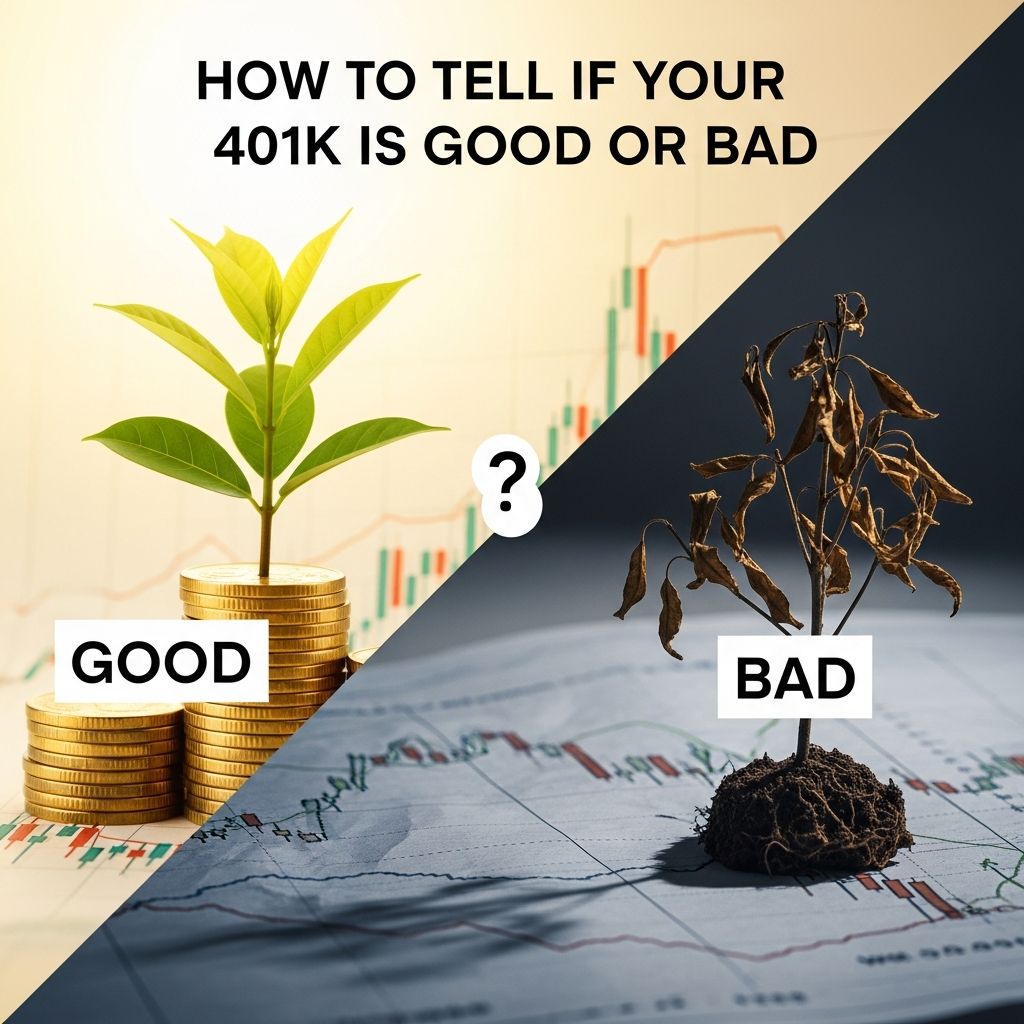
How to Tell if Your 401k Is Good or a Bad One
Your 401k plan is a cornerstone of retirement savings, but not all plans are created equal. A good 401k maximizes your contributions through low costs, strong employer matches, and smart investment choices, while a bad one drains your nest egg with high fees and poor options. This guide breaks down the essential criteria to evaluate your plan, drawing from expert insights on fees, matches, and fund quality to help you determine if yours is helping or hindering your financial future.
1. Check the Employer Match: Free Money You Can’t Ignore
The hallmark of a
strong 401k
is a generous employer match, often the most valuable benefit. Employers typically match 50 cents on the dollar up to 6% of your salary, potentially adding $1,500 annually for a $50,000 earner who contributes the maximum eligible amount. A good plan offers at least this standard formula, with no vesting cliffs that lock you out if you leave early.- True-up provision: Ensures you get the full match even if contributions are uneven, like from bonuses. Ask your plan sponsor if this exists—its absence signals a weaker plan.
- Vesting schedule: Immediate or cliff vesting (full ownership after 3 years) is ideal. Graded vesting over 6 years reduces portability.
- Match generosity: Top plans match dollar-for-dollar up to 3-6%; anything below 50% on 4-6% is subpar.
Without a solid match, you’re leaving free money on the table. For instance, maximizing a 50% match on 6% of pay doubles your effective contribution rate instantly. Evaluate by reviewing your plan documents or summary plan description (SPD).
2. Scrutinize Expense Ratios: The Hidden Wealth Killer
**High fees** are the top red flag in a bad 401k. Average expense ratios in underperforming plans exceed 1%, eroding returns significantly over decades. A good plan keeps overall fees under 0.5%, ideally below 0.2% with index funds.
| Fund Type | Average Expense Ratio (Bad Plan) | Good Plan Example (Vanguard) | 30-Year Impact on $5,000 (7% Return) |
|---|---|---|---|
| S&P 500 Index | 1.02% | 0.14% (VFINX) | +$4,998 saved |
| Bond Index | 0.80% | 0.20% (VSFTX) | +$3,200 saved |
| Target-Date | 1.02% | 0.15% | Avoid high-fee versions |
Vanguard reports that low-cost index funds outperform 75%+ of actively managed funds net of fees. If your plan’s average expense ratio tops 0.75%, push your administrator to renegotiate—over 75% of employers did so successfully in recent years. Use tools like your plan’s fee disclosure to calculate the ‘expense ratio’ across holdings.
3. Evaluate Investment Options: Index Funds Trump Active Management
A great 401k offers
low-cost index funds
tracking benchmarks like the S&P 500, not just high-fee active funds chasing returns. Actively managed funds average 1%+ fees and underperform indexes 80-90% of the time.- Core holdings: S&P 500 or large-cap index (90% allocation for growth), plus bond indexes (10%). Warren Buffett endorses S&P 500 Vanguard funds.
- Diversity: At least 80% of assets should be low-cost passives. Avoid plans limited to target-date funds with 1%+ fees.
- Action steps: Allocate 90/10 stocks/bonds, rebalance annually. If unavailable, request additions like Fidelity Large Cap (FLCSX) or Vanguard Growth (VWUSX).
Plans with automatic rebalancing and broad indexes (U.S. stocks, bonds, international) score highest. High-quality plans from Vanguard cover 60%+ with index cores.
4. Assess Plan Fees Beyond Expenses: Administrative Drag
Beyond fund expenses, watch for
administrative fees
, wrap fees, or revenue sharing (12b-1). Good plans cap total costs at 1% of assets, with transparency in quarterly statements. Bad plans hide fees in ‘revenue sharing,’ inflating costs indirectly.- Request a
fee breakdown
from your sponsor. - Compare to benchmarks: DOL guidelines push for fee transparency; plans over 1.5% total are poor.
- Red flag: No fee reduction efforts by employer.
5. Review Performance and Diversification
Track your plan’s
net returns
against benchmarks like S&P 500 (historical 7-10% annualized). A good 401k consistently beats inflation + fees post-match. Ensure diversification: stocks (growth), bonds (stability), minimal sector bets.As you age, shift to 60/40 or income-focused. Without auto-adjust, manually rebalance at milestones (age 59½, home purchase).
6. Portability and Loan Provisions
Top plans allow
rollovers
without penalties and low-interest loans (prime rate +1%). Vesting protects matches; bad plans have long cliffs.7. Signs of a Bad 401k and How to Fix It
Red flags: No/low match, fees >0.75%, active-only funds, opaque disclosures. Fixes: Maximize match, switch to indexes, lobby for better options.
- Bump contributions to capture full match.
- Exchange to low-fee funds (90% equities index, 10% bonds).
- Contact administrator for improvements.
Frequently Asked Questions (FAQs)
Q: What is a good 401k expense ratio?
A: Under 0.5% average, ideally 0.2% with index funds like Vanguard S&P 500.
Q: Should I max my 401k if in debt?
A: Get employer match first (free money), then build 3-6 months emergency fund before aggressive contributions.
Q: How often should I rebalance my 401k?
A: Annually or use auto-rebalance; adjust at life events.
Q: What if my plan lacks good funds?
A: Request low-cost indexes; consider IRA rollover if self-employed.
Q: Is a match always worth it?
A: Yes, unless high-interest debt exceeds match return (rare).
References
- 5 Simple Ways to Boost an Underperforming 401(k) — Wise Bread. 2015. https://www.wisebread.com/5-simple-ways-to-boost-an-underperforming-401k
- Bookmark This: A Step-by-Step Guide to Choosing 401(k) Investments — Wise Bread. 2016. https://www.wisebread.com/bookmark-this-a-step-by-step-guide-to-choosing-401k-investments
- 7 Things You Should Know About Your 401(k) Match — Wise Bread. 2014. https://www.wisebread.com/7-things-you-should-know-about-your-401k-match
- How to Tell if Your 401K Is a Good or a Bad One — Wise Bread. 2018. https://www.wisebread.com/how-to-tell-if-your-401k-is-a-good-or-a-bad-one
- Retirement Topics – 401(k) and Profit-Sharing Plan Contribution Limits — U.S. Department of Labor. 2025-11-01. https://www.dol.gov/agencies/ebsa/about-ebsa/our-activities/resource-center/fact-sheets/401k-profit-sharing-contribution-limits
- 401(k) Resource Guide – Plan Participants – General Distribution Rules — Internal Revenue Service (IRS.gov). 2024-05-15. https://www.irs.gov/retirement-plans/plan-participant-employee/401k-resource-guide-plan-participants-general-distribution-rules
Similar Articles







Read full bio of medha deb