How To Spot Counterfeit Money: 7 Practical Checks
Master essential techniques to detect fake US bills and protect your business from counterfeit currency losses effectively.
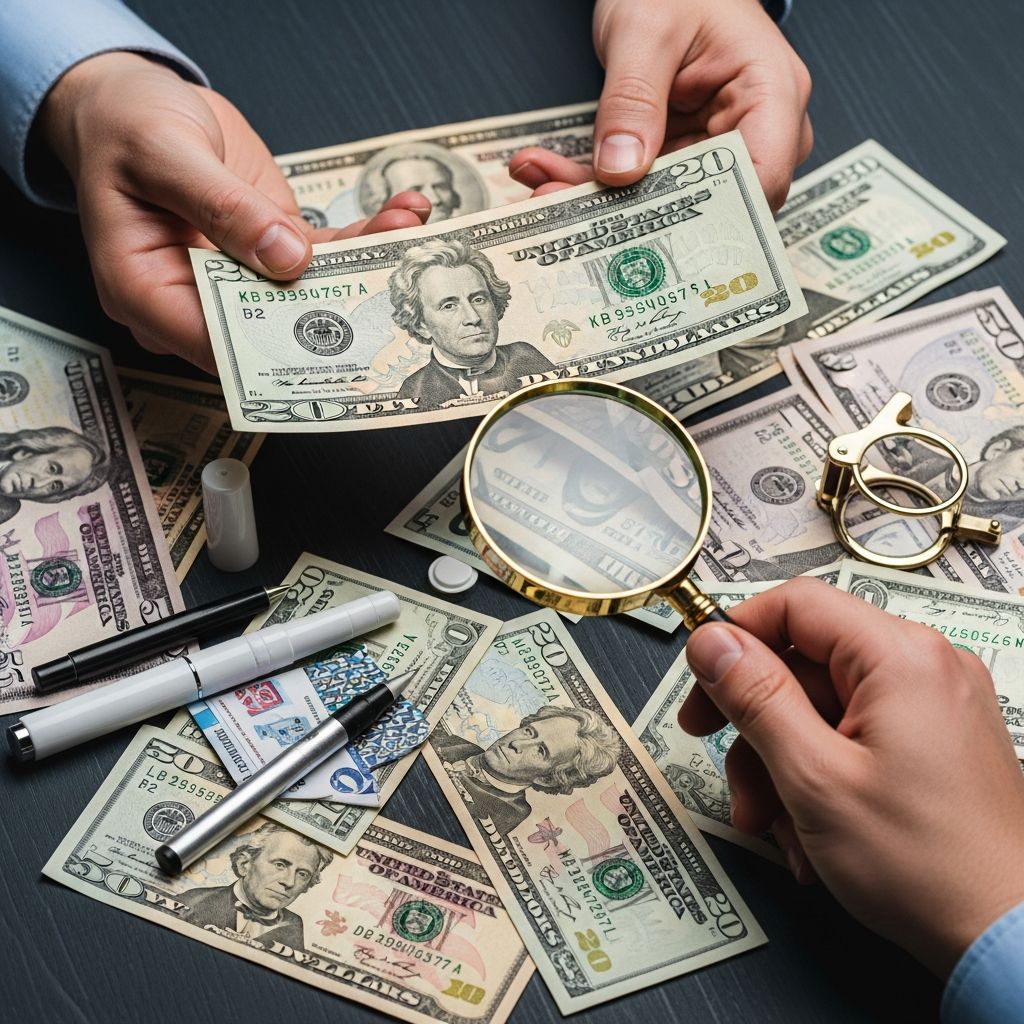
Counterfeit money poses a significant risk to businesses and individuals handling cash. With advancements in printing technology, fake bills are increasingly sophisticated, but the U.S. Bureau of Engraving and Printing incorporates multiple security features that make detection possible without specialized equipment. This guide covers all key methods to verify authenticity, drawing from official resources and practical checks applicable to $5, $10, $20, $50, and $100 bills.
Step 1: Look and Feel
The simplest and most accessible first step is to examine the bill’s appearance and texture. Genuine U.S. currency uses a unique paper blend of 75% cotton and 25% linen, giving it a distinct crispness and durability that common counterfeits cannot replicate. Run your fingers over the bill; authentic notes feel slightly raised, especially around the portrait’s vest or clothing edges due to intaglio printing, where ink is pressed into the paper under high pressure.
Visually, check for sharpness in details. Real bills have clear, unbroken borders and fine detailing on portraits, Federal Reserve, and Treasury seals. Counterfeits often appear blurry, dull, or flat, particularly in intricate areas like saw-tooth points on seals. Compare the suspect bill side-by-side with a known genuine one of the same denomination and series year for discrepancies in color vibrancy or printing quality. Cashiers with frequent handling experience can often detect fakes instantly by touch alone.
Step 2: Color-Shifting Ink
Higher-denomination bills feature color-shifting ink, a hallmark security element. Tilt the $100 bill to observe the bell in the inkwell and the large ‘100’ numeral in the lower right corner; they shift from copper to green. This dramatic change is difficult for counterfeiters to mimic accurately. Similarly, the $50 bill’s numeral shifts from copper to green, while the $20 shows a similar effect on its numeral.
For verification, hold the bill at a 45-degree angle under good lighting. The shift should be pronounced and smooth, not patchy or absent as in fakes. This feature, introduced in recent series, enhances security against digital printing commonly used by forgers.
Step 3: Security Strip (Thread)
Embedded security threads run vertically through bills (except $1 and $2). Hold the bill up to light; the faint strip should be visible from both sides, with microprinted text like ‘USA 100’ for $100 bills, positioned correctly relative to the portrait.
Under ultraviolet (UV) light, threads glow specific colors by denomination:
- $5: Blue (right side)
- $10: Orange (right side)
- $20: Green (left of portrait, reads ‘USA TWENTY’ with flag)
- $50: Yellow (right near middle)
- $100: Pink (left of Franklin)
Fakes often lack the glow or show incorrect colors. The thread is embedded, not printed on the surface.
Step 4: 3D Security Ribbon
Newer $100 bills include a blue 3D security ribbon woven into the paper. Tilt the bill left-to-right to see ‘100’ numerals appear in rows, moving side-to-side (not up-down). Further tilting reveals them shifting to bells, mimicking the inkwell bell’s motion. This holographic effect is produced with precise micro-lenses, nearly impossible to forge. Rotate the bill around its vertical axis for the full weird, flapping motion of the images.
Step 5: Red and Blue Fibers
Authentic bills have tiny red and blue fibers embedded throughout the paper, not just on the surface. Counterfeiters often print lines mimicking these, but close inspection under magnification reveals they lie flat on top rather than being woven in. Rub gently or hold to light; genuine fibers protrude slightly and are randomly distributed. Compare with a real bill for confirmation.
Step 6: Watermark
Hold the bill up to light to reveal a faint watermark matching the portrait (e.g., Lincoln on $5, Hamilton on $10). It appears on both sides but is visible primarily from the back. Fakes may have blurry or absent watermarks, or mismatched images. Position matters: it aligns precisely with the printed portrait.
Step 7: Microprinting
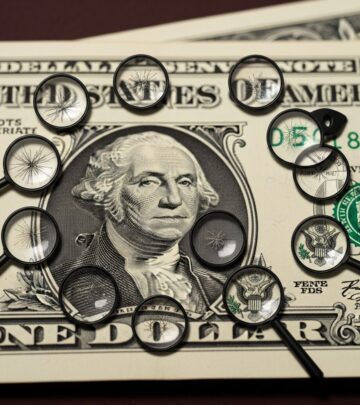
Tiny text, legible only under magnification, borders portraits and appears on security threads (e.g., ‘USA 100’). Counterfeits show this as blurry dots or smudges due to inferior printing resolution. Check collar edges or thread text specifically.
Additional Security Features
Serial Numbers: Must be evenly spaced, aligned, and unique. Fakes may repeat numbers across bills or show irregular fonts/spacing.
Counterfeit Detection Pens: Mark the bill; genuine paper turns the iodine-based ink yellow (absorbs it), while bleached fakes stay dark (starch-based paper). Pens with UV lights verify threads too—real bills absorb UV (darker), fakes reflect brightly. Note: Washed real bills may fail this test.
UV Fluorescence: Beyond threads, genuine bills show muted fluorescence; counterfeits often fluoresce brightly.
| Denomination | Thread Position & UV Color | Color-Shifting Ink | Watermark |
|---|---|---|---|
| $5 | Right, Blue | No | Lincoln |
| $10 | Right, Orange | No | Hamilton |
| $20 | Left, Green | Numeral | Jackson |
| $50 | Middle-right, Yellow | Numeral (copper-green) | Grant |
| $100 | Left, Pink + 3D Ribbon | Bell/100 (copper-green) | Franklin |
Frequently Asked Questions (FAQs)
Q: What should I do if I receive counterfeit money?
A: Do not use or return it to the passer. Contact local police and the U.S. Secret Service (report via uscurrency.gov). Businesses should train staff and use detectors.
Q: Do $1 and $2 bills have security threads?
A: No, they rely on feel, fibers, watermark, and microprinting. Low circulation reduces counterfeiting risk.
Q: Can counterfeit pens give false results?
A: Yes, on washed genuine bills or high-quality fakes using real paper. Always combine with other checks.
Q: How effective is UV light for detection?
A: Highly effective for threads; genuine glow colors confirm authenticity across denominations.
Q: Are there raised numeral fakes?
A: Yes, glue-on numbers on lower bills. Compare corner numerals to spelled denomination.
Protecting Your Business
Train employees on these steps, invest in UV pens/lights or bill counters with validation. Count cash in view of customers and compare suspicious bills immediately. Awareness reduces losses—counterfeits cost the U.S. economy millions annually. Stay updated via official sites as features evolve.
References
- Ways to Detect Counterfeit Money — Carnation Inc. Accessed 2026. https://carnation-inc.com/pages/ways-to-detect-counterfeit-money
- How to Detect Counterfeit US Money — Cornell University Finance. Undated PDF (authoritative guide). https://finance.cornell.edu/sites/default/files/detect-counterfeit.pdf
- How to Spot Counterfeit Money — Wise Bread. Undated. https://www.wisebread.com/how-to-spot-counterfeit-money
- A GUIDE TO IDENTIFYING GENUINE CURRENCY (CEP Teller Toolkit 2023) — U.S. Currency Education Program (official U.S. government). 2023. https://www.uscurrency.gov/sites/default/files/downloadable-materials/files/en/CEP_Teller_Toolkit_2023.pdf
Similar Articles








Read full bio of medha deb