Save Money As A Server: Essential Tips For Busy Shifts
Relying on cash tips as a server? Discover proven strategies to build savings, manage expenses, and secure your financial future despite irregular income.
Working as a server in the restaurant industry offers flexibility and the potential for good tips, but it also comes with financial unpredictability. Relying on cash tips means irregular income, late nights, and temptations to spend freely after a busy shift. Yet, with disciplined strategies, servers can build substantial savings, pay down debt, and achieve financial stability. This guide draws from real-world advice to help you navigate these challenges, covering everything from immediate tip management to long-term budgeting hacks tailored for hospitality workers.
Immediately Set Aside 10-15% of What You Make Each Shift
The moment you count your tips at the end of a shift is critical—don’t let the cash burn a hole in your pocket. Commit to setting aside 10-15% right away into a dedicated savings envelope or jar. For example, if you pocket $200 in tips, stash $20-$30 immediately. This ‘pay yourself first’ approach builds a habit of saving before spending on nights out or impulse buys.
Why this percentage? It strikes a balance: aggressive enough to grow savings but realistic for variable tip nights. Over a month with 20 shifts averaging $150 in tips, that’s $300-$450 saved effortlessly. Track it in a simple app or notebook to see progress and stay motivated. Servers who adopt this report having emergency funds within months, cushioning slow periods or unexpected car repairs.
- Pro Tip: Use a high-yield savings account for these funds—many offer 4-5% APY, turning small deposits into meaningful growth.
- Adjust based on shifts: On slow nights, aim lower; on banquets, push higher.
Deposit Larger Denominations in the Bank
Cash tips mean you’re handling a mix of bills, but not all should stay in your wallet. Prioritize depositing $100s, $50s, and $20s straight into your bank account on your next day off or via a mobile deposit app. Keep only smaller bills ($10s and $5s) for daily spending. This strategy ensures larger sums go toward fixed expenses like rent, utilities, and groceries, building your checking balance without temptation.
One server shared: ‘I deposit all $100, $50, and $20 bills and use them to pay rent and buy necessities. This way, most earnings build my account.’ It psychologically separates ‘big money’ for essentials from ‘spending money.’ If your bank charges fees for frequent deposits, batch them weekly. Combine with direct deposit for base wages to streamline.
| Bill Denomination | Action | Why? |
|---|---|---|
| $100, $50, $20 | Deposit Immediately | Covers rent, bills; builds savings |
| $10, $5 | Keep for Daily Use | Handles small purchases tangibly |
| Change/Ones | Save Separately | Quick emergency fund buildup |
Pay All Day-to-Day Expenses in Cash
Credit cards offer convenience but obscure spending—cash makes every dollar tangible. Use your smaller bills for gas, coffee, lunches, and minor outings. Feeling the wallet lighten discourages unnecessary swipes. Servers often overspend post-shift on drinks or food; cash limits this to what’s on hand.
Benefits extend to budgeting: No surprise statements. Pair with a weekly allowance—say $100 for incidentals—and stop when it’s gone. This mirrors envelope budgeting, proven to cut discretionary spending by 20-30%. Track via apps like Cleo for insights without ditching cash’s psychology.
When Paying in Cash, Never Use Change
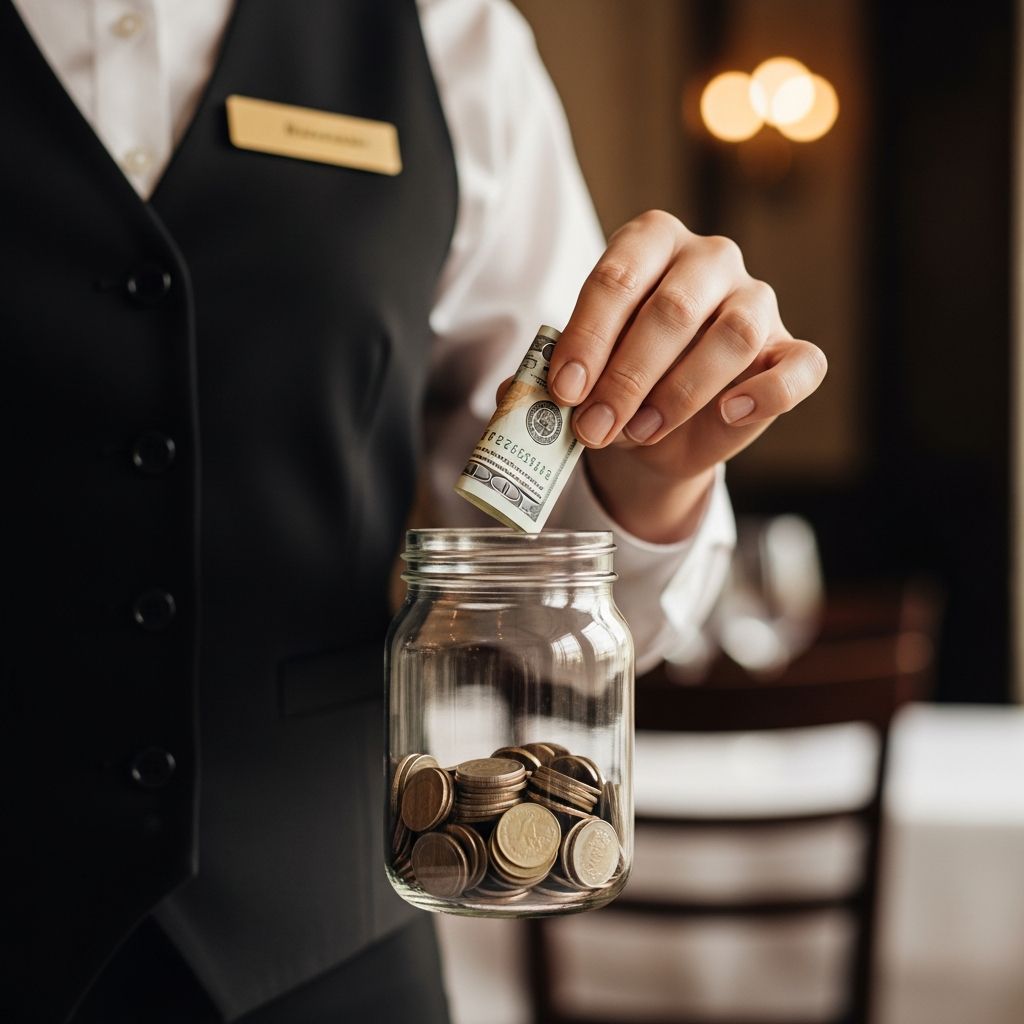
Pocket every coin from tips and drop it into a jar at home. This low-effort hack mimics roundup apps like Acorns but costs nothing. Change accumulates fast: $1-2 daily from tips adds $30+ monthly, $400 yearly—enough for a phone bill or date night.
A former server noted: ‘For years, this stash was my rainy day fund and saved me several times.’ Roll quarters monthly for deposit; use for fun or transfer to savings. It’s effortless wealth-building amid hand-to-mouth living.
Budgeting Challenges Unique to Servers
Servers face feast-or-famine paychecks, late hours tempting impulse eats, and peer pressure for post-shift hangs. Average hourly tipped wage hovers around $12-18 including tips (U.S. Bureau of Labor Statistics), but variability demands buffers. Slow weekdays mean lean savings; weekends boom but invite splurges.
Solution: Zero-based budgeting. Assign every dollar post-payday: 50% needs (rent, food), 30% wants (fun), 20% savings/debt. Automate transfers for base pay; manually allocate tips. Apps like Monarch categorize tips automatically.
Grocery and Meal Hacks for Late-Night Workers
Late shifts kill cooking motivation—takeout tempts. Counter with meal prep: Cook bulk on off-days (chicken, rice, veggies). Portion into containers for grab-and-go. Buy meat on sale, freeze in 1-lb packs. Serve smaller portions on small plates to curb waste.
- Shop seasonally for cheap produce.
- Opt for grocery pickup over delivery to dodge $20+ fees.
- Purchase versatile proteins: Chicken for salads, bowls, quesadillas.
Meal prepping saves $500+ yearly vs. eating out.
Transportation Savings for Shift Workers
Driving to work? Use GasBuddy for cheap fuel, fuel rewards. Carpool with coworkers. Public transit or biking cuts gas entirely. Maintain your vehicle: Tires, oil changes prevent breakdowns costing hundreds.
Entertainment on a Server Budget
Post-shift drinks drain tips. Host potlucks, use library freebies (books, streaming, events). Share streaming logins judiciously; free trials rotate services. No-spend challenges: Essentials only for a week, save $200+.
Side Hustles and Income Boosts
Leverage skills: Cater events, deliver via apps on off-nights (careful with tipping norms). Sell unused gear on Marketplace. Tax refunds? Direct to debt/savings.
Long-Term Financial Goals
Aim for 3-6 months’ expenses in emergency fund. High-yield savings, Roth IRA for retirement. Credit unions offer better rates for hospitality workers. Track net worth quarterly.
Frequently Asked Questions (FAQs)
Q: How much should a server save per shift?
A: Start with 10-15% of tips immediately—adjust based on your budget and goals. Consistency beats perfection.
Q: What’s the best bank for servers with cash deposits?
A: Credit unions or online banks like Ally with no-fee deposits and high APY. Avoid traditional banks’ fees.
Q: How to handle slow tip nights?
A: Stick to your percentage (even if $5), cut non-essentials, and side hustle. Build buffer during booms.
Q: Should servers use credit cards?
A: Only if paid off monthly; otherwise, cash prevents debt. Rewards cards for gas/groceries if disciplined.
Q: How to save for taxes on tips?
A: Set aside 20-30% of tips quarterly. Apps like QuickBooks track; report all cash to IRS.
References
- 33 Money Saving Hacks to Stretch Your Budget Further — The Penny Hoarder. 2023-05-15. https://www.thepennyhoarder.com/save-money/money-saving-hacks/
- How to Save Money: 25 Proven Tips That Actually Work — The Penny Hoarder. 2024-02-10. https://www.thepennyhoarder.com/save-money/how-to-save-money/
- Rely on Cash Tips? Here’s How to Save Money as a Server — The Penny Hoarder. 2023-08-22. https://www.thepennyhoarder.com/budgeting/how-to-save-money-as-a-server/
- Dear Penny: Do You Tip for Takeout Orders Delivered to Car? — The Penny Hoarder. 2024-01-05. https://www.thepennyhoarder.com/save-money/tip-for-takeout/
- Occupational Outlook Handbook: Food and Beverage Serving Workers — U.S. Bureau of Labor Statistics. 2025-09-03. https://www.bls.gov/ooh/food-preparation-and-serving/food-and-beverage-serving-workers.htm
Similar Articles








Read full bio of Sneha Tete